


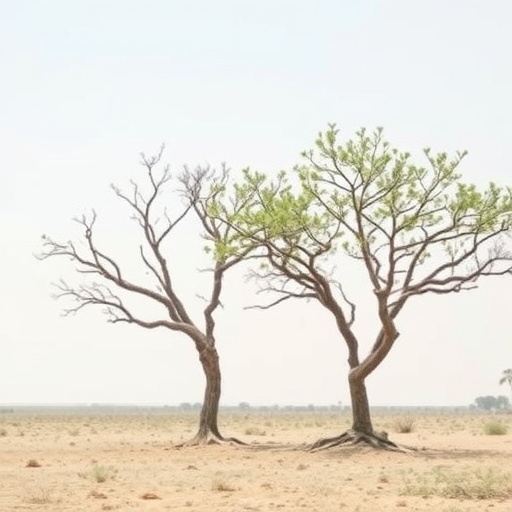
In the semi-arid landscapes of Rajasthan, India, where summer rains arrive as brief, isolated bursts between long stretches of punishing heat and dryness, the difference between a tree thriving and merely surviving may come down to how it drinks. A new field study published in Discover Forests has captured, at half-hourly resolution, the hydraulic responses of two ecologically important dryland tree species to discrete pre-monsoon rainfall pulses, and the results reveal two fundamentally different water-use philosophies operating just beneath the bark.
The research team, led by Sharat Kothari of the ICFRE-Arid Forest Research Institute in Jodhpur together with colleagues at the ICFRE-Forest Research Institute in Dehradun, monitored the deciduous species Anogeissus latifolia in the semi-arid black-soil forests of Sitamata Wildlife Sanctuary in Chittorgarh district, and the semi-evergreen Azadirachta indica, better known as neem, on the arid, sandy campus of the Arid Forest Research Institute in Jodhpur. Between April and July 2024, the team recorded continuous sap flow on four instrumented trees per species, using nine thermal sensors per species distributed across the trees, and captured three discrete summer rainfall events per species, six in total, ranging from 1.1 to 19.9 millimeters.
The measurement technique at the heart of the study was the Heat Ratio Method, or HRM, a thermal approach in which a brief heat pulse is released into the sapwood and the ratio of temperature change measured by sensors placed equidistant above and below the heater is used to compute sap velocity. The authors specifically chose HRM over the more common thermal dissipation probe technique because HRM can resolve zero, low, and even reverse sap flow, precisely the regime needed to detect nocturnal stem recharge when trees refill internal storage compartments overnight. Sap velocity was converted into whole-tree flow rates using wood basic density, sapwood moisture content, and sapwood cross-sectional area, all measured directly from increment-borer cores for each study tree, with flow integrated across conductive sapwood and expressed in litres per hour. Environmental drivers, including air temperature, relative humidity, solar radiation, wind speed, and soil moisture in the upper 30 centimeters, were logged concurrently by automated weather stations at each site.
From these data the researchers constructed a suite of metrics designed to dissect the anatomy of a rainfall response. Total sap flow in the 24 hours before each event was compared with the 24 hours after, a decay analysis extended the comparison out to 72 hours, and the continuous record was partitioned into morning (08:00 to 12:00), afternoon (14:00 to 18:00), and nocturnal (00:00 to 04:00) windows. The team also regressed sap flow against vapor pressure deficit, or VPD, the gradient in water vapor between the saturated interior of a leaf and the drier ambient air that serves as the primary atmospheric engine of transpiration. A novel Pulse Efficiency Index quantified how many units of water-use change each millimeter of precipitation bought the tree, standardized per unit of sapwood area to make cross-species comparison meaningful.
The statistical treatment was notably careful for a field study of this scale. Because hourly readings from the same tree are strongly autocorrelated, particularly in A. indica, where lag-1 autocorrelation reached 0.86 to 0.92, the authors based inference on true independent units, the tree-by-rainfall-event means, yielding 12 independent tree-event pairs for A. latifolia and 11 for A. indica. Exact permutation tests and a linear mixed-effects model with tree identity as a random intercept carried the inferential weight, and the authors were candid that because each species was monitored at only one site, species identity and site conditions are inherently confounded, making the findings hypothesis-generating rather than definitive.
Within those constraints, the contrast between the two species was striking. Anogeissus latifolia, whose baseline transpiration was heavily suppressed by the dry summer, showed a mean 41.7 percent increase in total sap flow following rainfall. That overall rise did not reach statistical significance under permutation testing (p = 0.150, with a 95 percent confidence interval spanning -1.8 percent to +85.3 percent), but the morning-window response did: morning sap flow surged by roughly 161 percent at the tree level, a statistically significant increase (p = 0.038). Nocturnal flow rose by 60.5 percent, a suggestive trend consistent with the refilling of internal stem water stores, and the 72-hour persistence analysis showed a positive trend of 38 percent, indicating the response was not merely a fleeting hiccup but a sustained recalibration of the tree’s hydraulic machinery.
The Pulse Efficiency Index told a threshold story for A. latifolia that maps neatly onto the classic pulse-reserve framework of dryland ecology. After the smallest event, just 1.1 millimeters, the index was negative, meaning the rain produced no usable physiological return. After an intermediate 6.8-millimeter event it hovered near zero, and after the largest event, 19.9 millimeters, it turned clearly positive. In other words, the water-retentive black soils at the Sitamata site preserved moisture long enough for the tree’s root network to exploit it, but only once rainfall crossed a minimum size. Small convective showers, in this system, evaporate before they can be drunk.
Azadirachta indica behaved almost like a different kingdom of plant. At the Jodhpur site, where the sandy profile drains rapidly and mean VPD was punishingly high, neem showed no significant change in total sap flow after rainfall (p = 0.117, with a mean decrease of 4.8 percent), and its Pulse Efficiency Index was negative across all three events regardless of rainfall magnitude. Instead, its transpiration remained tightly and persistently coupled to the atmosphere: VPD explained roughly 28 to 41 percent of the variance in sap flow both before and after rain (p < 0.0001 in both phases). The only significant diurnal change in neem was actually a decline, a 5.3 percent drop in afternoon flow after rainfall (p = 0.005), which the authors attribute not to the soil moisture pulse but to the transient dip in atmospheric demand that accompanies a passing weather system. Neem, in short, reads the sky, not the soil.
The authors interpret this as functional hydraulic decoupling from surface hydrology, most plausibly driven by the interaction between neem’s evergreen strategy and its sandy substrate. A tree that maintains a transpiring canopy through the brutal dry season cannot afford to depend on millimeter-scale surface showers that drain or evaporate within hours. The team hypothesizes that A. indica draws on deeper subsoil moisture reserves, which would explain its indifference to surface pulses, but they are careful to note that soil moisture was only monitored in the upper 30 centimeters and that rooting depth and root architecture were not measured, so deep-water reliance remains an inference rather than a demonstration. Rainfall magnitude and antecedent soil moisture were also highly collinear across events, precluding statistical separation of their effects, and the species-by-phase interaction in the mixed model was not significant (p = 0.141), reinforcing the call for caution.
Even so, the study’s diurnal and nocturnal signatures carry real mechanistic interest. In A. latifolia, the pre-rain relationship between sap flow and VPD was significantly nonlinear, and after rain the tree’s sensitivity slope to VPD nearly doubled, from -0.104 to -0.191, while its correlation with surface soil moisture strengthened. The pattern is consistent with a relaxation of the strict stomatal closure that dryland trees typically impose during peak evaporative demand to avoid catastrophic xylem tension and cavitation. The authors frame the nocturnal flow increase as consistent with stem-capacitance recharge, the overnight refilling that primes the hydraulic system for the dramatic morning surge observed the following day, though they stress that nighttime sap flow can also reflect nocturnal transpiration or hydraulic redistribution and that leaf-level gas exchange was not directly measured.
The broader implications stretch toward climate. Projections for arid and semi-arid zones point toward longer dry spells punctuated by more intense but isolated convective pulses, all under steadily rising atmospheric evaporative demand. If the patterns observed here generalize, each functional type faces a different future. An opportunistic, pulse-responsive strategy like that of A. latifolia could become a liability when short rainfall bursts are followed by dry intervals exceeding the soil’s water retention, potentially luring trees into transpirative spending they cannot sustain. A conservative, atmosphere-coupled strategy like neem’s, meanwhile, depends on the integrity of deep water reserves that only the monsoon reliably recharges. The authors also point to the growing recognition that hydraulic diversity across a forest, rather than any single “resilient” strategy, may underpin ecosystem-level drought resilience, making the coexistence of both water-use philosophies on the same landscape a form of ecological insurance.
The team is appropriately measured about what a one-season, two-site, eight-tree dataset can and cannot show. Most of their metrics, they write, are best characterized as consistent-direction trends rather than confirmed statistical effects, and they explicitly frame the work as a foundation for multi-site, multi-year studies that would separate species effects from environmental context, measure rooting depth and canopy leaf area directly, add deeper soil moisture sensors and isotopic tracer techniques, and ultimately connect these transient summer pulses to the total annual carbon budget of Indian dryland forests. Still, by catching the moment a raindrop hits dry ground and tracing, hour by hour, whether a tree decides to celebrate or shrug, the study offers a rare, high-resolution glimpse of the split-second economic decisions that govern survival at the dry edge of the forest biome.
Cite Scienmag News
Violet Maxwell. (September 5, 2026). Two dryland trees respond differently to summer rainfall pulses in Rajasthan. Scienmag. https://scienmag.com/two-dryland-trees-respond-differently-to-summer-rainfall-pulses-in-rajasthan/
Violet Maxwell. "Two dryland trees respond differently to summer rainfall pulses in Rajasthan." Scienmag, 5 September 2026, https://scienmag.com/two-dryland-trees-respond-differently-to-summer-rainfall-pulses-in-rajasthan/. Accessed 5 September 2026.
Violet Maxwell. "Two dryland trees respond differently to summer rainfall pulses in Rajasthan." Scienmag. September 5, 2026. https://scienmag.com/two-dryland-trees-respond-differently-to-summer-rainfall-pulses-in-rajasthan/


