


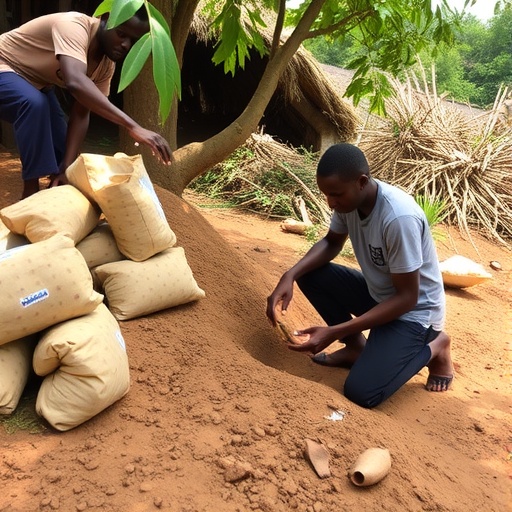
In a small riverside community in southeastern Ghana, archaeology is being rebuilt from the ground up—not in laboratories or excavation trenches first, but in town squares, family compounds, and long conversations between researchers and residents. A new study published in the African Archaeological Review documents how the Amedeka Archaeological Project, a community-based collaborative ethnoarchaeological initiative, is attempting to redefine who owns, produces, and benefits from knowledge about the past. Written by Dela Kuma of the University of Pittsburgh, Kodzo Gavua of the University of Ghana, Patricia Ayipey, Ivan K. E. Nyamasekpor, and community collaborator Fredrick Tekpor of Amedeka itself, the paper offers both a case study and a pointed critique of how archaeology has historically been practiced in Africa—and what an equitable alternative might look like.
Ethnoarchaeology, the branch of the discipline that studies living communities to generate analogies for interpreting the material remains of past societies, has long occupied an uneasy position on the continent. Researchers arrive with notebooks and research permits, document pottery production, house construction, or trade practices, and then leave—often without returning results, sharing credit, or addressing community priorities. The authors describe this extractive model as increasingly untenable, particularly in a moment when the African Union has declared 2025 a year focused on reparations and when demands for the restitution of African cultural heritage have accelerated worldwide. Against this backdrop, the Amedeka Archaeological Project represents something more ambitious than a fieldwork strategy: it is an attempt to build durable, reciprocal relationships in which community members are collaborators rather than subjects.
Amedeka is a Krobo community in the Lower Manya Krobo area of Ghana’s southeastern region, situated near the Volta River and within the broader landscape transformed by the Akosombo Dam, completed in the 1960s as the centerpiece of the Volta River Project. The dam’s construction flooded vast territories and resettled thousands of people, and its downstream effects—altered fisheries, changing floodplain agriculture, and, most recently, the catastrophic spillage of 2023 that displaced communities downstream—have made the region a living laboratory of environmental and social change. The authors situate Amedeka’s past within this layered history, tracing how 19th-century trade networks, the colonial commercial transition, and 20th-century state development schemes shaped what people bought, sold, consumed, and discarded. Kuma’s earlier research in the same community, published separately, reconstructed trade and consumer practices from the late 19th to mid-20th centuries, including the local negotiation of imported goods known as “Nkudzedze,” while companion work documented the spatio-temporal distribution of locally produced earthenwares.
The methodological core of the project is what the authors call community-based collaboration, and it operates on several levels simultaneously. Elders and knowledge holders in Amedeka participate in the interpretation of archaeological and oral historical data, not merely as informants but as analysts whose frameworks—Krobo concepts of personhood, community, and historical memory—are treated as epistemologically valid. Fredrick Tekpor, a resident of Amedeka and co-author of the paper, exemplifies this structure: his intellectual contribution is credited not as assistance but as authorship. Data governance follows the same logic. The study’s data availability statement notes that materials sensitive to the community are subject to access restrictions established through agreements with the Amedeka community, a mechanism that operationalizes the principle that communities can refuse, restrict, or condition research outputs concerning their own heritage.
The authors frame the future of equitable research around three interconnected dimensions. The first is positionality: an honest accounting of who the researchers are, where they stand relative to the community, and how their identities—Ghanaian, diasporic, institutional—shape what gets asked and what gets heard. Kuma and Gavua, both Ghanaian scholars working across North American, Ghanaian, and European institutions, reflect on the way their own embeddedness in academic systems of evaluation, funding, and publication creates pressures that can conflict with community timelines. The second dimension is the evolution of research questions themselves. Rather than fixing questions in a proposal written in Pittsburgh or Accra, the project allows questions to shift in response to community concerns—including, the authors suggest, issues of land access, heritage loss, and the community’s desire to benefit from tourism development along the Volta. The third dimension is partnership: the slow, sometimes fragile work of building institutions of accountability that survive beyond a single field season or grant cycle.
That slowness is deliberate, and the authors lean on a growing body of scholarship that treats it as a methodological virtue rather than a inefficiency. Cunningham and MacEachern’s influential argument that ethnoarchaeology should be understood as “slow science” is central here, as is Stahl’s call for assembling “effective archaeologies” oriented toward equitable futures. The Amedeka project also draws on Indigenous archaeology movements in North America and Oceania, on Black feminist and antiracist archaeologies, and on African philosophical frameworks—most notably Ubuntu, the relational ethic that locates personhood and knowledge in community. By citing these traditions together, the authors make a technical point about method: collaborative research is not simply conventional archaeology plus politeness. It requires different temporal rhythms, different consent structures, different instruments of data sovereignty, and different metrics of success than those embedded in the grant-and-publication machinery of the neoliberal university.
The practical stakes are considerable. Ghana’s legal framework, under the Environmental Protection Act and its predecessors, mandates environmental impact assessments for projects likely to have adverse environmental effects, yet archaeological and heritage considerations routinely enter such processes late, shallowly, or not at all. Previous large infrastructure projects in Ghana, including the Bui Dam, generated documented conflicts in which communities declared they would not relocate until their ancestors and shrines came with them—a signal that heritage is not an ornament of development but a condition of its legitimacy. The Amedeka paper argues that community-engaged archaeology, done early and done well, can function as an alternative archive: a way of surfacing local histories, sacred landscapes, and material claims before planning decisions harden into displacement. This echoes work by Logan, who showed how archaeology at Banda, Ghana, can serve as an archive of food security, and by Boateng and colleagues, who used archaeological knowledge of Africa’s past to inform safer food-packaging alternatives in Accra.
The authors are candid about the difficulties. Community archaeology in Africa has a history of what Chirikure, Pwiti, and others called unfulfilled promises: participatory rhetoric that dissolves into one-off consultations, museum-driven agendas, and tourism revenue that never reaches residents. Genuine co-production, the paper argues, requires that communities be able to shape research design from the beginning, that findings be returned in accessible and locally useful forms, and that funding structures—including the National Geographic Society grant and Social Science Research Council support that funded this work—be flexible enough to accommodate community-paced timelines. It also requires what the authors, following scholars such as Borrows, Tuck and Yang, and Santos, describe as humility and even refusal: the willingness of researchers to accept that some knowledge is not theirs to collect, that some questions will be redirected, and that the epistemologies of the South are not raw material for Northern theory but complete systems in their own right.
What emerges from the paper is less a template than a demonstration that the model can work. The Amedeka Archaeological Project has generated rigorous archaeological data—on earthenware production and consumption, on trade networks, on household material culture—while simultaneously producing a community of co-researchers, a set of enforceable data agreements, and a publication whose author list includes the community itself. Earlier versions of the work were presented at the Society of Africanist Archaeologists’ biennial meeting, and the project’s public-facing engagement has included recorded community events shared online, signaling a commitment to communicating results back to the people who made them possible.
For the wider discipline, the study arrives at a charged moment. Calls for an antiracist archaeology, for restitution of looted and removed African heritage, and for decolonized research methodologies have moved from conference margins to institutional agendas. The Ghanaian government’s Ministry of Tourism, Culture and Creative Arts has publicly reinvigorated restitution efforts, and the African Union’s reparations framing has given continental political weight to what were once framed as academic concerns. Within that landscape, the Amedeka paper’s central claim is quietly radical: that the future of African archaeology will be judged not only by what it discovers, but by whether the communities whose pasts are at stake gather around that past as authors of it—and whether the discipline is prepared to gather with them, on their terms, for the long term.
Cite Scienmag News
Courtney Benton. (September 5, 2026). Collaborative Ethnoarchaeology in Ghana Builds Equitable Futures With Communities. Scienmag. https://scienmag.com/collaborative-ethnoarchaeology-in-ghana-builds-equitable-futures-with-communities/
Courtney Benton. "Collaborative Ethnoarchaeology in Ghana Builds Equitable Futures With Communities." Scienmag, 5 September 2026, https://scienmag.com/collaborative-ethnoarchaeology-in-ghana-builds-equitable-futures-with-communities/. Accessed 5 September 2026.
Courtney Benton. "Collaborative Ethnoarchaeology in Ghana Builds Equitable Futures With Communities." Scienmag. September 5, 2026. https://scienmag.com/collaborative-ethnoarchaeology-in-ghana-builds-equitable-futures-with-communities/


