


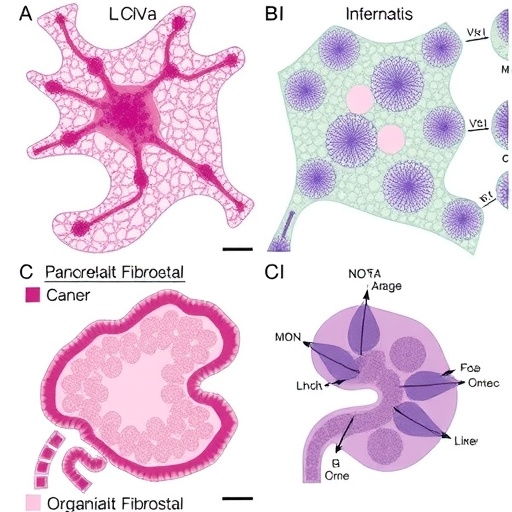
Pancreatic cancer has long been one of the most formidable opponents in oncology, and a substantial part of its lethality lies not in the cancer cells themselves but in the tissue that surrounds them. Now, a team of researchers has built an intricate laboratory model that recreates the dense, fibrous environment enveloping pancreatic tumors — and, in a twist, the inflamed tissue of pancreatitis as well. The study, published in Nature Cell Biology, describes a multi-stromal organoid co-culture platform that exposes, with unprecedented clarity, how pancreatic epithelial cells and fibroblasts reshape one another in disease, revealing a spectrum of cellular identities that earlier models simply could not capture. The work offers the research community something it has sorely lacked: a controllable, human, three-dimensional system in which the dialogue between tumor cells and their stromal neighbors can be watched, perturbed, and decoded.
Pancreatic ductal adenocarcinoma, the most common and most aggressive form of pancreatic cancer, is characterized by an extraordinary abundance of non-cancerous tissue woven through and around the malignant epithelium. This phenomenon, known as desmoplasia, produces tumors that are famously stiff, poorly vascularized, and saturated with signaling molecules that both shield the cancer from immune attack and nurture its growth. Fibroblasts — the spindle-shaped cells responsible for secreting collagen and other structural proteins of the extracellular matrix — are the dominant architects of this environment. In a healthy pancreas, fibroblasts maintain tissue integrity and participate in repair after injury. In cancer, they are reprogrammed into cancer-associated fibroblasts, cells that secrete growth factors, remodel matrix stiffness, and metabolically feed tumor cells. Decades of research have established that these cells are not a uniform population, yet most laboratory systems have treated them as such, and that simplification has arguably cost the field dearly.
The new study confronts this problem head-on by recognizing that fibroblast heterogeneity is not a nuisance to be averaged away but a biological reality to be modeled. Over the past several years, single-cell analyses of human pancreatic tumors have identified multiple cancer-associated fibroblast states, including myofibroblastic fibroblasts rich in alpha-smooth muscle actin and contractile machinery, inflammatory fibroblasts that broadcast cytokines such as interleukin-6 and CXCL12, and more specialized subsets that interact with immune cells or vascular structures. Each state appears to exert distinct effects on tumor behavior — some restraining cancer growth, others actively promoting invasion, metastasis, and resistance to chemotherapy. The difficulty has been reproducing this diversity outside the body. Standard two-dimensional co-cultures flatten the architecture; conventional organoids grown in extracellular matrix gels typically contain epithelium alone or pair it with a single fibroblast type, collapsing the multicellular logic of the real tumor stroma into something too simple to be informative.
The researchers’ solution was to build organoid cultures that incorporate not one but multiple stromal compartments simultaneously — a multi-stromal co-culture in which pancreatic epithelial organoids are grown alongside distinct populations of fibroblasts derived from the tumor stroma and from adjacent, non-malignant tissue. By assembling these components in a three-dimensional matrix that approximates the mechanical and biochemical properties of pancreatic tissue, the platform allows epithelial cells and fibroblasts to exchange the full repertoire of signals — soluble factors, extracellular matrix deposition, direct cell–cell contact — that shape their respective identities. Critically, the team applied the same modeling strategy to pancreatitis, the chronic inflammatory disease of the pancreas that is both a major risk factor for pancreatic cancer and a condition that shares with it a striking degree of stromal activation. Comparing the two diseases side by side, within the same experimental framework, is what gives the study much of its power.
Why include pancreatitis at all? The answer lies in one of the enduring puzzles of pancreatic biology. Chronic pancreatitis produces fibrosis, atrophy, and inflammatory remodeling that can look eerily similar, at the level of routine pathology, to the desmoplastic reaction around a tumor — yet one condition is inflammatory and largely non-neoplastic while the other is lethal. Epidemiologically, the link is strong: hereditary pancreatitis dramatically elevates lifetime pancreatic cancer risk, chronic inflammation creates a tissue field in which malignant transformation is more likely, and the molecular programs activated during injury repair are thought to be hijacked by emerging tumors. By modeling both conditions with matched stromal and epithelial inputs, the study could ask a question that has been almost impossible to address in patients: are the fibroblasts in cancer fundamentally different from those in chronic inflammation, or are they the same cells responding to different epithelial partners?
The answer, according to the team’s analysis, is that heterogeneity runs in both directions — the epithelium and the stroma each impose their signature on the other. Using high-resolution single-cell transcriptomics and related profiling approaches to dissect the co-cultures, the researchers found that fibroblasts did not simply adopt a single “activated” state when paired with diseased epithelium. Instead, they diversified into distinct phenotypic states whose character depended on whether the epithelial partner came from pancreatic cancer or from inflamed, pancreatitis-like tissue, and on the fibroblasts’ own origin. Epithelial cells, in turn, responded to their stromal surroundings, with cancer-derived epithelium and inflammation-derived epithelium inducing overlapping but non-identical fibroblast programs. This bidirectional specification — epithelium instructing stroma and stroma instructing epithelium in a continuous feedback loop — mirrors what pathologists observe in patient tissue, but here it unfolds in a dish, where each variable can be isolated and tested.
The technical achievement behind this observation should not be understated. Fibroblast states in vivo are shaped by their anatomical neighborhood: fibroblasts adjacent to ducts differ from those near acini or blood vessels, and tumor regions differ from marginal ones. Capturing that positional and functional diversity in vitro requires more than mixing cells together; it requires giving them the right architecture, the right matrix, and the right inflammatory and growth-factor milieu to self-organize. The multi-stromal design achieves this by allowing multiple fibroblast populations to coexist and compete, so that the emergent composition of the stromal compartment reflects genuine cell-intrinsic properties as well as paracrine negotiation with the epithelium, rather than the arbitrary choice of whichever single fibroblast line a laboratory happened to keep in the incubator. The result is a system in which heterogeneity arises from the biology rather than from experimental convenience.
The implications for drug development are considerable. The pancreas field has been burned before by therapies that looked promising against the stroma in preclinical models but failed in patients. Antistromal strategies — including agents that block fibroblast activation or deplete the desmoplastic reaction — produced striking benefits in genetically engineered mouse models, yet several clinical trials of stromal-targeting agents in combination with chemotherapy delivered disappointing results. One leading explanation is that the stroma is not a monolithic enemy: depleting all fibroblasts indiscriminately may remove subsets that actually restrain tumor progression, while sparing or even enriching the pro-tumor ones. A model that reproduces fibroblast heterogeneity in human cells therefore provides a far more faithful testing ground for deciding which stromal targets to pursue, which patient subsets are most likely to benefit, and which combinations of stromal and epithelial directed therapies might finally move the needle in a disease where five-year survival remains in the low double digits at best.
Equally important is what the platform means for personalized medicine. Because the co-cultures can, in principle, be established from a patient’s own tumor and stromal cells, they open a path toward testing how an individual’s unique epithelial–fibroblast ecosystem responds to chemotherapy, stromal inhibitors, or emerging targeted agents before those choices are made in the clinic. This is particularly valuable in pancreatic cancer, where treatment windows are short, tumors are notoriously chemoresistant, and the interplay between cancer cells and stroma contributes directly to drug penetration failures and acquired resistance. A model that preserves the heterogeneity of both compartments gives oncologists a chance to see not just how the cancer cells respond, but how the entire tumor ecosystem — including the fibroblasts that will still be there after the cancer cells are gone — reacts to intervention.
The comparison between cancer and pancreatitis also carries clinical weight in its own right. Chronic pancreatitis is a debilitating disease in its own right, lacking effective therapies that halt or reverse fibrosis, and it predisposes carriers to malignancy over years to decades. If the study’s finding that pancreatitis-associated fibroblasts occupy distinct states from cancer-associated ones holds up across larger cohorts, it suggests that the two diseases, despite their shared fibro-inflammatory appearance, may require different therapeutic approaches — and that interventions designed for one might be misguided if transplanted directly to the other. It also raises the possibility of identifying the specific fibroblast or epithelial features that mark the transition from harmless chronic inflammation toward premalignant transformation, an early-warning capability that could transform surveillance for the millions of people living with recurrent acute or chronic pancreatitis.
Looking forward, the multi-stromal organoid platform is likely to become a foundation upon which increasingly complete models of the pancreatic microenvironment are constructed — versions that add immune cells, endothelial networks, and neuronal elements to the epithelial–fibroblast core, and versions that subject the co-cultures to mechanical, metabolic, or inflammatory stresses that mimic the physiology of a growing tumor. For now, the study delivers its most important message in its title: heterogeneity is the organizing principle of the pancreatic stroma, and any model, biomarker, or therapy that ignores it is working with an incomplete map. By building a dish-sized version of one of cancer’s most complex microenvironments — and by placing cancer and its inflammatory precursor side by side — the researchers have given the field both a sharper map and the tools to redraw it as often as the biology demands.
Cite Scienmag News
Nathaniel Bowman. (September 5, 2026). Organoid co-cultures expose epithelial and fibroblast diversity in pancreatic cancer and pancreatitis. Scienmag. https://scienmag.com/organoid-co-cultures-expose-epithelial-and-fibroblast-diversity-in-pancreatic-cancer-and-pancreatitis/
Nathaniel Bowman. "Organoid co-cultures expose epithelial and fibroblast diversity in pancreatic cancer and pancreatitis." Scienmag, 5 September 2026, https://scienmag.com/organoid-co-cultures-expose-epithelial-and-fibroblast-diversity-in-pancreatic-cancer-and-pancreatitis/. Accessed 5 September 2026.
Nathaniel Bowman. "Organoid co-cultures expose epithelial and fibroblast diversity in pancreatic cancer and pancreatitis." Scienmag. September 5, 2026. https://scienmag.com/organoid-co-cultures-expose-epithelial-and-fibroblast-diversity-in-pancreatic-cancer-and-pancreatitis/


