


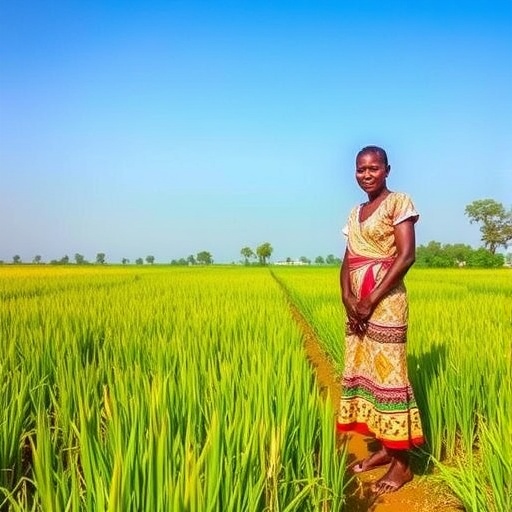
In the most comprehensive assessment of its kind ever conducted, an international research team has revealed that women who manage rice farms across sub-Saharan Africa face substantially larger performance gaps than their male counterparts, even when compared against the same sustainability benchmarks. The study, led by researchers affiliated with the Africa Rice Center and published in the journal Environmental and Sustainability Indicators, surveyed 3,081 rice-farming households in ten countries and applied the Sustainable Rice Platform (SRP) framework to measure how male- and female-managed farms perform across yield, profit, labor productivity, and nutrient use efficiency. The findings provide the first large-scale, multidimensional picture of gender disparities in sustainable rice cultivation across a continent where rice demand is projected to double by 2050.
The scale of the data collection alone sets this work apart. Working with National Agricultural Research and Extension Services partners, the team surveyed farmers in Burkina Faso, Burundi, the Democratic Republic of the Congo, Kenya, Madagascar, Nigeria, Rwanda, Sierra Leone, Tanzania, and Uganda after the 2020/2021 harvest season. The SRP survey tool covered all 46 requirements of the SRP Standard and its 12 performance indicators, a standardized, farm-level framework spanning economic, environmental, and social dimensions of sustainability. Of the households surveyed, 1,039 were managed by women and 2,042 by men, selected through multistage random sampling across three distinct production systems: irrigated lowland, rainfed lowland, and rainfed upland environments. The researchers focused on five performance indicators for agronomic gain: grain yield, net profit, labor productivity, and the partial factor productivity of nitrogen (PFPN) and phosphorus (PFPP).
The resource disparities documented in the survey are stark. Female-managed farms operated plots that were 36 to 41 percent smaller than those run by men, and they used roughly half the agricultural equipment. The share of female-managed farms varied dramatically by country, from just 8 percent in Nigeria’s irrigated lowlands to 45 percent in Sierra Leone and 44 percent in Madagascar. Fertilizer use told a similar story of inequity. Average nitrogen application rates reached 63 kilograms per hectare in irrigated lowlands but dropped to 23 and 18 kilograms per hectare in rainfed lowland and upland systems respectively, and women farmers generally applied less fertilizer than men, an average of 35 versus 54 kilograms of nitrogen per hectare when comparing female-managed to male-managed operations in some contexts. In Uganda, Sierra Leone, and Madagascar, surveyed farmers applied no nitrogen fertilizer at all.
Yields reflected these unequal inputs. In rainfed systems, 82 percent of female-managed farms and 72 percent of male-managed farms produced 3 tons per hectare or less, and only 7 percent of all farms exceeded 5 tons per hectare. Average yields ranged from a low of 0.6 tons per hectare in rainfed lowlands of Sierra Leone to 7.2 tons per hectare in Tanzania’s irrigated systems. Across all sites, female-managed farms averaged 3.1 tons per hectare compared with 4.1 tons for male-managed farms, a statistically significant difference. Male-managed farms consistently outperformed in irrigated lowlands (4.8 versus 4.0 tons per hectare), rainfed lowlands (2.5 versus 2.1), and rainfed uplands (2.4 versus 2.0).
Perhaps the most striking results concern labor productivity and profitability gaps. The researchers calculated gaps as the percentage difference between the top 10th percentile of performance within each country and production system and the overall mean. Yield gaps averaged 38 percent in irrigated lowlands, 48 percent in rainfed lowlands, and 53 percent in rainfed uplands. Net profit gaps exceeded 50 percent in all three systems, averaging 56, 57, and 67 percent respectively. Labor productivity gaps were the widest of all, averaging 72 percent in irrigated lowlands. When disaggregated by gender, female-managed farms showed significantly higher labor productivity gaps than male-managed farms in every production system, with gaps ranging from 78 to 99 percent in individual countries, compared with 3 to 68 percent for male-managed farms. In Nigeria, for instance, the female labor productivity gap reached 98 percent in rainfed lowlands and 99 percent in rainfed uplands.
Labor allocation itself followed gendered patterns. On female-managed farms, female workers contributed an average of 35 person-days per hectare per season, compared with 19 person-days on male-managed farms, while male labor input was greater on male-managed farms at 171 versus 160 person-days per hectare. Notably, when labor productivity was disaggregated by the gender of both the worker and the manager, female labor was more productive on female-managed farms than on male-managed farms, and the reverse held for male labor. The authors suggest this gender-concordant efficiency may reflect differences in labor organization, supervision, and task allocation, with managers optimizing the performance of work groups with which they share roles, experience, or communication dynamics.
To identify what drives performance, the team turned to machine learning, fitting random forest models with 500 trees and then quantifying the influence of the top predictors through multiple regression. Nitrogen input, total labor input, plot size, phosphorus input, and the number of irrigations emerged as the leading drivers of yield for both female- and male-managed farms, and the models showed their strongest predictive power for yield, with R-squared values between 0.63 and 0.67. For net profit, the top five predictors on female-managed farms were the use of certified seeds, adherence to a crop calendar, labor input, plot size, and the number of equipment items, while on male-managed farms the list included nitrogen input and training in sustainable practices. However, the models performed poorly for profit (R-squared of 0.13 to 0.16), suggesting that profitability is shaped by factors beyond the farm-level variables measured, such as market conditions and price structures. For labor productivity, plot size and labor input were the two primary drivers for both groups, with training in sustainable practices and record keeping playing significant roles, particularly on female-managed farms.
Nutrient use efficiency added nuance to the picture. The partial factor productivity of nitrogen ranged from 25 to 127 kilograms of grain per kilogram of elemental nitrogen across countries, while phosphorus efficiency ranged from 13 to 642 kilograms of grain per kilogram of elemental phosphorus. Only PFPN differed significantly between female- and male-managed farms in the lowland systems, with women’s farms averaging 65 versus men’s 70 kilograms of grain per kilogram of nitrogen overall. Interestingly, in rainfed systems, more female-managed farms fell above the desirable nitrogen efficiency threshold of 80 kilograms of grain per kilogram of nitrogen, suggesting that although women apply less fertilizer, they may use what little they have relatively efficiently. Multinomial logistic regression showed that higher nitrogen input reduced the likelihood of both abnormally low and abnormally high nitrogen efficiency on female-managed farms, while phosphorus input and equipment access stabilized phosphorus efficiency, pointing to the importance of balanced, site-specific nutrient management rather than input intensification alone.
The implications, the authors argue, extend well beyond agriculture statistics. Closing gender gaps in agricultural productivity could add roughly $1 trillion to global gross domestic product and lift 45 million people out of hunger, according to estimates cited in the study. In sub-Saharan Africa, where domestic rice production currently meets only 60 percent of consumption and demand is expected to reach approximately 150 million tons by 2050, leaving half the farming population systematically underperforming represents an enormous lost opportunity. The study’s findings that female-managed farms had larger gaps across yield, profit, and labor productivity in nearly every country and system indicate that the barriers are structural rather than a matter of farming ability. Customary land tenure systems frequently assign women smaller and less fertile plots, and the more productive lowland environments, where water control boosts yields, are often under men’s control.
The researchers are careful to note the limitations of their work. The analysis rests on a single cross-sectional survey season, precluding causal inference, and net profit calculations excluded the cost of family labor, which may overstate profitability, particularly on female-managed farms where unpaid household labor contributes substantially. Data on education, market access, credit availability, and land tenure security were incomplete or absent, and self-reported inputs carry the risk of recall bias. Nevertheless, the breadth of the survey, ten countries, three production systems, and more than 3,000 households, provides an unusually robust comparative foundation.
The policy prescriptions that emerge are equally clear-eyed. The authors conclude that improving women’s access to inputs alone will not close gender gaps; instead, an integrated approach combining fertilizer access with nutrient management training, responsive extension services, labor-saving technologies, inclusive financing, and improved access to land and equipment is needed. They also recommend embedding gender-disaggregated indicators into monitoring frameworks such as the Sustainable Rice Platform itself, so that interventions can be evaluated not only for whether they boost sustainability overall, but for whether they narrow the persistent gaps between women and men who grow one of the world’s most important staple crops. As rice demand surges across Africa, the study makes a compelling case that the continent’s food security may depend on how well its agricultural systems unleash the potential of its women farmers.
Cite Scienmag News
Alan Morgan. (September 4, 2026). Gender gaps found in sustainable rice farming indicators across sub-Saharan Africa. Scienmag. https://scienmag.com/gender-gaps-found-in-sustainable-rice-farming-indicators-across-sub-saharan-africa/
Alan Morgan. "Gender gaps found in sustainable rice farming indicators across sub-Saharan Africa." Scienmag, 4 September 2026, https://scienmag.com/gender-gaps-found-in-sustainable-rice-farming-indicators-across-sub-saharan-africa/. Accessed 4 September 2026.
Alan Morgan. "Gender gaps found in sustainable rice farming indicators across sub-Saharan Africa." Scienmag. September 4, 2026. https://scienmag.com/gender-gaps-found-in-sustainable-rice-farming-indicators-across-sub-saharan-africa/


