


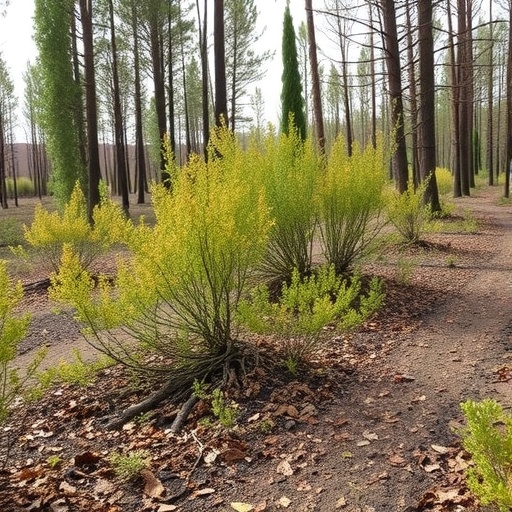
Wildfires across the Mediterranean region are escalating at a pace that traditional firefighting can no longer contain. The catastrophic blazes that swept through France, Spain and Greece in recent years have pushed emergency services to their operational limits, forcing scientists and land managers to confront an uncomfortable truth: suppressing fires after they ignite is no longer a viable long-term strategy. Now, an international research team led by the Universities of Göttingen and Kassel, together with the Spanish National Research Council (CSIC), argues that the solution lies not in bigger fire brigades or more aircraft, but in fundamentally redesigning the landscapes themselves. In a new study published in the journal iScience, the researchers present evidence that wildfire prevention succeeds best when it is planned hand in hand with nature conservation, agriculture and rural development, rather than treated as a narrow forestry problem.
The team set out to answer a deceptively simple question: what actually makes landscape-level fire prevention work? To find out, they analyzed ten landscape planning initiatives spread across the Mediterranean basin, examining in detail how each one influenced wildfire risk on the ground. These initiatives represented a wide spectrum of approaches and institutional settings. Some relied on extensive grazing by cattle, sheep and goats to reduce the accumulation of combustible biomass in shrublands and abandoned farmland. Others employed controlled or prescribed burning, a technique in which fires are deliberately set under carefully monitored conditions to consume fuel loads before dangerous wildfires can. Crucially, several of the initiatives went beyond purely technical measures and built structured collaboration between the agricultural and forestry sectors, nature conservation organizations, the scientific community and the fire services themselves.
The findings point toward a clear pattern. Initiatives that combined different forms of land use, actively involved a diverse range of social groups, and continuously refined and adapted their measures over time proved to be the most successful at mitigating wildfire risk. In other words, no single intervention, whether grazing, burning or fuelbreak construction, delivers resilience on its own. What matters is the integration of multiple ecological, economic and social objectives within a coherent landscape strategy, sustained by durable partnerships among the people who live in and manage these territories. This is the essence of what the researchers call integrated landscape approaches: frameworks that treat the landscape as a coupled social-ecological system rather than a collection of separate sectoral problems.
The reasoning behind this approach is rooted in how Mediterranean fire regimes have changed. Wildfires in the region are not merely natural disturbances amplified by heat; they are the product of complex interactions between climate, land use and societal development. Decades of rural depopulation and the abandonment of traditional agricultural and pastoral practices have allowed shrubby, highly flammable vegetation to spread across former farmland and pastures. At the same time, climate change is driving longer, hotter and drier summers, so that any fire that does ignite burns with drastically greater intensity. The convergence of abundant fuel and extreme weather has produced fire behavior that overwhelms conventional suppression capacity. Emergency response, however sophisticated, can only act once the fire has started; it does nothing to address the underlying conditions that make landscapes combustible in the first place.
This is where the mosaic landscape concept becomes central. One of the initiatives examined in the study, the Mosaico Extremadura project in northern Extremadura in Spain, aims to restore a diverse patchwork of agricultural and forestry land uses across the territory. Such mosaics act as natural fire brakes: heterogeneous landscapes with interspersed croplands, pastures, orchards and managed woodland contain fewer continuous stretches of dense fuel, which slows the spread of fire and creates opportunities for suppression. Restoring diversity to the landscape thus serves a double purpose. It reduces wildfire hazard while simultaneously supporting biodiversity, since many Mediterranean species depend on the varied habitats that traditional mixed land use once provided. The researchers emphasize that this dual benefit, fire protection and conservation in a single package, is what makes the landscape-based approach economically and socially attractive.
Extensive grazing deserves particular attention as a prevention tool. Livestock, when managed thoughtfully, function as living fuel-reduction machines, consuming grasses, shrubs and woody regrowth that would otherwise accumulate into hazardous fuel beds. Traditional transhumant pastoralism once performed this service across much of the Mediterranean, and several of the studied initiatives are deliberately reviving grazing systems, sometimes with contracts between shepherds and municipalities or insurance companies that value the risk-reduction service. Controlled burning operates on a similar principle from a different direction: by removing fuel in small, deliberate, low-intensity burns, managers prevent the buildup of the massive fuel loads that feed catastrophic crown fires. Both techniques require skilled practitioners and social acceptance, which is precisely why the study highlights stakeholder collaboration as a decisive success factor rather than an optional add-on.
Dr Elsa Varela, lead author of the study from CSIC, who coordinated the research as a Humboldt Fellow at the Chair of Socio-Ecological Interactions in Agricultural Systems at the Universities of Göttingen and Kassel, frames the message in systemic terms. Wildfires, she explains, are not just a problem for the forestry sector but the outcome of complex interactions between climate, land use and societal developments. The study’s findings show that successful wildfire prevention combines ecological, economic and social objectives and brings the relevant stakeholders together around a shared agenda. When farmers, foresters, conservationists, scientists and fire services plan together, the resulting measures are more likely to be implemented, maintained and adapted, because the people affected by them have a stake in their success.
Professor Tobias Plieninger, from the same chair at Göttingen, underscores the broader opportunity that this reframing opens up. A landscape-based approach, he argues, offers the chance to combine wildfire prevention with biodiversity conservation and sustainable land use, producing solutions that are ecologically effective and socially viable. But he is equally candid about what such an approach demands. It requires stable partnerships that survive political cycles, long-term funding commitments rather than short project grants, and joint learning processes in which science, policy and practice exchange knowledge continuously. Prevention, unlike firefighting, does not deliver dramatic visible results overnight; its value must be built up over years and decades, which makes institutional persistence the real bottleneck.
The policy implications of the study are substantial. Across Europe, the bulk of wildfire budgets is still spent on suppression, while prevention receives only a small fraction of resources. The researchers are calling for a deliberate shift in wildfire management from a predominantly reactive posture toward long-term preventive shaping of resilient landscapes. In practical terms, this means redirecting investment toward integrated landscape programs, supporting rural livelihoods that keep land actively managed, compensating farmers and herders for the fire-risk reduction their activities generate, and embedding fire science into agricultural, environmental and regional development policy. It also means rethinking how success is measured: not in hectares of fire extinguished, but in the resilience of the social-ecological system as a whole.
As the Mediterranean continues to warm, the window for incremental adjustments is closing. The recent spate of unprecedented fires is widely interpreted as a preview of the region’s future under continued climate change, and the study’s authors argue that only a proactive, landscape-scale transformation can alter that trajectory. The good news, their analysis suggests, is that the tools already exist and have been demonstrated on the ground: mosaic restoration, extensive grazing, prescribed fire, and above all the social architecture of cooperation. What is needed now is the political will and financial commitment to scale these integrated approaches from ten exemplary initiatives to the entire Mediterranean basin, turning landscapes that currently act as tinderboxes into resilient, living mosaics that can coexist with fire rather than be consumed by it.
News Publication Date: 3-Sep-2026
Web References: Not provided
References: Varela, E. et al. (2026). Capitalizing on integrated landscape approaches for wildfire risk mitigation in the Mediterranean region. iScience. https://doi.org/10.1016/j.isci.2026.116741
Cite Scienmag News
Russell Cooper. (September 4, 2026). Collaborative efforts build resilient landscapes to fight wildfires. Scienmag. https://scienmag.com/collaborative-efforts-build-resilient-landscapes-to-fight-wildfires/
Russell Cooper. "Collaborative efforts build resilient landscapes to fight wildfires." Scienmag, 4 September 2026, https://scienmag.com/collaborative-efforts-build-resilient-landscapes-to-fight-wildfires/. Accessed 4 September 2026.
Russell Cooper. "Collaborative efforts build resilient landscapes to fight wildfires." Scienmag. September 4, 2026. https://scienmag.com/collaborative-efforts-build-resilient-landscapes-to-fight-wildfires/


