


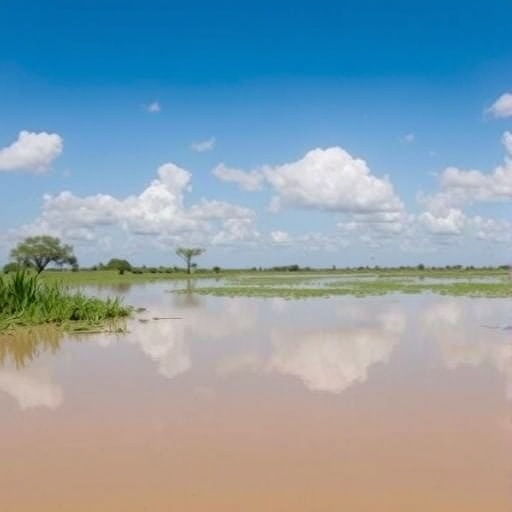
The world’s largest tropical wetland is undergoing a human crisis that scientists have barely been able to study. The Sudd, a vast expanse of swamps and floodplains in the middle of South Sudan through which the White Nile spreads into an intricate mosaic of channels, marshes and seasonally inundated grasslands, has been gripped by the most severe flooding in living memory. Between 2019 and 2022, floodwaters submerged settlements, drowned farmland and grazing land, and displaced hundreds of thousands of people. Now, a team of researchers led by Deng Majok Chol of the University of Oxford’s Environmental Change Institute has produced the first systematic empirical assessment of how communities in this extraordinarily remote region are adapting—and, in many cases, being forced to abandon their homes permanently. The study, published in the journal Regional Environmental Change, offers rare ground truth from one of the planet’s least accessible wetland systems.
The scale of the hydrological anomaly is striking. The Sudd sits within the Nile basin, and its flood regime is closely tied to water levels in Lake Victoria, the source of the White Nile. When Lake Victoria rose by more than two metres between 1961 and 1964 due to exceptionally high rainfall, inflows to the Sudd at Mongalla surged and the extent of permanent and seasonal inundation expanded dramatically. That episode reshaped the channels through the swamps and has long served as the reference point for extreme flooding in the region. But Lake Victoria has now surpassed even those levels, reaching a record elevation of 1136.79 metres above sea level in May 2024, according to satellite altimetry data. Water levels at the Jinja Dam in Uganda nearly exceeded capacity, prompting releases of 2600 cubic metres per second downstream into South Sudan. The result has been the largest flood extent in the Sudd in recent memory, with floodwaters in many areas refusing to recede for five consecutive years.
Chol and his colleagues, including Kevin Wheeler and Jim Hall at Oxford, conducted fieldwork between February and June 2024 across six states within and around the Sudd: Jonglei, Unity, Upper Nile, Warrap, Lakes and Central Equatoria. These locations sit within unrestricted flooding zones, areas of high flood risk with limited protective infrastructure. The research team used a mixed-method design combining focus group discussions, semi-structured interviews, walking interviews, participatory mobility mapping, and direct field observations via boat, vehicle and aerial surveys. In total, 216 people participated, including pastoralists, subsistence farmers, fishers, and internally displaced persons, along with community leaders and water sector experts. Discussions were conducted largely in Dinka, Nuer and Shilluk languages, transcribed, translated and then analysed thematically using NVivo software, with the team developing ten major themes from the data.
What emerges from the transcripts is a picture of a society whose entire adaptation architecture has been overwhelmed. The Sudd’s communities, including the Dinka, Nuer, Shilluk, Murle, Mandari, Anuak and Jie peoples, have for generations practiced transhumance, a carefully choreographed seasonal movement of people and cattle between wet-season and dry-season pastures. This system, passed down through oral traditions and learned by adolescents between the ages of 12 and 17, is finely tuned to the predictable rhythms of the Sudd’s hydrology. But the researchers found that 93 percent of respondents across all surveyed counties reported that the annual transhumance cycle had become unfeasible, as traditional routes were submerged and dry land disappeared. Pastoralists have been pushed into new upland migration patterns, moving cattle away from expansive lowlands that were once their dry-season refuges.
The consequences go well beyond pastoral logistics. Roughly 86 percent of rural households in South Sudan depend on rain-fed agriculture and animal husbandry, and five consecutive seasons of waterlogged fields rendered farming impossible across much of the region. Respondents described crop destruction, outbreaks of cattle disease, and the disappearance of wild game. One 89-year-old man in Bentiu, Unity State, described the 2019 to 2022 flood as “Baap” in the Nuer language, a sweeping force of nature that swept away people, forests, settlements, buildings and roads. The Dinka communities of Warrap State named it “Riem,” a massive force that destroyed everything indiscriminately. Flooding of this magnitude affects approximately one million people and displaced more than 300,000 according to prior assessments, and it intersects with ongoing armed conflict dating back to 2013, compounding the region’s already fragile coping capacity.
The migration patterns documented by the study reveal how temporary displacement is evolving into something more permanent. The researchers used coding references to quantify what they found: only 20 percent of migration referenced by participants followed patterns similar to past flood responses, while 80 percent represented entirely new patterns. Interstate migration within South Sudan and transboundary migration across national borders each accounted for roughly 17 percent of all migration-related references. In Twic East County in Jonglei State, 75 percent of the population, more than 100,000 people, migrated to other states or to Ethiopia, Kenya, Uganda or the Democratic Republic of the Congo. The former mayor of Bor Town described a cascading pattern: rural populations flooded into the town, then when the town itself flooded, they moved on to Mongalla, Juba and Nimule, and eventually to refugee camps in Uganda and Kenya when they could not reestablish livelihoods. Some South Sudanese migrants have been resettled to third countries including Australia, the United States, Canada and western Europe.
But the study also complicates any simple narrative of mass displacement. Migration responses proved highly heterogeneous across communities. Elderly populations in Unity State showed much lower rates of interstate and transboundary migration, reflecting constrained mobility among those lacking the resources or social networks for long-distance movement. The Shilluk community in Panyikang County responded to flooding not primarily through migration but through mobility across river landscapes, drawing on generations of fishing knowledge to maintain food security when cattle-keeping and agriculture became unviable. In some areas, floodwaters actually created productive aquatic environments, increasing access to fish and water lilies, though the researchers note these benefits were unevenly distributed and could not compensate for broader livelihood collapse.
The interaction between flooding, migration and conflict emerges as one of the most complex findings. Respondents from all 16 community-level focus groups described flood-induced migration as both causing conflict and exacerbating tensions rooted in older political and ethnic divisions. Competition for scarce dryland, grazing areas and fishing islands intensified as habitable space shrank, and the widespread availability of small arms lowered the threshold for violence in resource disputes. Yet flooding also produced unexpected effects: in some areas it created buffer zones that temporarily reduced cattle raiding, and shared experiences of displacement fostered new forms of coexistence among previously antagonistic communities. The study documents deep cultural anxieties alongside these dynamics, with elders describing the erosion of clan bonds, customary institutions and place-based identity as populations scattered across multiple locations.
Building on these findings, the team developed a spatio-temporal socio-hydrological framework that conceptualizes flood adaptation as a dynamic process operating across interconnected household, community, regional and national scales over time. Rather than treating flooding, migration, conflict and institutional change as sequential cause-and-effect relationships, the framework emphasizes feedback loops between them, showing how adaptation emerges through cross-scale interactions and how governance responses in turn shape future vulnerability. The authors argue that strengthening flood resilience in the Sudd requires strategies that integrate hydrological monitoring with local knowledge, mobility patterns and social institutions, including community-based early warning systems that combine indigenous flood memory with scientific observation.
This study is the first of its kind in a region that has been largely inaccessible to researchers for more than half a century due to dense vegetation, difficult terrain and successive conflicts, including the Sudanese civil war from 1983 to 2005 and the South Sudanese civil war from 2013 to 2018. South Sudan ranks as the world’s most vulnerable country to climate change with the lowest coping capacity, and seventh globally for the share of its population exposed to river floods. As climate change intensifies flood regimes across the Nile basin, the findings provide a critical empirical baseline for policymakers, humanitarian organizations and communities themselves. The researchers emphasize that protecting the Sudd is not merely an environmental priority but essential for sustaining the livelihoods, cultural systems and well-being of the millions who depend on this extraordinary wetland, and that adaptation planning must account not just for physical flood exposure but for the social and institutional fabric that determines whether communities can truly remain resilient.
Cite Scienmag News
Violet Maxwell. (September 4, 2026). How people in South Sudan’s Sudd wetlands adapt to flood risk. Scienmag. https://scienmag.com/how-people-in-south-sudans-sudd-wetlands-adapt-to-flood-risk/
Violet Maxwell. "How people in South Sudan’s Sudd wetlands adapt to flood risk." Scienmag, 4 September 2026, https://scienmag.com/how-people-in-south-sudans-sudd-wetlands-adapt-to-flood-risk/. Accessed 4 September 2026.
Violet Maxwell. "How people in South Sudan’s Sudd wetlands adapt to flood risk." Scienmag. September 4, 2026. https://scienmag.com/how-people-in-south-sudans-sudd-wetlands-adapt-to-flood-risk/


