


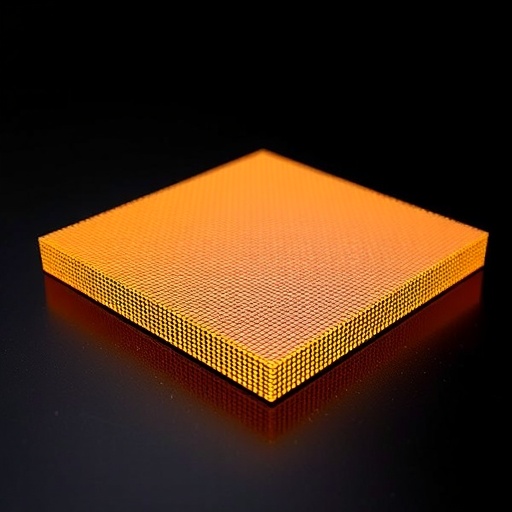
In the race to build the next generation of hard X-ray telescopes, the difference between a successful mission and a failed one can come down to a fraction of a nanometer. That is the scale at which a team of researchers in China has now demonstrated mastery over one of the most demanding fabrication challenges in X-ray astronomy: the deposition of depth-graded tungsten-silicon multilayer coatings on silicon pore optics, the mirror technology at the heart of the proposed Wide-band X-ray Polarization Telescope, or WXPT. In a study published in Experimental Astronomy, the team, led by researchers at the Institute of High Energy Physics of the Chinese Academy of Sciences, reports that its coatings have met the stringent performance targets required for the mission, achieving high reflectivity across a broad band of hard X-ray energies and interface quality that rivals the best results anywhere in the field.
The WXPT concept aims to extend X-ray astronomy’s reach into the hard X-ray band, where some of the most energetic and enigmatic processes in the universe reveal themselves. Black hole accretion disks, neutron star surfaces, relativistic jets, and the hot plasma in galaxy clusters all emit strongly in the 10 to 80 kiloelectronvolt range. Yet focusing this radiation is extraordinarily difficult. Unlike visible light, X-rays cannot be bent by conventional lenses or reflected at normal incidence by ordinary mirrors. They can only be guided by grazing incidence reflection, striking polished surfaces at angles of a degree or less. At higher X-ray energies, even grazing reflection fails for single-layer coatings, because the critical angle for total external reflection shrinks as photon energy rises.
The solution, developed over decades and employed by missions such as NuSTAR, is the multilayer mirror: a stack of hundreds of alternating thin films of a high-atomic-number material and a low-atomic-number material, in the WXPT case tungsten and silicon. Each interface in the stack partially reflects X-rays, and the reflections interfere constructively when the layer spacing, or d-spacing, satisfies the Bragg condition. By grading the d-spacing continuously with depth, a so-called depth-graded multilayer or supermirror, the coating reflects a broad, continuous band of energies rather than a narrow spectral line. The price of this broadband capability is extreme sensitivity to imperfection. Every interface must be smooth, uniform, and faithful to the designed spacing, because roughness and interdiffusion scatter X-rays out of the reflected beam and progressively destroy the constructive interference, especially in the deepest layers where the thinnest films reside.
The WXPT team fabricated its coatings using a custom-built linear direct-current magnetron sputtering system, a technique in which energetic argon ions bombard targets of tungsten and silicon, ejecting atoms that condense layer by layer onto the substrate. By carefully controlling deposition time and geometry, the researchers built stacks in which the bilayer period varies systematically with depth according to an optimized design. The substrates included silicon pore optics, a technology pioneered for the European Space Agency’s Athena mission, in which mirror plates are diced with grooves and stacked to form lightweight, tightly nested reflective channels. SPO promises the large collecting area that wide-band surveys demand, but it presents a difficult coating substrate: the silicon surfaces are structured, and their roughness directly imprints itself on the multilayer stack.
To evaluate the resulting coatings, the team deployed a battery of complementary metrology techniques, each probing the structure at a different scale. Grazing-incidence X-ray reflectometry, which measures how monochromatic X-rays reflect as a function of grazing angle, was fitted using the GenX 3 simulation package to extract layer thicknesses, densities, and interface widths. Cross-sectional transmission electron microscopy provided direct, real-space images of the layered structure, revealing the actual stacking of tungsten and silicon films from the substrate to the surface. Atomic force microscopy mapped the topography of the outermost surface. The combination allowed the researchers to verify not just the average quality of the coatings but how quality evolves over the full depth of hundreds of layers.
The results were strikingly consistent. X-ray reflectometry and transmission electron microscopy together showed interface widths of approximately 0.3 to 0.4 nanometers, a figure comparable to a few atomic diameters. More importantly, the team found that this quality held throughout the stack: the cumulative roughening that often degrades graded multilayers, in which small imperfections at each interface replicate and amplify through successive layers, remained minimal even after hundreds of deposition cycles. Atomic force microscopy confirmed that the final surfaces were ultra-smooth, with root-mean-square roughness below 0.3 nanometers. In a field where a single nanometer of excess roughness can measurably reduce reflectivity, these numbers represent exceptional layer uniformity and process control.
The measurements also delivered a clear quantitative lesson about the role of the substrate. The team demonstrated that substrate roughness has a critical impact on multilayer reflectivity, propagating upward through the coating and imposing a floor on achievable performance regardless of the deposition process itself. This finding matters enormously for silicon pore optics, where the structured substrates must be polished to exacting standards before coating. It provides mission engineers with a concrete specification: no amount of deposition refinement can compensate for an inadequately smooth mirror plate, so substrate finishing and coating development must advance together.
The ultimate test came from hard X-ray reflectivity measurements at the energies where the coatings will actually work. The team characterized its mirrors both with a laboratory X-ray source and with synchrotron radiation, the latter performed at the Shanghai Synchrotron Radiation Facility, where the intense, well-collimated beam allows precise measurement at fixed high energies and shallow grazing angles. Reflectivity data from both sources agreed excellently with theoretical simulations that assumed an interface width of 0.4 nanometers. That agreement between measurement and model, across a broad angular and energetic range, is the strongest evidence that the deposited stacks truly match the intended design, not merely in average properties but in the details that govern X-ray performance.
The headline result is the broadband reflectivity itself. For a coating design optimized for 0.3-degree incidence, the coatings achieved roughly 25 percent reflectivity across the 20 to 30 kiloelectronvolt band, successfully meeting the performance targets set for the WXPT mission. Achieving such performance requires that essentially every element of the fabrication chain work in concert: the sputtering system must deliver stable flux and reproducible chemistry; the d-spacing grading must track the design profile with sub-angstrom accuracy; the tungsten-silicon interfaces must resist intermixing and columnar growth; and the substrate must present a surface smooth enough not to poison the stack. The reported results indicate that the team’s custom-built deposition system, paired with careful metrology and modeling, has achieved that integration.
For the WXPT mission itself, the significance goes beyond a single coating demonstration. The telescope concept pairs wide-band X-ray focusing with advanced polarimetry, relying on transition-edge sensor detectors whose development is proceeding in parallel, with recent work modeling the position-dependent photon response of large-absorber TES detectors for the mission. Focusing optics capable of hard X-ray polarization measurements would open a new observational window on magnetic fields and particle acceleration near compact objects, where polarization encodes geometry that intensity measurements alone cannot reveal. The multilayer mirror is the enabling component: without efficient, uniform, broadband reflection at grazing incidence, photons in the hard X-ray band are simply lost.
The work also situates the Chinese team within a broader international effort to mature silicon pore optics for science missions. SPO was developed to enable the large effective areas of Athena, and its adaptation for a wide-band polarization telescope requires extending the coated bandpass well beyond what soft X-ray missions demanded. The demonstration that depth-graded W/Si coatings can be deposited on SPO with 0.4-nanometer-class interfaces and validated reflectivity establishes what the authors describe as a robust and reliable fabrication pathway, marking a significant step toward flight-qualified optics. The pathway from laboratory coating runs to an entire telescope module, in which thousands of mirror plates must be coated with uniformity across large areas and matched performance plate to plate, remains demanding, but the foundational process has now been shown to work at the level the science requires.
What makes the result compelling is the completeness of the validation. Structural imaging, surface topography, model-fitted reflectometry, and direct hard X-ray performance measurements all converge on the same conclusion: the coatings are what the designers intended, and they perform as theory predicts. In precision optics, such consistency across independent measurement techniques is rare and hard-won. As the WXPT concept advances from proposal toward realization, the demonstrated ability to coat silicon pore optics with smooth, depth-graded W/Si multilayers meeting 25 percent reflectivity at 20 to 30 kiloelectronvolts provides exactly the technological confidence a future mission needs. The universe’s most violent phenomena emit their most diagnostic photons in the hard X-ray band; with work like this, the mirrors capable of catching those photons are coming into focus, a few angstroms at a time.
Cite Scienmag News
Grant Pearson. (September 3, 2026). Depth-graded W/Si multilayers boost silicon pore optics for WXPT mission. Scienmag. https://scienmag.com/depth-graded-w-si-multilayers-boost-silicon-pore-optics-for-wxpt-mission/
Grant Pearson. "Depth-graded W/Si multilayers boost silicon pore optics for WXPT mission." Scienmag, 3 September 2026, https://scienmag.com/depth-graded-w-si-multilayers-boost-silicon-pore-optics-for-wxpt-mission/. Accessed 3 September 2026.
Grant Pearson. "Depth-graded W/Si multilayers boost silicon pore optics for WXPT mission." Scienmag. September 3, 2026. https://scienmag.com/depth-graded-w-si-multilayers-boost-silicon-pore-optics-for-wxpt-mission/


