


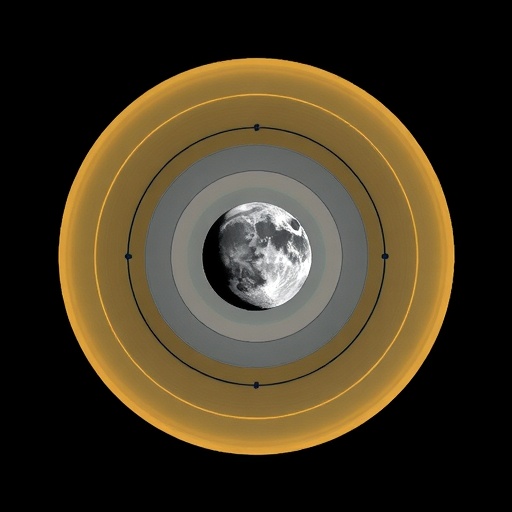
As space agencies prepare for a new era of crewed lunar exploration, one of the most demanding computational challenges in mission planning has just received a dramatic speedup. A team of researchers from the National University of Defense Technology in Changsha, China, has unveiled a fast new method—based on what they call velocity surfaces—for rapidly determining the set of Earth–Moon transfer orbits available to mission planners at any given departure time. The work, published in the journal Celestial Mechanics and Dynamical Astronomy, promises to make the design and planning of lunar missions faster, more flexible, and better prepared for emergencies.
The core problem the researchers tackled is known as the time-dependent controllable set, abbreviated TDCS. In plain terms, the controllable set is the collection of all possible trajectories that a spacecraft can follow from a given starting point—say, a parking orbit around Earth—to a desired destination, such as the Moon, while satisfying the constraints imposed on the mission. What makes the problem “time-dependent” is that the geometry of the Earth–Moon system changes continuously: the Moon orbits Earth roughly every 27.3 days, so the position and velocity of the lunar destination shift with every passing hour. A transfer orbit that works beautifully at one departure moment may be geometrically impossible just a day later. For crewed missions, where launch windows are tight and every contingency must be planned in advance, knowing the controllable set at each possible departure time is not a luxury—it is a necessity.
Traditionally, mapping out this set has been computationally brutal. Engineers must propagate vast numbers of candidate trajectories under high-fidelity models of gravitational dynamics, checking which combinations of departure conditions actually reach the Moon within acceptable parameters. Each trajectory requires numerical integration of the equations of motion, and sweeping across the full multidimensional space of departure variables—position, velocity, flight path angle, and time—multiplies the cost enormously. The Chinese team, led by Zhenjiang Du and including Heng Jing, Haiyang Li, and Hua Wang, recognized that this brute-force approach is poorly suited to the rapid iteration that modern mission design demands, particularly for crewed Artemis-class missions where terminal time constraints—fixed arrival times at the Moon—must be strictly honored.
Their solution begins with a clever mathematical reformulation. Instead of propagating countless trajectories forward and testing each one, the team built a framework based on velocity surfaces: two-dimensional manifolds in velocity space that describe how the radial and tangential components of a spacecraft’s velocity behave as a function of orbital geometry. The mathematical foundation rests on classical orbital mechanics. For a large elliptical orbit with a given perigee distance, the researchers derived closed-form expressions for the radial velocity and tangential velocity at any point along the trajectory as functions of the apogee distance. Using the specific angular momentum, eccentricity, and gravitational parameter of the central body, they showed that both velocity components increase monotonically as the apogee distance grows—provably so, by taking derivatives of the velocity expressions with respect to apogee distance and demonstrating that these derivatives remain positive.
This monotonicity result is far more than a mathematical curiosity. It means that for the elongated transfer orbits characteristic of Earth–Moon trajectories, where the apogee distance vastly exceeds the perigee distance, the radial velocity varies with apogee distance more than an order of magnitude faster than the tangential velocity does. The tangential component can therefore be treated as approximately constant across the relevant parameter range, collapsing a complex three-dimensional search problem into a much simpler structure. The researchers further derived the limiting values of both velocity components: as the apogee distance tends toward infinity, the radial and tangential velocities approach well-defined maxima, while both reach sharp minima when the apogee coincides with the spacecraft’s current position. These bounded ranges allow the velocity surfaces to be constructed systematically, providing a complete map of which departure velocities can reach the Moon for any given departure position and time.
To handle the terminal time constraint—the requirement that the spacecraft arrive at the Moon at a specified moment—the team embedded the time dependency directly into the velocity surface construction. Because the Moon’s position at the required arrival time is known in advance from planetary ephemerides, the target state is fixed, and the velocity surfaces can be evaluated against that fixed target rather than against a moving one. The result is a rapid approximation of the departure time-dependent controllable set: a map showing, for each candidate departure time, the full family of departure velocity vectors that will deliver the spacecraft to the Moon on schedule.
The team validated their method in two stages. First, numerical tests compared the velocity surfaces approximation against the controllable sets obtained through traditional computationally expensive methods, demonstrating that the new approach reproduces the essential structure of the controllable set with high fidelity while slashing computation time. Second, and more rigorously, the approximate solutions were fed into a high-fidelity dynamical model—incorporating the full complexity of the Earth–Moon–Sun gravitational environment—to verify that the predicted transfer orbits actually fly. The velocity surfaces method proved especially valuable as a generator of initial guesses: the approximate solutions provide excellent starting points for subsequent high-fidelity trajectory correction, allowing precise solvers to converge quickly rather than grinding through vast parameter spaces blind.
Beyond speed, the method opens a window onto the physics of lunar transfers themselves. By rapidly computing controllable sets under varying constraints, the researchers analyzed how different mission requirements—terminal arrival times, departure geometries, and other boundary conditions—reshape the structure of the accessible parameter space. This kind of sensitivity analysis, once prohibitively expensive, becomes routine with the new technique, giving mission designers quantitative insight into how flexible or fragile a given mission plan is. For crewed missions, that insight translates directly into safety: knowing how much room there is between the nominal trajectory and the edges of the controllable set informs decisions about abort options, contingency planning, and the reserves of propellant and time needed to recover from off-nominal events.
The timing of this work is significant. With NASA’s Artemis program aiming to return astronauts to the lunar surface, China’s Chang’e missions advancing from robotic sample return toward crewed landings, and international partners planning lunar orbit stations and surface infrastructure, the demand for fast, reliable trajectory design tools has never been higher. Crewed lunar missions differ from robotic ones in a critical respect: human lives depend on the mission architecture, and every phase—including the Earth–Moon transfer—must have pre-planned contingency options. The concept of the controllable set is central to that safety philosophy, defining the boundaries within which a spacecraft can be steered to a safe outcome. Earlier work by members of the same group applied related ideas to abort orbits from low lunar orbit and to point return orbits, and the present study extends the velocity surfaces framework to the forward Earth–Moon transfer phase with explicit time constraints.
The researchers emphasize that their method is not intended to replace high-fidelity trajectory optimization but to complement it. The velocity surfaces act as a fast screening layer: they rapidly identify which regions of the departure parameter space are viable and which are hopeless, then hand off the promising candidates to detailed optimizers that refine them under full force models, including solar gravity, nonspherical lunar gravity, and other perturbations. This division of labor mirrors a broader trend in aerospace engineering, where surrogate models and analytical approximations tame the combinatorial explosion of modern mission design, and the study’s authors note that the approach provides effective initial guesses that substantially accelerate the high-fidelity correction stage.
The mathematical appendix of the paper reveals the depth of care behind the approximation. The team proved that for large elliptical orbits with fixed perigee distance, the radial velocity at a given position grows with apogee distance far more steeply than the tangential velocity, and they established exact expressions for the limiting maximum values of both components—results that hold generally for the class of orbits relevant to lunar transfers. They also supplied the full definitions of the unit rotation matrices used to transform between coordinate frames, ensuring the method can be implemented consistently in three-dimensional mission geometries.
Funded by the National Natural Science Foundation of China, the study represents a quiet but meaningful advance in the infrastructure of lunar exploration. As launch windows for crewed missions are planned years in advance and recomputed continuously as conditions change, tools that compress hours of computation into moments will shape how quickly mission planners can respond to shifting requirements. The velocity surfaces method offers a template: find the analytical structure hidden inside the brute-force search, exploit it, and reserve the expensive numerical machinery for the final, decisive refinements. For the astronauts who will one day ride these trajectories toward the Moon, the invisible mathematics of controllable sets may prove to be among the most important safety equipment aboard.
Cite Scienmag News
Grant Pearson. (September 3, 2026). Velocity surfaces method speeds analysis of Earth–Moon transfer orbit controllable sets. Scienmag. https://scienmag.com/velocity-surfaces-method-speeds-analysis-of-earth-moon-transfer-orbit-controllable-sets/
Grant Pearson. "Velocity surfaces method speeds analysis of Earth–Moon transfer orbit controllable sets." Scienmag, 3 September 2026, https://scienmag.com/velocity-surfaces-method-speeds-analysis-of-earth-moon-transfer-orbit-controllable-sets/. Accessed 3 September 2026.
Grant Pearson. "Velocity surfaces method speeds analysis of Earth–Moon transfer orbit controllable sets." Scienmag. September 3, 2026. https://scienmag.com/velocity-surfaces-method-speeds-analysis-of-earth-moon-transfer-orbit-controllable-sets/


