


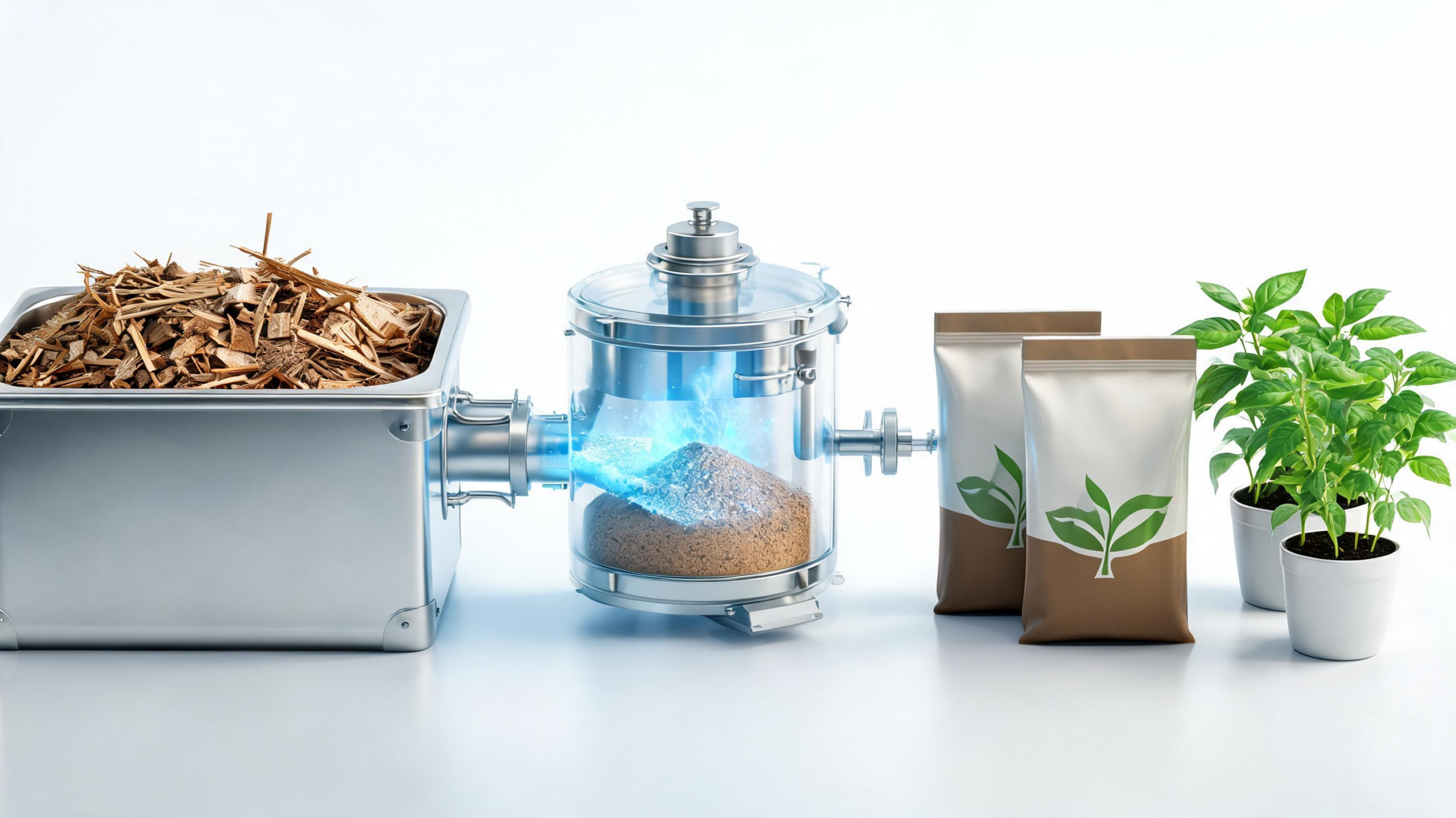
Global agriculture runs on three finite pillars: phosphate rock, natural gas for nitrogen synthesis, and potash deposits. All three are geographically concentrated, energetically costly to process, and exposed to supply-chain shocks, and phosphate rock is now formally listed as a critical raw material under the EU Critical Raw Materials Act. At the same time, modern biomass processing generates enormous volumes of nutrient-bearing residues that are typically managed as waste rather than recovered as resources. A comprehensive new review published in Discover Green Chemistry argues that this convergence of scarcity and surplus is precisely the opening that circular biorefineries need, and that heterogeneous catalysis, working alongside complementary interfacial processes, is the mechanistic platform that can transform chemically messy residues into standardised, safe, and agronomically effective fertiliser products.
The review, authored by Katarzyna Chojnacka, classifies biorefinery residues into three functional nutrient fractions, each demanding a different combination of chemical transformation and separation. Ammonium-rich aqueous streams, such as the liquid fraction of anaerobic digestate, concentrate nitrogen and potassium in dissolved, mobile forms that plants can access immediately but that also carry elevated risks of volatilisation, leaching, salinity, and phytotoxicity. Carbonaceous solid matrices, including biochars and hydrochars, embed nutrients within organic and mineral frameworks whose fertiliser value is expressed through release kinetics and soil-microbe-mediated transformations. Inorganic mineral concentrates, chiefly biomass ashes, deliver nutrients as salts, oxides, carbonates, and phosphates, but face the strictest contaminant qualification requirements. The central insight is that bulk elemental analysis is fundamentally insufficient: the same total phosphorus content can reside in immediately soluble ammonium phosphate, in slowly dissolving calcium phosphate minerals, or in recalcitrant iron-bound forms with negligible short-term plant availability.
This speciation problem is where heterogeneous catalysis earns its central role. The review draws a deliberately sharp line between true catalytic reactions, in which a solid catalyst accelerates a chemical transformation and is regenerated within a catalytic cycle, and complementary non-catalytic operations such as adsorption, ion exchange, reactive crystallisation, and membrane separation. Acid- and base-catalysed conversion, heterogeneous redox chemistry, and electrocatalytic nitrogen transformation are treated as genuinely catalytic, while struvite precipitation, for example, is classified as reactive crystallisation because the magnesium source is incorporated stoichiometrically into the mineral product. This mechanistic discipline matters because sorbents, stoichiometric reagents, and separation media are frequently mislabelled as catalysts, obscuring what each process can and cannot achieve and preventing valid comparisons of performance, regeneration, and technological readiness.
The evidence for catalytic control of nutrient speciation is strongest in thermochemical processing. Catalytic pyrolysis over H-ZSM-5 zeolites mediates how fuel nitrogen partitions between gas-phase ammonia and hydrogen cyanide and nitrogen retained in liquid and solid products: in model amino-acid studies, the zeolite increased the gas-phase nitrogen fraction from 38.54 percent to 53.95 percent while reducing nitrogen in tar and char by 69.22 percent and 58.07 percent respectively. Hydrothermal carbonisation of wet biomass offers a second lever, with temperature governing nitrogen solubilisation into process water and phosphorus partitioning into less soluble apatite-type phases at higher severity. Perhaps most strikingly, co-pyrolysis of piggery biogas residue with ten percent Fenton sludge as an iron and magnesium source at 600 degrees Celsius promoted conversion towards high-activity apatite inorganic phosphorus and increased phosphorus bioavailability by 41 to 48 percent relative to the undoped control, demonstrating how waste-derived mineral additives can drive phase transformation during conversion itself.
For aqueous streams, the review catalogues a spectrum of surface-engineered functional materials. Metal oxides such as ferrihydrite capture phosphate through inner-sphere surface complexation, transitioning towards amorphous iron-phosphate precipitation at higher surface loading. Zeolites provide practical ammonium exchange, with alkaline-activated and lanthanum-impregnated variants achieving simultaneous ammonium and phosphate removal at reported capacities of 23.9 and 21.2 milligrams of ammonium-nitrogen per gram respectively. Layered double hydroxides recover phosphate by anion exchange and, for calcined materials, through reconstruction via the memory effect; MgFe-Zr-coated magnetic particles sustained 75 to 97 percent phosphate adsorption after one hour across fifteen laboratory adsorption cycles with fourteen intervening desorption cycles. Metal-modified biochars emerge as the only material class with documented functions in both aqueous and carbonaceous-solid fractions, acting as phosphate sorbents in solution and as nutrient carriers and contaminant immobilisers in soil.
The review is equally candid about the gap between laboratory promise and field reality. A three-tier testing hierarchy is proposed as standard practice: single-component model solutions to establish mechanism, spiked real matrices to quantify the performance discount from competitive co-ions and dissolved organic matter, and unmodified real residues under repeated operational cycling for process design. Tier-one experiments dominate the current evidence base, and the authors argue that prioritising tiers two and three would represent the single most important methodological change for improving the transition from laboratory demonstration to process deployment. Catalyst stability under real residue conditions, which are aqueous, moderately acidic to alkaline, and rich in dissolved organics, sulphur, and chloride species, is identified as the primary practical barrier, with fouling, leaching, structural transformation, and poisoning often acting simultaneously.
Nitrogen recovery illustrates both the maturity spectrum and the catalytic frontier. Stripping of ammonium from digestate liquid fraction followed by acid scrubbing to ammonium sulphate remains the most commercially deployed route, while membrane-based concentration offers a complementary path that recovers water alongside nutrients. The most catalytically explicit approach is electrocatalytic oxidation of ammonia to nitrate on NiOOH electrode surfaces bearing hydroxyl and oxygen vacancies, a mechanistically characterised pathway that converts ammoniacal nitrogen into nitrate rather than merely capturing it. However, the review notes that this approach rests on a single model-solution study, that validation in real digestate matrices has not been reported, and that any recovered nitrate product would face the EU limit of 100 milligrams of nickel per kilogram of dry matter, making direct measurement of nickel transfer from the electrode mandatory before CE marking is possible.
On the product side, the review evaluates five fertiliser categories against release mechanism, agronomic performance, and soil-microbe interactions. Mineral precipitates such as struvite-type phosphates and ammonium salts from stripping-scrubbing carry the strongest field evidence, with struvite performing comparably to soluble phosphate sources on acid soils but releasing phosphorus more slowly on near-neutral to alkaline soils. Organo-mineral composites and biochar-based slow-release fertilisers show the clearest benefit from chemically or thermochemically engineered precursors but require more field validation, with binder type, pyrolysis temperature, and nutrient formulation jointly determining mechanical strength and release dynamics. Coating-controlled products offer the most precise timing control but add manufacturing cost and raise microplastic concerns that are driving development of biodegradable shells. Across all architectures, soil pH, texture, moisture, and biological activity remain decisive external controllers of actual nutrient delivery, and release claims require soil-context qualifiers.
Environmental, techno-economic, and regulatory dimensions complete the picture. Life cycle assessment studies identify energy-intensive drying and pH-control chemicals, rather than the recovery steps themselves, as the dominant environmental hotspots, and methodological inconsistency in functional units and allocation methods is large enough to reverse the environmental ranking of competing technologies. Under the EU Fertilising Products Regulation, struvite qualifies under Component Material Category 12, biomass ash under CMC 13, and compliant biochar under CMC 14, with Article 19 providing a harmonised end-of-waste route that converts compliant residues into CE-markable products. Yet regulatory gaps persist for antibiotics, antimicrobial resistance genes, pharmaceuticals, and microplastics, none of which currently carry EU-wide limits in CE-marked products. The review concludes that closing nutrient loops at a scale that genuinely reduces primary mineral fertiliser demand will require harmonised assessment methods, reliable contaminant monitoring as a mandatory quality gate, and, above all, multi-season field trials that isolate the contribution of catalytic processing to real agronomic performance, because a catalytic innovation without a demonstrated connection to crop response remains incomplete.
Beyond the technical chemistry, the review’s framing carries implications for how biorefinery operators might sequence investments. Because the three residue fractions respond to different processing logic, a single facility handling digestate, process water, and ash simultaneously would need parallel recovery trains rather than one universal technology, reinforcing the argument for adaptive process design that can accommodate feedstock-driven variability. The observation that feedstock origin is a primary determinant of both nutrient forms and trace element burdens suggests that regional sourcing strategies, not just reactor engineering, will shape product consistency.
The methodological critique embedded in the review also deserves attention from the wider research community. By distinguishing model-substrate evidence from real-matrix evidence and giving interpretive priority to the latter, the authors provide a template for evaluating claims across the nutrient recovery literature. Many reported capacities and efficiencies, including the zeolite exchange and layered double hydroxide adsorption figures, derive from simplified solutions whose competitive chemistry differs substantially from digestate process water. Readers should therefore treat such numbers as upper bounds indicative of mechanism rather than as deployment forecasts.
Finally, the policy analysis highlights a quiet but consequential alignment: the classification of phosphate rock as a critical raw material creates regulatory momentum that could accelerate permitting and financing for recovery facilities, while the end-of-waste pathway under the Fertilising Products Regulation offers a defined route from residue to CE-marked product. The binding constraint, on this reading, is less the availability of individual technologies than the absence of harmonised contaminant standards and multi-season agronomic validation, gaps that the review identifies as the field’s most urgent research priorities.
Subject of Research: Nutrient recovery and fertiliser production from biorefinery residues using heterogeneous catalysis and complementary processes
Article Title: Heterogeneous catalysis and complementary processes enable nutrient recovery and fertiliser production from biorefinery residues
Article References: Chojnacka, K. (2026). Heterogeneous catalysis and complementary processes enable nutrient recovery and fertiliser production from biorefinery residues. Discover Green Chemistry, 1(1), Article 28. https://doi.org/10.1007/s44509-026-00028-w
Image Credits: AI Generated
DOI: 10.1007/s44509-026-00028-w
Keywords: heterogeneous catalysis, biorefinery residues, nutrient recovery, circular fertilisers, struvite precipitation, biochar, phosphorus recovery, nitrogen recovery, slow-release fertilisers, circular bioeconomy, digestate, EU Fertilising Products Regulation
Cite Scienmag News
Bethany Barker. (September 3, 2026). Catalysts Turn Biorefinery Waste Into Tomorrow’s Fertilisers. Scienmag. https://scienmag.com/catalysts-turn-biorefinery-waste-into-tomorrows-fertilisers/
Bethany Barker. "Catalysts Turn Biorefinery Waste Into Tomorrow’s Fertilisers." Scienmag, 3 September 2026, https://scienmag.com/catalysts-turn-biorefinery-waste-into-tomorrows-fertilisers/. Accessed 3 September 2026.
Bethany Barker. "Catalysts Turn Biorefinery Waste Into Tomorrow’s Fertilisers." Scienmag. September 3, 2026. https://scienmag.com/catalysts-turn-biorefinery-waste-into-tomorrows-fertilisers/


