


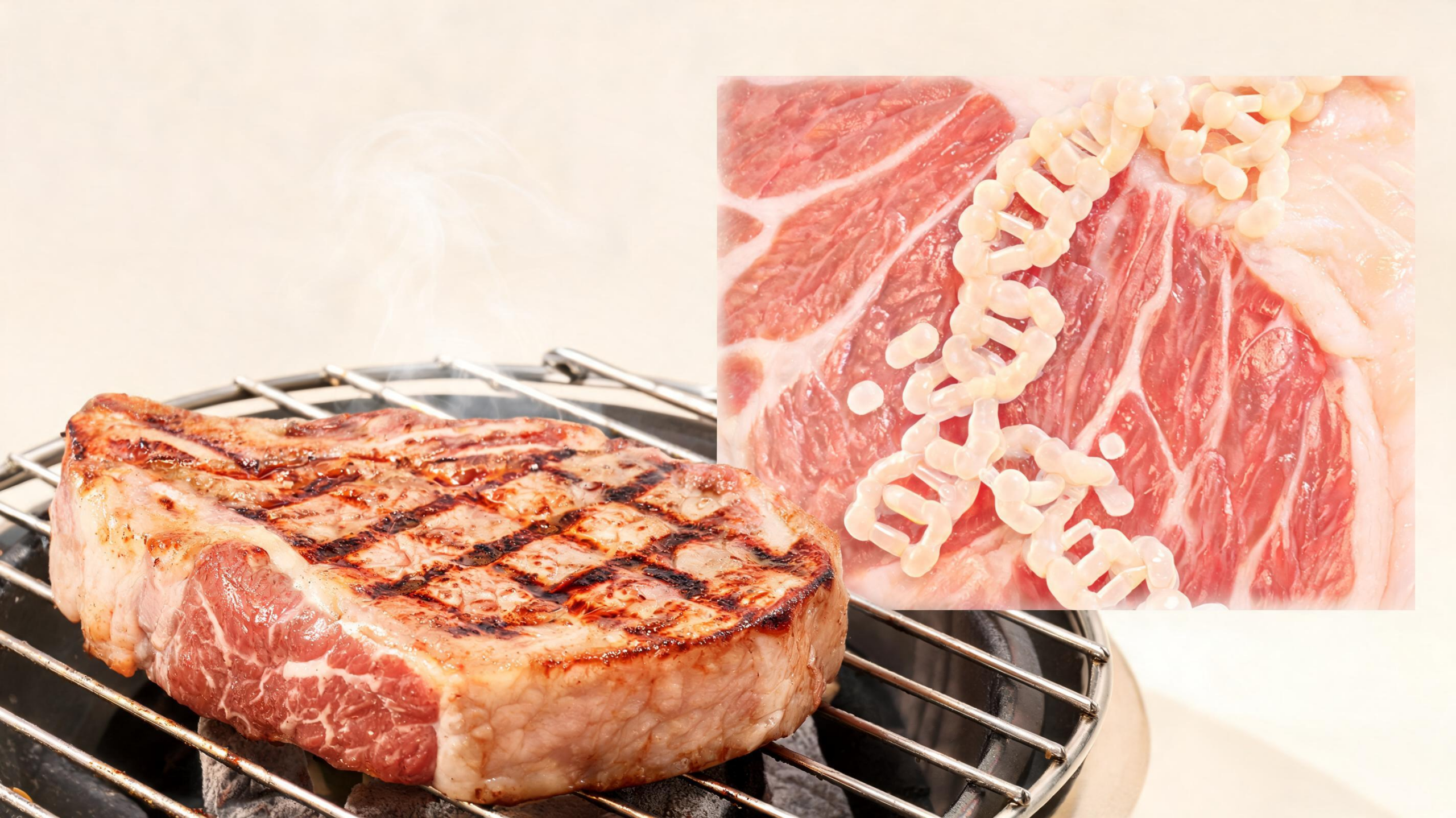
Every cook knows the frustration: two pork loins, cooked the same way, can emerge from the heat with completely different personalities. One slices up juicy and yielding, the other resists the knife and demands a serious chewing workout. For decades, meat scientists have attributed these differences mainly to protein denaturation and connective tissue behavior during heating. Now a study from Gyeongsang National University in South Korea adds a surprising new character to the story: the specific fatty acids embedded in the meat’s fat, which appear to shape the texture of cooked pork so strongly that they could serve as predictors of how a chop will eat before it ever touches the grill.
The research, published in Food Science of Animal Resources, compared loin muscles from three foundational breeds of the global pork industry: Landrace, Yorkshire, and Duroc. Ninety pigs raised under identical conditions on the same farm in Yeonggwang-gun, Korea, were slaughtered at a live weight of 120 plus or minus 10 kilograms. Twenty Landrace, fifty Yorkshire, and twenty Duroc animals contributed loin samples, which were excised between the tenth and eleventh ribs after chilling for 24 hours postmortem. By raising all animals on one farm under standardized conditions for roughly 180 days, the team controlled for the environmental noise, diet, and management differences that often confound breed comparisons.
The analytical program was thorough. Proximate composition was measured by standard AOAC methods, with crude fat determined through the classic Folch extraction using chloroform and methanol. The researchers measured pH in homogenized loin samples with a calibrated meter, recorded backfat thickness between the tenth and eleventh ribs, and quantified total collagen by acid hydrolysis followed by a colorimetric hydroxyproline assay read at 558 nanometers. Cooking loss, a practical proxy for water-holding capacity, was assessed by grilling trimmed loins on an electric grill at 200 plus or minus 10 degrees Celsius until the internal temperature reached 70 degrees, then weighing before and after. Texture was evaluated with texture profile analysis using a Shimadzu EZ-SX fitted with a flat-ended cylindrical probe, compressing one-centimeter cubes twice to 50 percent of their original height with muscle fibers oriented perpendicular to the probe.
Fatty acid composition demanded the most elaborate chemistry. Crude fat was extracted, saponified with sodium hydroxide in methanol at 75 degrees Celsius, and methylated with boron trifluoride at 85 degrees. The resulting fatty acid methyl esters were separated on a 100-meter Supelco SP-2560 capillary column in an Agilent 6890N gas chromatograph, with peaks identified against a 37-component standard mixture and quantified as fatty acid content per gram of sample. Statistical treatment used a mixed model with breed as a fixed effect and individual animal as a random effect, followed by regression analysis in which individual fatty acids served as explanatory variables for texture parameters such as hardness, cohesiveness, and chewiness.
The breed differences were pronounced. Duroc loins carried the most crude fat, the thickest backfat at 2.57 centimeters, the highest pH at 5.71, and the lowest total collagen content, while Landrace showed the opposite profile with the least fat, thinnest backfat at 1.95 centimeters, the lowest pH at 5.51, the most collagen, and the greatest cooking loss. Yorkshire fell between the two extremes on nearly every trait. Crude protein ran inversely to fat, highest in Landrace and lowest in Duroc. These patterns echo long-standing observations that Duroc pigs deposit lipid more aggressively than the maternal breeds that anchor most commercial crossbreeding programs.
The texture results delivered the study’s most striking twist. In fresh meat, Duroc loin was the firmest and chewiest of the three breeds, consistent with its dense fat deposition. But after cooking, the ranking flipped completely: Duroc showed the lowest hardness, cohesiveness, and chewiness, while Landrace, the softest breed raw, became the toughest on the plate. This reversal means that a breed’s reputation for fresh-meat firmness says almost nothing about how it will behave in the pan, and it pointed the investigators squarely toward the changing physical state of fat during heating as the missing explanatory factor.
Fatty acid analysis supplied that factor. Duroc carried significantly higher levels of total fatty acids, saturated fatty acids including C10:0, C14:0, C16:0, C20:0, and C22:0, and the monounsaturated C16:1 than the other breeds, both raw and cooked. Because saturated and monounsaturated fatty acids accumulate in proportion to lipid deposition while polyunsaturated fatty acids do not, faster-fatting breeds like Duroc naturally build a more saturated lipid profile. Saturated fatty acids have relatively high melting points and remain solid or semi-solid at room temperature, which helps explain why Duroc felt firm raw. Yet during cooking, when muscle temperatures cross the melting ranges of these lipids, the picture changes dramatically.
The regression analysis quantified the connection. In fresh meat, total fatty acids, saturated fatty acids, C10:0, C14:0, C18:0, monounsaturated fatty acids, C16:1, C18:1 cis, and C18:3 n-3 all showed significant negative relationships with the hardness of cooked meat, most with R-squared values above 0.20. In cooked meat, hardness fell as C10:0, C12:0, C14:0, C16:1, C18:1 cis, and C18:3 n-3 rose, while cohesiveness and chewiness declined with saturated fatty acids, C12:0, C16:0, and C14:1. Given the notoriously high biological variability of meat texture, single variables explaining more than a fifth of the variance is remarkable, and the consistent appearance of saturated fatty acids in both fresh-based and cooked-based models suggests a persistent, mechanistically real effect rather than statistical coincidence.
The proposed mechanism hinges on timing. Myosin denatures at roughly 60 to 65 degrees Celsius, collagen begins shrinking near 57 degrees, denatures around 64 degrees, and melts above 70 degrees into gelatin, and the melting ranges of meat’s saturated fatty acids overlap this same thermal window. As proteins denature and connective tissue transforms, melted lipids can redistribute through the protein matrix, lubricating structures and lowering resistance to compression. Meanwhile C16:1, with a melting point below 1 degree Celsius, stays liquid throughout, increasing lipid mobility in the cooked product. In effect, protein denaturation, collagen transformation, and lipid melting proceed concurrently, and the breed-specific fatty acid mix determines how much lubrication the solidifying protein network receives.
The practical implications reach from breeding programs to dinner plates. If fatty acid profiles predict cooked texture, then selecting breeding stock for lipid composition, not just growth rate, could steer eating quality in predictable directions, and a simple fatty acid assay on fresh loin could forecast how a cut will perform after cooking. The authors caution that cooking conditions, lipid microstructure, and protein-lipid interactions deserve deeper study before the approach becomes an industry tool. But the core message stands: the tenderness of a grilled pork chop is written partly in its fat chemistry, and breed is the pen.
The three breeds examined in the study occupy distinct roles in commercial pig production. Landrace and Yorkshire are maternal breeds, valued for litter size and mothering ability, while Duroc is typically used as a terminal sire to inject growth rate and leanness into crossbred market hogs. This division of labor means that most pork reaching consumers comes from animals carrying mixtures of these genetic lines, so understanding how each breed contributes lipid characteristics to the final carcass has direct relevance for crossbreeding system design.
The statistical framework deserves some elaboration. By treating breed as a fixed effect and individual animal as a random effect in a mixed model, the researchers accounted for the fact that pigs within a breed are not identical clones; this partitions variance attributable to genetics from background biological noise. Least-squares means then allow fair comparisons across breeds even when group sizes differ, as they did here with fifty Yorkshire animals against twenty each of the others. The Tukey-Kramer test applied afterward guards against the inflated false-positive risk that arises when making multiple pairwise comparisons simultaneously.
Texture profile analysis itself has a long pedigree in food science. The double-compression protocol traces back to work formalized by Bourne in the late 1970s, and the parameters it yields, including hardness, cohesiveness, and chewiness, remain the standard vocabulary for describing mechanical eating behavior. Compressing cubes to half their original height with fibers perpendicular to the probe standardizes the test so that results reflect the material properties of the muscle rather than geometry or fiber orientation artifacts.
The collagen measurement also rewards attention. Total collagen was estimated through hydroxyproline, an amino acid found almost exclusively in collagen, after acid hydrolysis released it from the protein. Because collagen undergoes dramatic thermal shrinkage and gelatinization during cooking, differences in baseline collagen among breeds could plausibly interact with lipid effects on cooked texture, and the finding that Duroc carried the least collagen while becoming the most tender after cooking fits coherently within the proposed lipid-lubrication mechanism.
Beyond eating quality, the compositional differences carry nutritional weight. Higher saturated fatty acid levels in Duroc loin intersect with longstanding dietary guidance recommending limits on saturated fat intake, while greater proportions of polyunsaturated fatty acids in leaner breeds offer a modestly different lipid profile for health-conscious consumers. Any breeding strategy tuned toward texture prediction would therefore need to balance palatability gains against nutritional considerations, a tension the authors acknowledge implicitly by framing fatty acid composition as a predictive indicator rather than a straightforward optimization target.
Finally, the open-access publication of the full dataset and methods means that other research groups can attempt to replicate the regression relationships in different production systems, feeding regimes, and pig populations, which will determine whether breed-linked fatty acid signatures hold up as a general forecasting tool or remain specific to the conditions of this Korean study.
Subject of Research: Breed-related fatty acid composition and its relationship to the texture of cooked pork loin
Article Title: Effects of breed differences in meat quality traits and fatty acid composition on the physical properties of cooked pork loin
Article References: Jeong, K.-J., Park, Y.-S., Eom, J.-U., Seo, J.-K., & Yang, H.-S. (2026). Effects of breed differences in meat quality traits and fatty acid composition on the physical properties of cooked pork loin. Food Science of Animal Resources, 46(1), Article 99. https://doi.org/10.1007/s44463-026-00106-4
Image Credits: AI Generated
DOI: 10.1007/s44463-026-00106-4
Keywords: pork loin, pig breeds, fatty acid composition, saturated fatty acids, cooked meat texture, texture profile analysis, Duroc, intramuscular fat, cooking loss, regression analysis, meat quality, lipid melting
Cite Scienmag News
Alan Morgan. (September 3, 2026). Why Duroc Pork Turns Tender on the Grill: Fatty Acids Hold the Answer. Scienmag. https://scienmag.com/why-duroc-pork-turns-tender-on-the-grill-fatty-acids-hold-the-answer/
Alan Morgan. "Why Duroc Pork Turns Tender on the Grill: Fatty Acids Hold the Answer." Scienmag, 3 September 2026, https://scienmag.com/why-duroc-pork-turns-tender-on-the-grill-fatty-acids-hold-the-answer/. Accessed 5 October 2026.
Alan Morgan. "Why Duroc Pork Turns Tender on the Grill: Fatty Acids Hold the Answer." Scienmag. September 3, 2026. https://scienmag.com/why-duroc-pork-turns-tender-on-the-grill-fatty-acids-hold-the-answer/


