


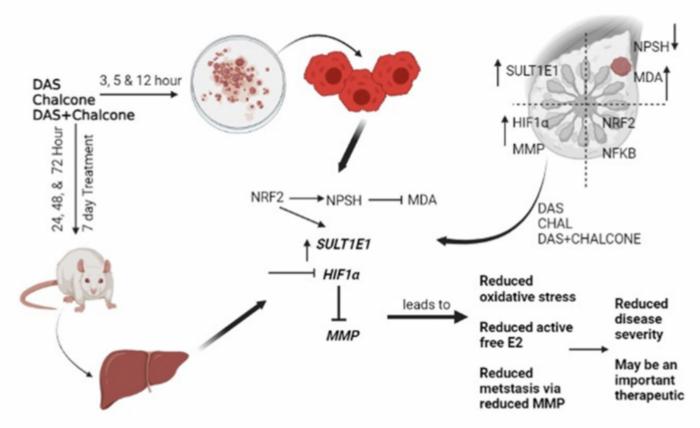
“For the first time, we are revealing that advanced cancer tissue with elevated SULT1E1-protein may reactivate in a reducing-state initiated by chalcone, but remain dormant in an oxidative environment.“

Credit: Nazmeen et al.
“For the first time, we are revealing that advanced cancer tissue with elevated SULT1E1-protein may reactivate in a reducing-state initiated by chalcone, but remain dormant in an oxidative environment.“
BUFFALO, NY- August 23, 2024 – A new research paper was published in Volume 15 of Genes & Cancer on August 9, 2024, entitled, “Dialyl-sulfide with trans-chalcone prevent breast cancer prohibiting SULT1E1 malregulations and oxidant-stress induced HIF1a-MMPs induction.”
In some breast cancers, altered estrogen-sulfotransferase (SULT1E1) and its inactivation by oxidative stress lead to modified E2 levels. Simultaneously, hypoxia-inducible tissue-damaging factors (HIF1α) are induced. The expression of these proteins/genes was verified in human breast cancer tissues, and combinations of SULT1E1-inducing drugs were tested for their potential protective effects. In this study, the oxidative stress neutralizer chalcone (trans-1,3-diaryl-2-propen-1-ones) and the SULT1E1 inducer pure diallyl sulfide (from garlic, Allium sativum) were tested in both in-vitro and in-vivo rat models to prevent cancer-related changes.
In their research paper, researchers Aarifa Nazmeen, Sayantani Maiti and Smarajit Maiti from Oriental Institute of Science and Technology, Haldia Institute of Health Sciences, and AgriCure Biotech Research Society in Midnapore, India, reveal for the first time that advanced cancer tissues with elevated SULT1E1 protein levels may be reactivated in a reducing environment initiated by chalcone but remain dormant in an oxidative environment.
The current study explores the redox-dependent regulation of SULT1E1 and the potential role of estradiol in breast cancer tissues of postmenopausal women. This process has been linked to the induction of HIF1α and the activation of MMP2/9.
“In an attempt towards the therapeutic approach, we have demonstrated that Dialyl-sulfide is a good inducer of SULT1E1 gene and protein which significantly decreased the HIF1α and MMPs.”
Correspondence: Smarajit Maiti – maitism@rediffmail.com
About Genes & Cancer:
Genes & Cancer covers all aspects of the structure and function of oncogenes, growth suppressor and apoptotic genes, their role in signal transduction and the mechanisms by which their expression and function are altered during tumor development. In addition to publishing manuscripts that directly relate to these areas of research, Genes & Cancer also aims to attract papers in the areas of genomics, drug development and systems biology.
To learn more about Genes & Cancer, visit www.genesandcancer.com and connect with us on social media:
For media inquiries, please contact media@impactjournals.com.
Genes & Cancer Journal Office
6666 East Quaker St., Suite 1
Orchard Park, NY 14127
Phone: 1-800-922-0957 (option 3)
Journal
Genes & Cancer
Method of Research
News article
Subject of Research
Animals
Article Title
Dialyl-sulfide with trans-chalcone prevent breast cancer prohibiting SULT1E1 malregulations and oxidant-stress induced HIF1a-MMPs induction
Article Publication Date
9-Aug-2024
COI Statement
Authors have no conflicts of interest to declare.
Cite Scienmag News
Nathaniel Bowman. (August 23, 2024). Dialyl-sulfide and trans-chalcone prevent breast cancer by targeting SULT1E1 and HIF1a-MMPs. Scienmag. https://scienmag.com/dialyl-sulfide-and-trans-chalcone-prevent-breast-cancer-by-targeting-sult1e1-and-hif1a-mmps/
Nathaniel Bowman. "Dialyl-sulfide and trans-chalcone prevent breast cancer by targeting SULT1E1 and HIF1a-MMPs." Scienmag, 23 August 2024, https://scienmag.com/dialyl-sulfide-and-trans-chalcone-prevent-breast-cancer-by-targeting-sult1e1-and-hif1a-mmps/. Accessed 4 September 2026.
Nathaniel Bowman. "Dialyl-sulfide and trans-chalcone prevent breast cancer by targeting SULT1E1 and HIF1a-MMPs." Scienmag. August 23, 2024. https://scienmag.com/dialyl-sulfide-and-trans-chalcone-prevent-breast-cancer-by-targeting-sult1e1-and-hif1a-mmps/

