


StackRSS Canonical Source Context
Original Article Title: Mercury’s crust formed by extreme volcanism
Journal or Source Feed: EurekAlert! News by Subject | Space & Planetary
Original Publication Date: Not provided
Canonical Source URL:
Canonical DOI: Not provided
Context Rule: These fields identify the source article. DOIs inside the bibliography identify cited works and must not replace the canonical DOI above.
News Release
28-Aug-2026
Mercury’s crust formed by extreme volcanism
From tiny glass beads and a moon map to Mercury: A new study uses an indirect approach to determine the silicon dioxide content of Mercury’s surface.
Peer-Reviewed Publication
Max Planck Institute for Solar System Research

view more
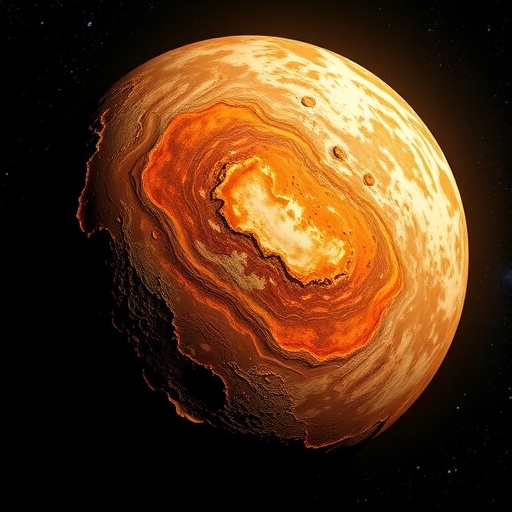
Credit: MPS / hormesdesign.de
The evolutionary histories of Earth and Mercury differ fundamentally. The smallest planet, closest to the Sun, likely began cooling early on, much like a setting pudding: As early as about one billion years after its formation, Mercury’s volcanic activity came to a halt, and a solid, continuous “rock skin” formed on the planet’s surface. Earth’s crust, on the other hand, is still in motion: volcanism and plate tectonics are constantly stirring up the “Earth pudding.” Exactly what Mercury’s unique volcanic past looked like and how it shaped its current appearance remains unclear. However, researchers can gain important clues from the composition of its surface.
In a new study, researchers from the Max Planck Institute for Solar System Research in Germany and the Universities of Münster and Göttingen, also Germany, have now determined the proportion of silicon dioxide on Mercury’s surface with greater accuracy than ever before. Their findings are published now in the journal Planetary Research, which, as a Diamond Open Access journal, is freely available to all interested readers. The study reveals a surprise: with a mass fraction of about 37 percent, silicon dioxide on Mercury is up to 25 percent less abundant than previously thought. On Earth, however, the compound consisting of one silicon atom and two oxygen atoms is virtually ubiquitous: in its pure form as sand, and in large quantities in all volcanic rocks such as basalt, andesite, and granite, which contain up to 75 percent silicon dioxide.
“Our findings suggest that the volcanic rocks on Mercury formed from more deeply melted mantle material than previously assumed,” said Christian Renggli, lead author of the new study and head of the “Experimental Laboratory Magma Ocean” research group at the MPS. Silicon dioxide gradually accumulates in the molten mantle of a young planet – that is, the layer beneath the solidified crust. This is because, as the mantle cools, the first rocks to form extract comparatively little silicon dioxide from the melt. The hot lava that wells up to the surface therefore becomes increasingly rich in silicon dioxide over time. If this compound is present in small amounts on the surface, it indicates high temperatures in the interior.
It is also possible that Mercury once had more silicon dioxide in its crust but gradually lost its oxygen.
From tiny glass beads to a map of the Moon…
It is difficult to make statements about the surface composition of Mercury. No lander has ever touched down on its surface; there are no rock samples from there. Researchers therefore have no choice but to infer its composition from remote sensing data – that is, from telescopes on Earth or from space probes. The infrared radiation from Mercury’s surface contains revealing information in this regard.
To make the infrared measurement data usable, the researchers’ first step took them into the laboratory. There, they produced tiny glass beads – only about half a millimeter in size – with precisely defined proportions of silicon dioxide and determined the exact properties of their infrared radiation. “The glass beads serve a similar function to calibration weights on a scale,” explains Iris Weber from the University of Münster. “Their weight is known precisely. They therefore allow us to correctly interpret the scale’s balance. Similarly, the glass beads allow us to draw the correct conclusions from the properties of the infrared radiation.”
To be absolutely certain, the team tested its newly discovered calibration relationship between silicon dioxide content and infrared radiation in a second step on a natural – and significantly larger – object: the Moon. It offers ideal conditions for this: NASA’s Lunar Reconnaissance Orbiter has been orbiting the Moon since 2009 and has measured the infrared radiation emanating from its surface with high spatial resolution. From this data, the researchers were able to create the first complete map of the silicon dioxide content of the Moon’s surface. Rock samples brought back to Earth from various regions of the Moon’s surface as part of both astronautic and unmanned missions made it possible to verify the results.
Quote:
“The Moon is a kind of touchstone for us – and an important conceptual stepping stone on our way to Mercury.”
Christian Renggli, first author and head of the “Experimental Laboratory Magma Oceans” research group at MPS
…and on to Mercury
Only after successfully passing the “Moon test” did the researchers turn their attention to infrared data from Mercury in the third and final step of their investigation. Such data were collected, for example, at the Bok Telescope at Steward Observatory in the U.S. state of Arizona.
The team now hopes to confirm the low silicon dioxide content of Mercury’s surface using data from the ESA’s BepiColombo mission. In November of this year, the spacecraft, consisting of two separatable probes provided by ESA and JAXA respectively, is scheduled to enter orbit around the small planet. The first step in this process – separating both probes from the transport module – is scheduled for next Thursday, September 3, 2026. BepiColombo’s MERTIS instrument, which was developed and built under the leadership of the DLR together with the Institute for Planetology at the University of Münster, will then record significantly more precise and higher-resolution infrared data. “Our study lays the groundwork for deriving the most accurate information possible about the silicon dioxide content of Mercury’s surface from BepiColombo’s measurements,” said Christian Renggli.
Method of Research
Experimental study
Subject of Research
Not applicable
Article Title
The SiO2 abundance on the surfaces of the Moon and Mercury
Article Publication Date
27-Aug-2026
Cite Scienmag News
Grant Pearson. (August 31, 2026). Mercury’s crust formed by extreme volcanism. Scienmag. https://scienmag.com/mercurys-crust-formed-by-extreme-volcanism/
Grant Pearson. "Mercury’s crust formed by extreme volcanism." Scienmag, 31 August 2026, https://scienmag.com/mercurys-crust-formed-by-extreme-volcanism/. Accessed 31 August 2026.
Grant Pearson. "Mercury’s crust formed by extreme volcanism." Scienmag. August 31, 2026. https://scienmag.com/mercurys-crust-formed-by-extreme-volcanism/

