


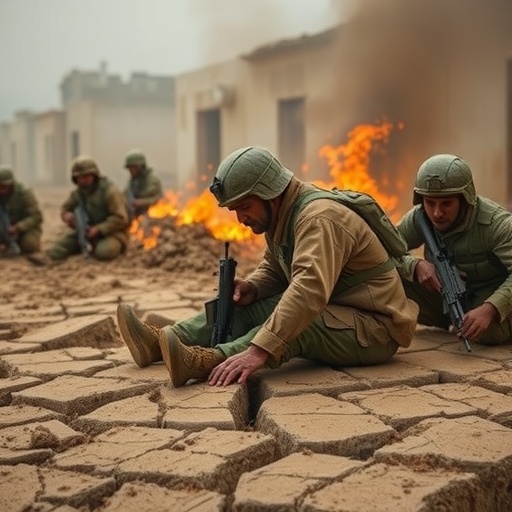
War is usually counted in casualties, destroyed buildings and refugee columns, but its heaviest toll is often invisible: the depression, anxiety and post-traumatic stress that shadow survivors long after the shooting stops. A new study published in Nature Sustainability adds a sobering dimension to that ledger, reporting that drought — the slowest and least cinematic of disasters — substantially deepens the psychological burden carried by populations already ravaged by conflict. In the paper, researchers Döring, Hecker and Hall present evidence that drought does not simply sit alongside war as a parallel hardship; it amplifies war’s psychological damage, interacting with violence, displacement and scarcity in ways that multiply human suffering. The timing could hardly be more pointed. Climate change is intensifying drought across many of the world’s most fragile regions, more than 120 million people are forcibly displaced worldwide according to the UN refugee agency, and dozens of armed conflicts are grinding on with no end in sight. What the study describes is not a rare overlap of bad luck but an increasingly common condition of the twenty-first century — and one whose costs are measured not only in livelihoods lost but in minds broken.
The mental-health cost of war is well documented yet chronically underestimated. WHO-commissioned research published in The Lancet estimated that roughly one in five people living in conflict-affected settings — about 22 percent — experiences a mental-health condition at any given time, most commonly depression, anxiety or post-traumatic stress disorder, roughly double the prevalence seen in stable populations. These conditions are not transient. Longitudinal studies of war survivors show elevated symptoms persisting for years, sometimes decades, after violence ends, eroding work, parenting, physical health and the social trust that rebuilding depends on. Children are especially vulnerable: toxic stress during development is linked to lasting changes in emotion regulation, learning and lifelong health. The economic knock-on effects are large as well, because untreated mental disorders depress productivity, strain households and feed cycles of violence that make recovery harder. Yet in precisely the places where the need is greatest, care is scarcest. Many fragile and conflict-affected states count fewer than one psychiatrist for every 100,000 residents, and humanitarian budgets routinely devote only a small fraction of funding to mental-health and psychosocial support. The result is a vast, untreated reservoir of psychological injury — one that, the new study suggests, drought is making considerably deeper.
To understand why drought intersects so destructively with war, it helps to be precise about what drought actually is. Scientists distinguish meteorological drought — a sustained deficit in precipitation — from agricultural drought, in which soil moisture falls too low to sustain crops, and hydrological drought, in which rivers, reservoirs and aquifers run down. Each form is tracked with standardized indices, such as the Standardized Precipitation Index, that measure how far conditions deviate from long-term norms. What sets drought apart from an earthquake or a flood is its slow onset and punishing duration: it is a creeping emergency that can persist for years, eroding livelihoods grain by grain. Unlike a flood, whose damage is concentrated and visible, a drought’s damage diffuses into prices, harvests and household decisions, making it harder to see — and easier to ignore. The scale is growing. The United Nations Convention to Combat Desertification estimates that the number and duration of droughts have increased by 29 percent since 2000, and the Intergovernmental Panel on Climate Change projects that additional warming will intensify agricultural and ecological drought across many already water-stressed regions — including several that overlap with the world’s active conflict zones.
Even on its own, drought leaves a distinct psychological signature. Studies of farming and herding communities have linked prolonged water shortage to chronic stress, hopelessness and elevated suicide risk; a major meta-analysis published in Nature Climate Change concluded that suicide rates themselves rise as temperatures climb. Rural populations whose identities and incomes rest on land and livestock are hit first and hardest, and research on agricultural communities documents strong associations between drought and both anxiety and depressive symptoms. Surveys of roughly 10,000 young people across ten countries, published in The Lancet Planetary Health, found that nearly six in ten were very or extremely worried about climate change — a phenomenon now studied under the label of eco-anxiety. Psychologically, drought fuses two especially potent stressors: loss of control over one’s material survival, and uncertainty that never resolves, because no one can say when the rains will return. Chronic activation of the body’s stress machinery — the hypothalamic-pituitary-adrenal axis, which governs cortisol release — is implicated in depression, memory impairment and inflammatory disease. Drought, in other words, is not merely an economic shock. It is a sustained assault on mental well-being even before any bullets fly.
The central contribution of the new paper is to show what happens when these two assaults collide. In the language of statistics, drought does not simply add a fixed amount of distress on top of war’s toll; it behaves as an effect modifier, changing the very relationship between conflict exposure and psychological harm. If the burdens were merely additive, a person enduring both war and drought would face the sum of two separate risks. Amplification implies something more troubling: under drought conditions, the same degree of war exposure produces a larger psychological toll than it would in water-secure times. Climate scientists have a framework for such overlaps — compound events, in which multiple hazards interact to produce impacts greater than their parts, a concept that now runs through IPCC assessments. What Döring and colleagues make unmistakable is that mental health belongs squarely inside that framework. The distinction is not academic hair-splitting. Additive risks can be managed with parallel programs; interactive risks demand integrated ones, because treating one hazard while ignoring the other leaves the amplification intact. War and drought, managed by policymakers as separate problems in separate ministries, are in reality a single, mutually reinforcing crisis with a compounded human price.
The mechanisms behind this amplification form a cascade that researchers are only beginning to map. Drought destroys harvests and livestock, driving food insecurity, and hunger is tightly coupled to psychological distress: food-insecure households show sharply elevated rates of depression, particularly among mothers, while childhood malnutrition interacts with chronic stress to shape emotional development for a lifetime. Water scarcity forces families — usually women and girls — into longer and more dangerous journeys to collect water, and unsanitary conditions raise the risk of disease outbreaks that layer grief and exhaustion onto scarcity. Heat that accompanies drought disrupts sleep, shortens tempers and is consistently associated with spikes in aggression and interpersonal violence. Meanwhile, drought strips away rural livelihoods and the farming and herding identities that anchor community life, pushing families into displacement, where social support networks fray exactly when they are needed most. Humanitarian agencies, stretched thin by war, are typically resourced for either a conflict response or a climate shock — not both at once. Services crack precisely when psychological need peaks, and untreated distress accumulates in the population like water behind a failing dam.
Nor is the overlap hypothetical; it describes much of the contemporary map of human misery. Syria endured a devastating multi-year drought from 2006 to 2010 that destroyed harvests and helped displace well over a million rural residents — an upheaval that some scholars argued fed the unrest that followed, though that causal chain remains contested in the research literature. The Horn of Africa has seen drought and violence intertwined for decades: Somalia’s 2011 famine unfolded amid active conflict, and the 2020–2023 drought, the region’s driest stretch in some forty years, displaced millions even as fighting blocked aid. In the Sahel, shrinking pastures and dwindling water points have been repeatedly linked to clashes between herders and farming communities. Security analysts adopted the phrase “threat multiplier” years ago to describe how climate stress magnifies existing instability. What the new study adds is a precise psychological dimension to that security language: the multiplier operates inside human minds as well as across battlefields.
Measuring these effects is notoriously difficult, which is what makes rigorous work in this area so consequential. Mental-health surveys inside active war zones battle attrition, danger and the simple impossibility of reaching besieged populations; drought, meanwhile, must be quantified objectively across space and time rather than assumed. Any analysis must also guard against confounding — poverty, weak institutions and pre-existing violence all shape both climate vulnerability and mental health, and disentangling drought’s independent contribution from war’s is a statistical tightrope. Researchers therefore triangulate, combining standardized drought indices with longitudinal mental-health data and models that test explicitly whether drought modifies the effect of conflict exposure. No single study can settle such questions definitively; the field’s conclusions rest on converging lines of evidence rather than any one dataset. But the direction of that evidence is consistent, and its implication is uncomfortable: as warming deepens drought in fragile states, the psychological price of every ongoing war is quietly rising, compounding year after year. The relationship also cuts both ways. If drought deepens war’s psychological damage, then easing drought — through water infrastructure, food aid or insurance schemes — should measurably lighten that damage, a testable prediction that gives the finding practical force.
The policy implications cut across humanitarian aid, climate adaptation and security planning. Mental-health and psychosocial support — long among the most underfunded components of emergency responses — cannot remain an afterthought bolted onto food distributions; the World Health Organization’s mhGAP programme and inter-agency guidelines on mental health in emergencies provide blueprints that rarely reach anything like scale. Drought early-warning systems and forecast-based financing, which release funds before a crisis peaks, could be explicitly paired with psychosocial services so that counseling arrives alongside the water trucks. Investments in drought-resilient water infrastructure, drought-tolerant crops and social-protection schemes should be understood, explicitly, as mental-health interventions, because they blunt the stress cascade before it begins. And climate finance, which has been slow to reach fragile and conflict-affected states, will need to treat those states as priorities rather than exceptions. If drought amplifies the psychological burden of war, the arithmetic of suffering becomes brutal: the droughts of the coming decades will not wait for the wars to end, and it is minds — not only harvests — that will bear the difference.
Cite Scienmag News
Glenn Wilkins. (August 30, 2026). Drought deepens the mental toll of war. Scienmag. https://scienmag.com/drought-deepens-the-mental-toll-of-war/
Glenn Wilkins. "Drought deepens the mental toll of war." Scienmag, 30 August 2026, https://scienmag.com/drought-deepens-the-mental-toll-of-war/. Accessed 30 August 2026.
Glenn Wilkins. "Drought deepens the mental toll of war." Scienmag. August 30, 2026. https://scienmag.com/drought-deepens-the-mental-toll-of-war/


