


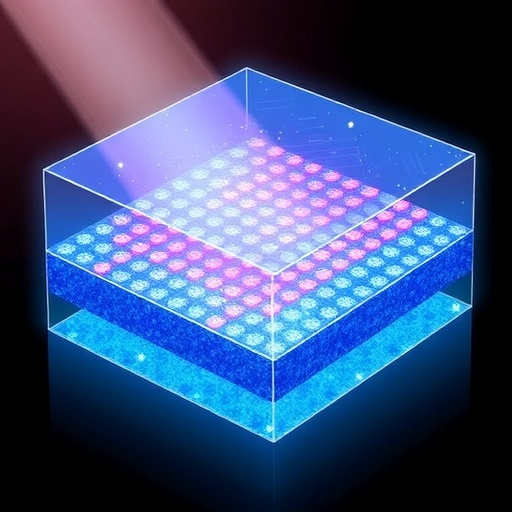
Solar technology has spent years chasing a difficult combination: higher efficiency without sacrificing durability. A new perovskite design could bring that challenge closer to resolution by changing not only the composition of a light-absorbing film, but also the behavior of the negatively charged ions inside its crystal lattice. In a study reported in Nature Synthesis, researchers engineered dynamically disordered cyanate anions into wide-bandgap perovskite materials and used them to build a more efficient, more stable top cell for perovskite–silicon tandem photovoltaics. The resulting tandem device achieved a power conversion efficiency of 34.79%, with an independently certified efficiency of 34.29%. It also retained 95% of its initial performance after 1,100 hours of continuous illumination, while extended outdoor-style testing continued for more than 1,300 hours. The work points to a chemical strategy for addressing one of the most persistent weaknesses in next-generation solar cells: the tendency for the materials that deliver high voltage to be especially vulnerable to energy loss and degradation.
Perovskites are a family of semiconductors whose crystal structures can be tuned by mixing different ions. Their strong absorption, adjustable bandgaps and ability to form thin films have made them leading candidates for tandem solar cells, in which two light-absorbing devices are stacked so they can harvest different portions of sunlight. Silicon is particularly effective at converting lower-energy visible and near-infrared light, while a wide-bandgap perovskite top cell can absorb higher-energy photons before they reach the silicon layer. In principle, this division of labor allows a tandem device to produce more electricity than either material could generate alone. In practice, wide-bandgap perovskite top cells often suffer from a voltage deficit: the voltage delivered by the operating solar cell falls significantly below the energy expected from the material’s optical bandgap. Non-radiative recombination, in which excited electrons and holes lose their energy as heat rather than light or electrical current, is a major cause.
The new approach focuses on the anionic sublattice, the network of negatively charged ions that helps define the perovskite crystal’s structure and electronic environment. Rather than treating these anions as passive components, the researchers designed perovskite derivatives containing cyanate anions with dynamic disorder. This means that the anions are not locked into a single perfectly static arrangement within the lattice. Their changing local configurations can influence how the material crystallizes and how charges move through it. The researchers used this behavior to alter crystallization kinetics—the rates and pathways by which a thin film transforms from a precursor mixture into an ordered semiconductor. According to the study, this dynamic anionic engineering directed the formation of a coherent bulk heterojunction, a continuous internal architecture in which related semiconductor regions are intimately connected rather than separated into poorly matched domains.
That structural control matters because the microscopic quality of a perovskite film determines how efficiently it handles photogenerated charge. During crystallization, imperfections can form at grain boundaries, where individual crystalline regions meet, and at interfaces between different materials. These sites can contain electronic defects known as trap states. Deep-level traps are especially damaging because they can capture electrons or holes and facilitate non-radiative recombination, shortening the time available for charges to reach the electrical contacts. A solar cell may therefore absorb sunlight efficiently while still losing much of the resulting energy before it becomes usable current. The cyanate-containing materials were designed to act at these vulnerable locations. The study reports that the anions provided chemical and electronic passivation at grain boundaries and interfaces, effectively neutralizing deep-level traps and suppressing the recombination pathways that create voltage losses.
The film morphology produced by the method was also important. The researchers observed large-grained material, meaning the perovskite contained relatively broad crystalline regions with fewer grain boundaries per unit area. Large grains do not automatically guarantee a high-performing solar cell, because defects can still occur within crystals or at contacts, but reducing the total density of boundaries can limit the number of locations where charge carriers become trapped. The reported coherent bulk heterojunction adds another layer of control by creating a connected internal structure that supports charge transport across the absorber. Together, the crystallization pathway, grain growth and interfacial passivation address different parts of the same problem: keeping photogenerated carriers mobile and preventing them from dissipating their energy before extraction.
The performance results show how those chemical and structural changes translated into working devices. A single-junction wide-bandgap perovskite solar cell made using the method reached a power conversion efficiency of 24.35%. Power conversion efficiency is the fraction of incident sunlight converted into electrical power, and in a wide-bandgap perovskite cell it reflects the balance among current generation, voltage, and the fill factor, which describes how effectively the device maintains useful power across its operating range. The more consequential result came when the perovskite was placed above a silicon cell in a monolithic tandem architecture. Because the two subcells are connected within a single integrated device, the top perovskite layer must transmit suitable light to the silicon beneath it while generating a high voltage of its own. The tandem reached 34.79% efficiency in the reported measurements, and a certified value of 34.29% provided an independently validated benchmark.
Tandem photovoltaics are attractive partly because they can surpass the practical efficiency ceiling of conventional single-junction silicon. A single semiconductor absorbs photons over a limited energy range: photons below its bandgap pass through or are weakly absorbed, while excess photon energy above the bandgap is lost as heat. Stacking materials with different bandgaps reduces both forms of loss. Yet this design also increases the number of interfaces and processing constraints. The top perovskite must be deposited without damaging the silicon device, remain optically and electrically compatible with the lower cell, and withstand illumination, heat and electrical stress over time. Wide-bandgap compositions have been particularly challenging because increasing the bandgap can intensify chemical instability and promote non-radiative losses. By engineering the anion chemistry rather than relying solely on broad compositional adjustments, the researchers sought to improve efficiency and stability through the same underlying material design.
Durability testing provided a second major result. Under the ISOS-L-1 protocol, which evaluates operational stability under continuous illumination, the tandem retained 95% of its initial performance after 1,100 hours. The study also reports more than 1,300 hours of extended real-world testing under the ISOS-O-2 protocol. Stability measurements are crucial for perovskite technology because impressive initial efficiencies have often been accompanied by rapid performance declines. Perovskite crystals and their interfaces can respond to light, temperature and electric fields, with ions moving through the lattice or chemical reactions developing at contacts. Such changes can create new defects, alter the distribution of elements and undermine the electrical properties of the device. The reported retention under both continuous illumination and longer-duration real-world conditions suggests that the cyanate-based design may suppress several degradation pathways, although the timescales remain short compared with the operational lifetimes expected of commercial solar modules.
The significance of the work is therefore broader than a single efficiency record. It demonstrates that the negative-ion framework of a perovskite can be deliberately designed to control processes occurring at multiple scales, from the motion and disorder of individual anions to the crystallization of the full absorber and the behavior of interfaces in a tandem device. The researchers describe this strategy as dynamic anionic sublattice engineering, emphasizing that anions can actively shape the formation and operation of the semiconductor. That concept could help materials scientists move beyond a trial-and-error search through combinations of elements. By selecting anions for their effects on crystallization, defect chemistry and electronic passivation, researchers may be able to design perovskites around specific performance requirements. In this case, the approach was aimed at the stability–performance trade-off, the tendency for improvements in efficiency to be offset by faster degradation.
The new results do not by themselves establish that perovskite–silicon tandems are ready for mass deployment. Commercialization will still depend on manufacturing uniform large-area films, protecting devices from moisture and heat, maintaining performance across millions of cells and demonstrating long-term reliability under diverse climates. Certified laboratory efficiency and controlled stability testing are essential milestones, but they are not substitutes for years of field operation. Even so, the study offers a compelling blueprint for tackling the materials problems that stand between laboratory devices and practical solar power. By using dynamically disordered cyanate anions to guide crystallization, passivate defects and support a coherent heterostructure, the researchers produced a tandem cell that combines unusually high efficiency with substantial short-term operational retention. If the chemistry can be translated to scalable manufacturing, engineering the anionic sublattice could become one of the most important tools for turning perovskite–silicon tandems from high-performance experiments into a durable source of low-carbon electricity.
Cite Scienmag News
Florence R. (August 29, 2026). Engineering Anionic Sublattices in Perovskite Heterostructures Advances Tandem Solar Cells. Scienmag. https://scienmag.com/engineering-anionic-sublattices-in-perovskite-heterostructures-advances-tandem-solar-cells/
Florence R. "Engineering Anionic Sublattices in Perovskite Heterostructures Advances Tandem Solar Cells." Scienmag, 29 August 2026, https://scienmag.com/engineering-anionic-sublattices-in-perovskite-heterostructures-advances-tandem-solar-cells/. Accessed 29 August 2026.
Florence R. "Engineering Anionic Sublattices in Perovskite Heterostructures Advances Tandem Solar Cells." Scienmag. August 29, 2026. https://scienmag.com/engineering-anionic-sublattices-in-perovskite-heterostructures-advances-tandem-solar-cells/


