

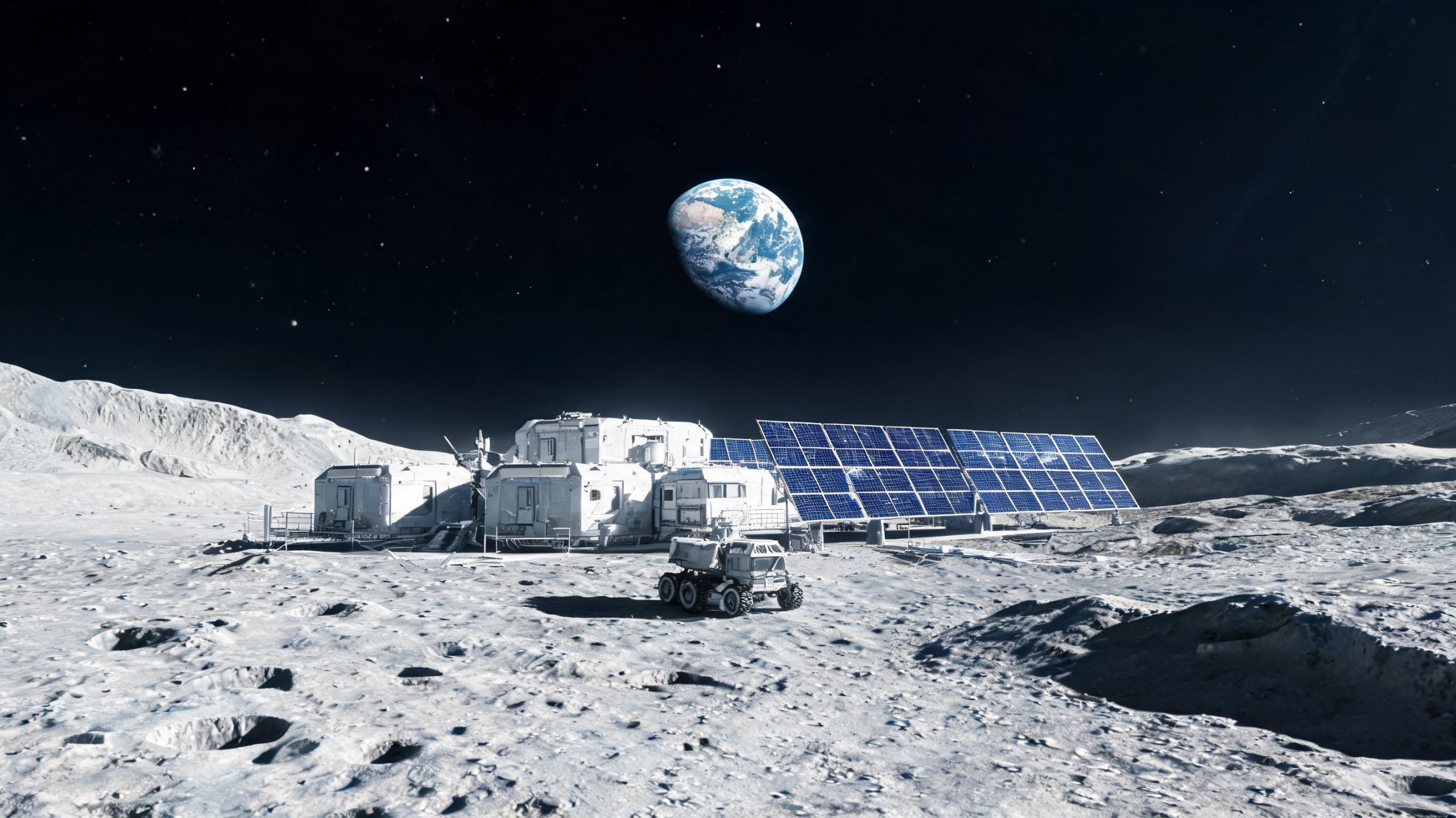
The next space race may not be defined only by rockets, landings or scientific discoveries. It could be decided by something less dramatic but equally consequential: whether companies can build supply chains that remain traceable, secure and environmentally responsible from Earth to the Moon. A study published in Space and Planetary Resources argues that space-based manufacturing and lunar resource extraction should be governed by continuous supply-chain due diligence before industrial activity becomes routine. The paper examines a future in which orbital factories, lunar processing plants, autonomous robots, communication networks and transport systems operate as connected commercial infrastructure. Its central warning is that a licence proving technical feasibility would not be enough. Operators and regulators would also need to show that missions are lawful, resilient, environmentally careful, cybersecure and capable of being supervised throughout their lifecycles.
The researchers describe cislunar activity as a complex network rather than a simple journey from a terrestrial supplier to a customer. It would begin on Earth, where companies obtain critical minerals, electronics, batteries, propulsion components, sensors, robotics and artificial-intelligence hardware. It would continue through launch facilities, cryogenic propellant storage, spaceports and transport services before reaching orbital manufacturing platforms, depots and staging areas. Further links would connect those systems with lunar-orbit vehicles, landers, rovers, excavation equipment, power stations and processing plants. Products or resources could then move between space platforms, remain on the Moon or return to Earth. Because every segment depends on the others, a shortage of a specialised component, a cyberattack on a ground station or a failed launch could create consequences far beyond the original point of failure.
That chain also carries familiar terrestrial risks into space. Minerals such as cobalt, nickel, lithium, rare-earth elements, aluminium and titanium may be associated with unsafe working conditions, labour exploitation, community displacement or environmental damage before they ever become part of a spacecraft. The study therefore argues that the space sector cannot treat human-rights and labour concerns as issues that end at the atmosphere. Operators should be able to trace important materials and components as far upstream as reasonably possible, assess suppliers, maintain grievance and corrective-action procedures, and document how risks are addressed. Due diligence would not simply be a public-relations exercise or an environmental, social and governance report. In the proposed approach, it would become an operational capability linking procurement, licensing, mission assurance and accountability.
Space introduces hazards that have no straightforward terrestrial equivalent. Orbital manufacturing could increase the number of objects, components and discarded materials in already congested regions, making debris mitigation, collision avoidance and end-of-life planning essential parts of mission design. On the Moon, excavation could generate dust plumes that interfere with instruments, solar panels or nearby equipment. Permanently shadowed regions may contain water ice and are scientifically significant, while other locations could possess heritage value because of earlier missions. Extraction and processing could also generate slag, excess metals, volatile releases or other waste streams. The authors propose that operators assess site selection, plume behaviour, contamination, waste containment, recycling and safe retirement before operations begin, rather than attempting to repair irreversible damage after it occurs.
The legal structure of space makes this oversight a shared responsibility. Under the Outer Space Treaty, states remain internationally responsible for national activities in space, including those conducted by private entities, and must authorise and continually supervise non-governmental operations. The treaty also prohibits national appropriation of celestial bodies, calls for exploration and use to benefit all countries, links jurisdiction and control to registration, and requires due regard for the interests of other states. The study interprets these principles as a foundation for preventive and traceable governance. A company may receive national permission to recover and use space resources without claiming sovereignty over the Moon, but its activities would still need to account for other missions, scientific interests and the broader legitimacy of industrial activity in a shared domain.
Autonomous systems make the case for continuous oversight even stronger. Orbital factories and lunar infrastructure are expected to rely on robots and software for navigation, docking, inspection, excavation, processing, repair and emergency response, often with limited real-time human intervention. Artificial intelligence could improve efficiency and reduce exposure to dangerous environments, but failures may arise from model drift, hidden software dependencies, cyber manipulation, inadequate testing or decisions that operators cannot readily explain. The proposed due-diligence model would require records of an AI system’s purpose, training and validation, operating limits, update procedures, human override capacity and incident history. Cybersecurity would likewise extend beyond spacecraft hardware to telemetry, command links, ground stations, supplier software, cloud systems and data exchanges. A corrupted command could become a collision, equipment failure or unsafe lunar operation.
To make these principles testable, the researchers propose a Cislunar Due Diligence Cycle and a benchmarking framework. The cycle begins by tracing and registering critical suppliers, materials, software, AI models, mission assets and resource transfers in digital chain-of-custody records. It then forecasts and ranks risks according to their severity, likelihood and potential irreversibility. The prevention and adaptation phase could involve supplier audits, worker protections, redundant systems, collision-avoidance procedures, cyber testing, dust controls, safe modes and stable power supplies. Finally, verification and remediation would draw on telemetry, remote sensing, digital twins, mission logs and independent analysis. The process is designed to repeat as suppliers change, software is updated and new hazards emerge, rather than ending when a launch licence is granted.
Benchmarking would allow regulators, investors, mission partners and operators to compare documented practices without reducing complex missions to a simplistic league table. The study identifies domains including traceability, transparency, supplier governance, environmental care, safety and mission assurance, cybersecurity, resilience, circularity and end-of-life management. Indicators could be scored using evidence such as licences, supplier records, environmental assessments, audit reports, cybersecurity plans, telemetry logs and disposal commitments. An illustrative comparison based on publicly available regulatory material examined authorisation and supervision, registration and traceability, environmental risk management, and digital and cybersecurity oversight in the United States, Luxembourg and Japan. The authors stress that such scores are intended to reveal weaknesses and encourage improvement, not to establish permanent rankings. They recommend that states require due-diligence plans in space-resource and in-orbit-manufacturing licences, create common checklists and develop international reporting practices that protect sensitive information while making essential safeguards visible. Their conclusion is both practical and strategic: building accountability into cislunar supply chains now could help ensure that humanity’s next industrial frontier is resilient without repeating Earth’s patterns of opacity, extraction and environmental neglect.
A useful distinction in the study is between sustainability and resilience. Sustainability asks whether an activity can avoid or reduce unacceptable environmental and social impacts over time. Resilience asks whether the connected system can continue operating, recover from disruption and adapt when conditions change. In cislunar activity, the two objectives overlap but are not identical. A supply chain could be highly redundant yet still depend on damaging extraction practices, or environmentally cautious while remaining dangerously vulnerable to a single supplier, launch provider or communications link. Due diligence is presented as the mechanism for considering both dimensions together.
This perspective also changes how risk should be prioritised. Conventional procurement may focus on cost, delivery schedules and the probability of failure. Cislunar planning must additionally consider the scale of consequences, the difficulty of intervention and whether harm can be reversed. A delayed shipment of a terrestrial component may be inconvenient; the loss of a critical orbital asset or contamination of a sensitive lunar location may affect operations for much longer. Risk assessment therefore needs to examine not only the most likely event, but also low-frequency failures with severe or persistent consequences.
Verification is especially difficult when industrial assets are remote, autonomous and distributed across jurisdictions. Operators may possess detailed telemetry while regulators control licences and suppliers hold information about materials, software or manufacturing processes. The paper’s emphasis on traceability addresses this information gap. Records should allow authorised reviewers to connect a component or service with its origin, tests, modifications, operating history and eventual disposition. Such records would support investigations after an incident, but their value is also preventive: missing or inconsistent information can identify a governance weakness before it becomes a mission failure.
Environmental assessment in this setting cannot be limited to emissions from terrestrial production. It must follow the full operational pathway, including launch-related inputs, orbital congestion, propellant handling, spacecraft disposal and changes to lunar terrain. Baseline observations are important because detecting change requires knowledge of conditions before excavation, construction or repeated vehicle activity begins. Monitoring could combine mission telemetry with remote sensing and independent review, allowing operators to compare predicted effects with observed dust, debris or surface disturbances. This creates an evidence loop in which environmental assumptions can be revised as operational experience accumulates.
The governance challenge is not solved by transferring terrestrial rules unchanged into space. The source article instead supports adaptation: familiar ideas such as risk identification, mitigation, reporting and remedy must be interpreted through state responsibility, remote supervision, registration requirements and the physical constraints of space operations. Licensing can provide the legal connection between public oversight and private activity, while contractual requirements can transmit safeguards to suppliers and business partners. Internationally compatible expectations would be valuable because cislunar chains may cross borders even when a mission is authorised by a single state.
Early standards could also reduce uncertainty for investors and engineers. Clear expectations about evidence, reporting and corrective action would make responsible design part of project planning rather than an expensive addition after hardware and contracts are fixed. They could encourage modular systems, repairability, recycling and compatible data practices where those choices improve continuity and reduce waste. The authors do not present due diligence as a guarantee that accidents or conflicts will disappear. Its purpose is more practical: to make risks visible, assign responsibility, support informed authorisation and create opportunities to correct problems before industrial activity becomes too extensive to govern effectively.
Subject of Research: Supply-chain due diligence for sustainable cislunar manufacturing and lunar resource extraction
Article Title: Supply chain due diligence in space-based manufacturing and lunar resource extraction: building sustainable & resilient cislunar operations
Article References: Lather, M., Gulati, P., Kumar, H., & Mahajan, A. (2026). Supply chain due diligence in space-based manufacturing and lunar resource extraction: building sustainable & resilient cislunar operations. Space and Planetary Resources, 2(1), Article 6. https://doi.org/10.1007/s44461-026-00011-0
Image Credits: AI Generated
DOI: 10.1007/s44461-026-00011-0
Keywords: cislunar operations, lunar resources, space manufacturing, supply chains, space sustainability, space law, AI governance, cybersecurity, orbital debris, Supply, chain, diligence
Cite Scienmag News
Scienmag. (August 29, 2026). How Due Diligence Could Keep the Lunar Economy Sustainable. https://scienmag.com/how-due-diligence-could-keep-the-lunar-economy-sustainable/
Scienmag. "How Due Diligence Could Keep the Lunar Economy Sustainable." Scienmag, 29 August 2026, https://scienmag.com/how-due-diligence-could-keep-the-lunar-economy-sustainable/. Accessed 29 August 2026.
Scienmag. "How Due Diligence Could Keep the Lunar Economy Sustainable." Scienmag. August 29, 2026. https://scienmag.com/how-due-diligence-could-keep-the-lunar-economy-sustainable/


