

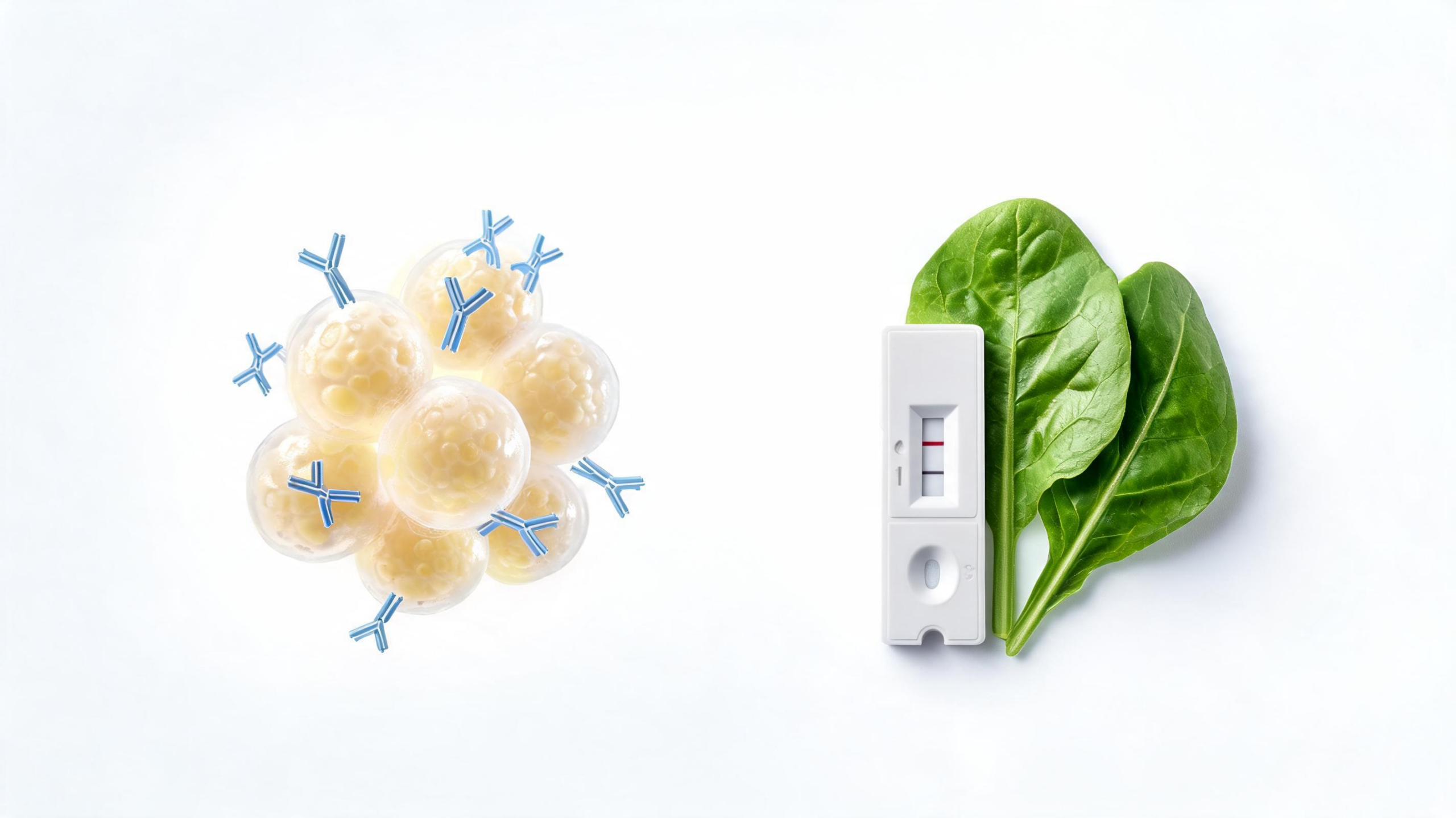
A genetically engineered yeast has produced a full-length antibody that can detect the insecticide chlorantraniliprole in agricultural products, offering a potential route to faster and less expensive residue screening. In a study published in Crop Health, researchers used Pichia pastoris to manufacture an antibody that recognizes chlorantraniliprole and incorporated it into a gold nanoparticle-based lateral flow immunoassay. The strip produced a visible positive result at concentrations of 0.63 nanograms per milliliter in buffer and gave results that agreed closely with ultra-high-performance liquid chromatography–tandem mass spectrometry in blind rice samples. Chlorantraniliprole is an anthranilic diamide insecticide widely used to control crop pests. Monitoring its residues is important because food must comply with regulatory maximum residue limits, while conventional instrumental analysis can require expensive equipment, trained personnel and lengthy sample preparation. The new work does not replace confirmatory laboratory methods, but it demonstrates how recombinant antibody production and portable testing can be combined for rapid screening near farms, markets or food-processing facilities.
Immunoassays detect target chemicals through selective binding between an analyte and an antibody. Their appeal lies in their relative simplicity, low cost, speed and capacity to process many samples. Yet the reliability of these tests depends heavily on the quality and consistency of the antibody reagent. Conventional monoclonal antibodies are commonly produced with hybridoma cells, which are created by fusing antibody-producing immune cells with immortalized cells. Hybridoma cultures can be genetically unstable, and traditional antibody production may also require substantial animal use. Recombinant antibody technology addresses these limitations by copying the antibody’s genetic information and expressing it in a controllable host. The resulting sequences can be preserved, reproduced and redesigned more readily than cell-based antibody sources. The researchers chose a full-length antibody rather than a smaller fragment because the complete immunoglobulin structure more closely retains the native conformation and binding behavior of the parental antibody. Their goal was to determine whether yeast could produce a functional, full-length pesticide-recognizing antibody suitable for a practical field assay.
The team began with mouse monoclonal antibody 5C5B9, which recognizes chlorantraniliprole. They extracted messenger RNA from the hybridoma and converted it into complementary DNA, then amplified and sequenced the variable regions of the antibody’s heavy and light chains. These regions contain the complementarity-determining regions, or CDRs, that form the antigen-binding site. The researchers combined the variable sequences with genes encoding the antibody’s constant regions and inserted the resulting constructs into two expression plasmids. One plasmid encoded the heavy chain and the other encoded the kappa light chain. Both constructs used the inducible AOX1 promoter, a regulatory sequence activated by methanol in P. pastoris, and an alpha-mating-factor secretion signal designed to direct the antibody chains outside the yeast cells. The plasmids were first assembled and sequence-verified in Escherichia coli. They were then introduced sequentially into the yeast genome, allowing cells to produce and secrete the two chains needed to assemble the complete recombinant antibody.
Expression conditions were systematically adjusted because the amount and quality of a recombinant protein can depend strongly on its cultivation environment. The investigators evaluated induction time, temperature, shaking speed, starting pH and methanol concentration. Antibody accumulation increased during cultivation, but extended induction also brought more impurities into the culture supernatant. The selected production point was 120 hours after induction. Under the optimized conditions, cultures were maintained at 28 degrees Celsius with shaking at 280 revolutions per minute in medium initially adjusted to pH 7 and containing 0.8 percent methanol for expression optimization. The purified product reached a yield of 9.3 milligrams per liter in shake-flask cultures. Sodium dodecyl sulfate–polyacrylamide gel electrophoresis showed bands near 57 kilodaltons and 25 kilodaltons under reducing conditions, consistent with the expected heavy and light chains. Protein A affinity chromatography was used to recover the antibody from the yeast culture supernatant. The yield is below those commonly achieved in optimized mammalian industrial systems, but the yeast platform offers simpler cultivation and a potentially lower-cost manufacturing pathway for diagnostic reagents.
The recombinant antibody preserved the parent antibody’s ability to distinguish chlorantraniliprole from several related compounds, although its performance differed depending on the assay format. In an indirect competitive enzyme-linked immunosorbent assay, the recombinant antibody had a half-maximal inhibitory concentration of 2.9 nanograms per milliliter, a working range from 0.4 to 25.8 nanograms per milliliter and a detection limit of 0.4 nanograms per milliliter. The parent monoclonal antibody had an IC50 of 0.24 nanograms per milliliter, making it about ten times more sensitive in that format. Cross-reactivity testing showed the greatest response among the analogues for cyclaniliprole, at 39.2 percent, while tetraniliprole produced 0.4 percent cross-reactivity and the other tested compounds remained below 0.1 percent. The researchers interpreted this pattern as evidence that the recombinant antibody retained the parent antibody’s specificity. Because pesticide molecules are structurally related, such testing is essential: an assay that responds strongly to unintended compounds could generate misleading residue results.
For rapid screening, the researchers attached the recombinant antibody to gold nanoparticles and assembled a lateral flow strip from a sample pad, conjugate pad, nitrocellulose membrane, absorbent pad and backing plate. The strip used a competitive format. When chlorantraniliprole is absent, antibody–gold nanoparticle conjugates bind to pesticide-like molecules immobilized at the test line, producing a visible red signal. When chlorantraniliprole is present, it binds the antibody first and prevents that interaction, causing the test line to fade or disappear while the control line remains visible. A result could be read after 10 minutes. The team optimized the strip’s working buffer, selecting phosphate buffer at pH 7.4 with 0.14 molar sodium ions, 0.05 percent Tween-20 and 2.5 percent methanol. Methanol helped dissolve the pesticide, but concentrations above 2.5 percent weakened antigen–antibody binding. Under the final conditions, the visual detection limit was 0.63 nanograms per milliliter, approximately twofold lower than the value obtained with the parental antibody in a comparable lateral flow format.
The researchers next examined whether the strip could function in real food matrices, where pigments, sugars, proteins and other compounds can interfere with antibody binding or capillary flow. They tested rice, apples, sweet potatoes and grapes, extracting homogenized samples with 60 percent methanol before dilution. A 48-fold dilution, achieved through the extraction and subsequent dilution steps, reduced matrix effects sufficiently for rice, apple, sweet potato and grape extracts to show sensitivity comparable to that observed in buffer. In the tested agricultural products, the visual detection limit was 0.04 milligrams per kilogram. That threshold was low enough to meet the maximum residue limits specified by both Chinese and European Union standards for rice, apples and grapes. The result was different for sweet potatoes: the assay’s detection limit exceeded the applicable maximum residue limits of 0.02 milligrams per kilogram in both regulatory systems. The strip therefore showed practical promise for several matrices but was not sufficiently sensitive for reliable compliance testing in sweet potatoes. The researchers identified this limitation rather than treating the assay as universally applicable.
To assess performance against an established analytical method, the team tested ten rice samples containing unknown concentrations of chlorantraniliprole with both the recombinant-antibody strip and UPLC-MS/MS. The strip classified three samples as negative and seven as positive. Instrumental analysis found that the three negative samples contained concentrations below the strip’s rice detection threshold, while the seven positive samples exceeded it. This agreement supported the strip’s accuracy for screening rice samples under the tested conditions. The study also points to several steps needed before broader deployment. The authors plan to improve sweet-potato testing by optimizing QuEChERS-style sample preparation, reducing the dilution that can lower analyte concentration, and using higher-signal nanolabels. They also intend to investigate glycoengineered yeast. Yeast and mammalian cells add different carbohydrate structures to proteins, and those glycosylation patterns can influence antibody stability and activity. Thermal stability and room-temperature storage were not evaluated in the present study, leaving important questions about shelf life and field use. Even with those limitations, the work establishes a yeast-based route for producing a full-length pesticide antibody and connects it to a rapid, low-equipment assay that could expand preliminary residue monitoring outside specialized laboratories.
An important distinction in this work is that the yeast-produced antibody is intended for analytical recognition rather than therapeutic use. Yeast can attach carbohydrate structures that differ from those made by mammalian cells, a difference that can affect Fc-mediated biological functions and, in some settings, protein behavior. For an in vitro pesticide assay, however, Fc effector activity is not the measurement target; preservation of the antigen-binding site is the central requirement. Sequence analysis of the antibody’s variable regions found no common predicted glycosylation sites, providing a molecular reason to expect a lower risk that yeast-specific modification would directly disrupt recognition in this construct. The finding does not eliminate the need to assess stability, aggregation or lot-to-lot performance as production is scaled.
The assay’s reported visual limit of detection should also be interpreted as a screening threshold rather than a universal measurement capability. In a competitive strip, signal decreases as chlorantraniliprole occupies more antibody, so visual scoring depends on the contrast between test and control lines as well as on sample preparation. Matrix dilution can suppress interfering substances, but it can simultaneously reduce the concentration of the target reaching the strip. This trade-off helps explain why performance can differ among commodities even when the same antibody and membrane format are used. Recovery experiments in rice, apple and grape therefore provide matrix-specific evidence, not a guarantee that the strip will perform identically in every crop or processing condition.
At a broader manufacturing level, preservation of the cloned heavy- and light-chain sequences creates a defined starting point for further reagent engineering. The same genetic framework could support systematic optimization of expression, secretion or labeling without repeatedly returning to hybridoma production. That reproducibility is particularly relevant for immunoassays, where changes in antibody supply can alter calibration and complicate comparisons between test batches. The study consequently links two forms of standardization: a genetically specified antibody source and a portable assay format whose practical value can be judged against an established instrumental method.
Subject of Research: Yeast production of a recombinant antibody for rapid chlorantraniliprole residue detection
Article Title: Expression and immunoassay application of full-length recombinant antibody recognizing chlorantraniliprole using Pichia pastoris expression system
Article References: Huang, L., Cui, P., Zhang, Y., Wu, Y., Ding, Y., Jin, M., & Hua, X. (2026). Expression and immunoassay application of full-length recombinant antibody recognizing chlorantraniliprole using Pichia pastoris expression system. Crop Health, 4(1), Article 23. https://doi.org/10.1007/s44297-026-00085-4
Image Credits: AI Generated
DOI: 10.1007/s44297-026-00085-4
Keywords: recombinant antibodies, Pichia pastoris, chlorantraniliprole, pesticide residues, lateral flow immunoassay, food safety, gold nanoparticles, agricultural testing, Expression, immunoassay, application, full-length
Cite Scienmag News
Scienmag. (August 29, 2026). Yeast-Made Antibody Sharpens Rapid Tests for Crop Pesticide Residues. https://scienmag.com/yeast-made-antibody-sharpens-rapid-tests-for-crop-pesticide-residues/
Scienmag. "Yeast-Made Antibody Sharpens Rapid Tests for Crop Pesticide Residues." Scienmag, 29 August 2026, https://scienmag.com/yeast-made-antibody-sharpens-rapid-tests-for-crop-pesticide-residues/. Accessed 29 August 2026.
Scienmag. "Yeast-Made Antibody Sharpens Rapid Tests for Crop Pesticide Residues." Scienmag. August 29, 2026. https://scienmag.com/yeast-made-antibody-sharpens-rapid-tests-for-crop-pesticide-residues/


