

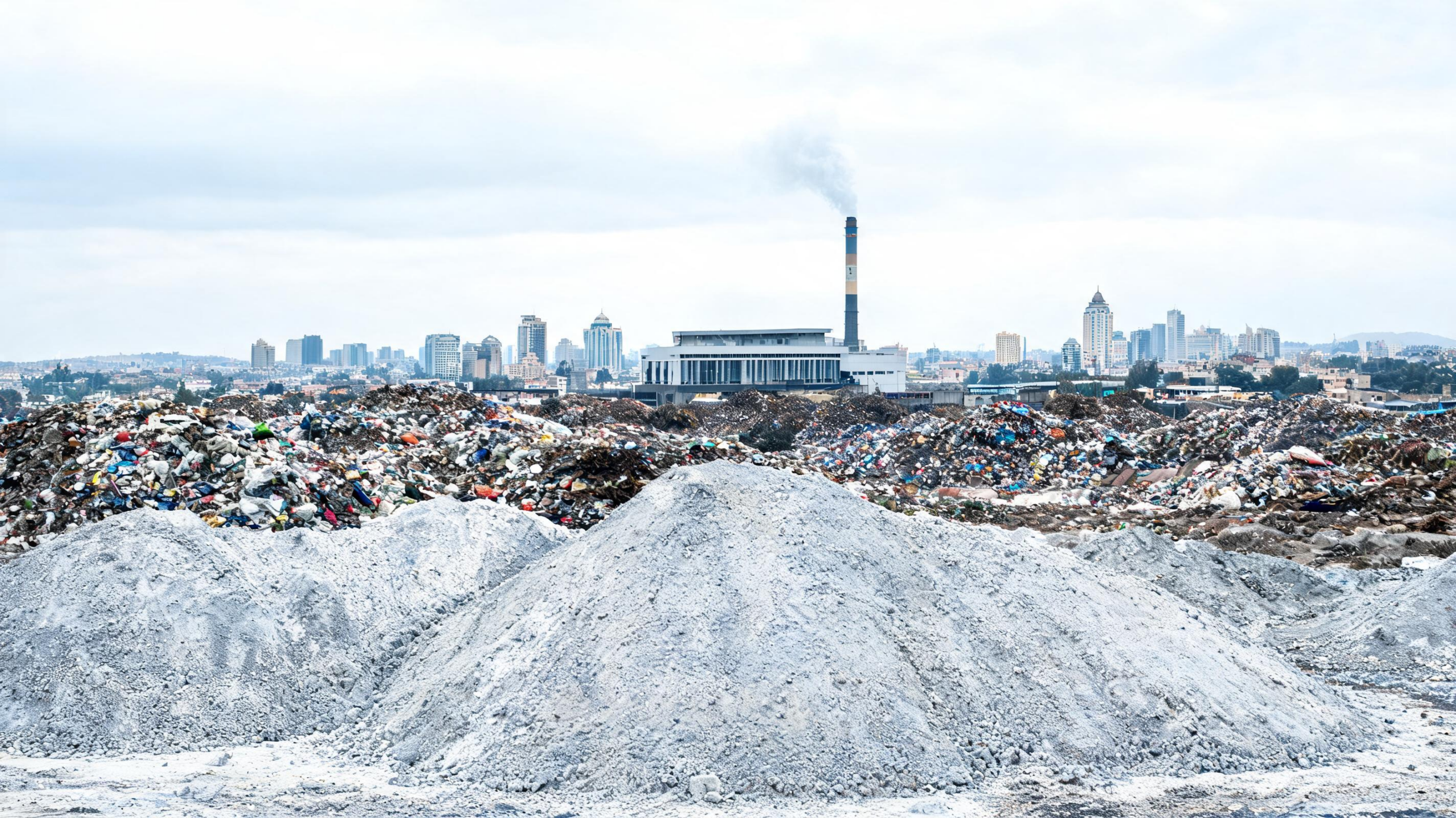
Waste-to-energy technology is often presented as a way to address two urban pressures at once: the growing volume of municipal refuse and the demand for electricity. But a study of ash and soil around Addis Ababa’s Reppe facility suggests that the environmental costs do not end when the furnace stops. Researchers report that ash deposited at the adjacent open dumpsite contains exceptionally high concentrations of mercury and cadmium, while nearby soils affected by leachate show substantial mercury enrichment. The findings, published in Discover Soil, identify the Reppe site as a serious ecological concern and highlight the risks created when combustion residues are managed without engineered containment. The study examined six metals—cadmium, chromium, copper, lead, zinc and mercury—in bottom ash, fly ash and surface soils. Its results point to a complex contamination pattern shaped by high-temperature combustion, mixed urban waste, atmospheric redistribution and the movement of leachate through the dumpsite. The authors argue that ash from waste-to-energy operations should not be treated as ordinary municipal waste when it contains mobile and highly toxic elements.
Reppe is located in the Kolfe Keraniyo Sub-city of Addis Ababa, where an open dumpsite established in 1964 has become surrounded by expanding residential communities. The site now receives ash from the nearby waste-to-energy plant, creating a direct connection between incineration residues and a long-used disposal area that lacks the engineered barriers found in a modern sanitary landfill. In such settings, rainfall can pass through waste and ash, producing leachate that dissolves or carries contaminants into surrounding soils and potentially toward groundwater. To investigate that pathway, the researchers collected three bottom-ash samples and three fly-ash samples from the plant’s ash-handling system, along with six surface-soil samples from a transect extending from the ash deposition zone toward the nearest residential area. The soil was sampled at depths of 0 to 15 centimetres, the biologically active surface layer most relevant to contact, dust and other exposure routes. Sampling took place during February and March 2024, the dry season, when rain-driven dilution was less likely to obscure contamination patterns.
In the laboratory, the team processed half-gram portions using United States Environmental Protection Agency Method 3050B, an acid-digestion procedure designed to release metals from soil and solid material before instrumental measurement. Chromium, copper, lead and zinc were measured with flame atomic absorption spectrophotometry; cadmium was measured with graphite-furnace atomic absorption, which is more sensitive at low concentrations; and mercury was analysed using a cold-vapour or hydride-generation approach. Each sample was analysed in triplicate. Quality-control procedures included certified reference materials, procedural blanks, daily calibration and replicate testing. Recoveries from the reference materials ranged from 92 to 105 per cent, while relative standard deviations were below 5 per cent. These checks indicate that the analytical procedures were precise for the samples tested, although the study’s conclusions remain limited by the small number of samples and the absence of a local uncontaminated reference soil. Instead, background values used in several calculations came from average upper-continental-crust concentrations, which may overestimate or underestimate enrichment at a particular Ethiopian site.
The most striking results came from the ash. The study reports mercury concentrations reaching 2,630 micrograms per litre and cadmium concentrations reaching 1,530 milligrams per litre in ash samples, with values varying substantially between locations and ash types. The reported mercury maximum was thousands of times higher than the comparison soil limit cited in the study, while the cadmium maximum was hundreds of times above the World Health Organization guideline used by the researchers. Because mercury and cadmium are toxic at relatively low concentrations and can be mobile under suitable chemical conditions, their presence in loosely managed ash is especially important. The study’s contamination-factor analysis identified mercury as the dominant contaminant, with ash values ranging from 12.9 to 65.8 times the chosen background. Cadmium showed moderate to severe enrichment, particularly in fly ash, whereas chromium, copper, lead and zinc generally displayed much lower contamination factors relative to the background used. The authors describe the resulting ash profile as mercury-dominated, followed by cadmium, with the other metals contributing less to enrichment.
The distinction between bottom ash and fly ash helps explain why combustion residues can concentrate particular contaminants. Bottom ash is the heavier material that remains in the furnace, while fly ash consists of finer particles carried with combustion gases and captured by pollution-control equipment. During incineration, volatile elements such as mercury and cadmium can enter the gas phase and later condense onto fine particles as the gases cool. Those particles may therefore carry a disproportionate share of certain metals. Statistical results from the Reppe ash samples support this interpretation. Principal-component analysis found that two components explained 94.5 per cent of the total variation. The first, accounting for 70.5 per cent, carried strong loadings for lead, cadmium and copper, a grouping the researchers associate with anthropogenic combustion sources such as mixed municipal waste, batteries and electronic materials. The second explained 24 per cent and was linked mainly to chromium and mercury, suggesting a combination of geochemical background and combustion-related behaviour. A strong positive correlation between lead and cadmium, reported as r = 0.91, further indicates that these elements may share a common source in the ash.
The risk calculations translate those concentrations into a broader ecological warning. The study’s total ecological-risk index for every ash sample fell between 1,086 and 3,000, well above the threshold of 600 classified as very high risk in the assessment framework. Mercury contributed more than 80 per cent of the total toxicity-unit values in the ash samples, reflecting both its measured concentration and its high toxic-response factor. Some bottom-ash samples had summed toxicity units above eight, while fly-ash values ranged from 2.93 to 4.88; the authors interpret these results as evidence that the material should be handled as hazardous waste rather than placed in an uncontained dump. The numbers are screening and assessment metrics, not direct measurements of human illness or exposure. They indicate the potential for ecological harm if contaminants are released, inhaled as dust, ingested or transported into water, but they do not by themselves establish the health risk to a particular resident. That distinction matters, especially because the study did not conduct biomonitoring, groundwater testing or epidemiological assessment.
Soils along the leachate-affected transect contained lower metal concentrations than the ash, yet mercury remained the dominant concern. Reported mercury values in the soil samples ranged from 205 to 1,015 micrograms per litre, and contamination factors ranged from 5.1 to 25.4 times the selected background. Three soil samples had ecological-risk indices at or above 600, placing them in the study’s very-high-risk category, while the full range for soils was 255 to 1,065. Cadmium was generally less enriched according to the contamination-factor analysis, and chromium, copper, lead and zinc were often near the chosen background values. However, correlations among chromium, copper and lead suggested that localized waste disposal or metal-bearing refuse had influenced parts of the transect. Mercury behaved differently: its inverse relationship with some of those metals and positive association with zinc were consistent with separate combustion and atmospheric-deposition pathways. The findings therefore do not describe a uniform plume. They show a heterogeneous site where some contaminants remain close to the ash source, while mercury may be redistributed through volatilization, condensation, leachate movement and re-emission.
Source-apportionment results estimated that anthropogenic inputs accounted for 58 per cent of the metal signal in ash and 38 per cent in leachate-impacted soil, with the remainder assigned to geogenic or mixed sources. Those percentages are model-based estimates rather than direct measurements of individual waste streams, and they depend on the background assumptions and the small dataset. Still, they reinforce the central message: the contamination cannot be explained solely by the natural composition of local soil. The authors recommend that ash, particularly fly ash exceeding hazardous-waste thresholds, be stabilized and disposed of in engineered facilities equipped with leachate collection rather than placed in the open dumpsite. They also call for groundwater monitoring, restricted access to high-risk areas, remediation of contamination hotspots and stronger national standards for waste-to-energy residues. Separating batteries, electronic waste and mercury-containing products before combustion could reduce the metals entering the ash. The study sampled a plant operating at less than half capacity, so contamination could differ with full operation or changes in the waste feedstock. Even with those limitations, the results offer a baseline for Addis Ababa and a broader warning: converting waste into energy does not eliminate hazardous elements, and the safety of the system depends on how its ash is contained after combustion.
The study’s dry-season design provides a snapshot of conditions when rainfall was unlikely to dilute surface contamination, but it cannot establish how concentrations change during wet periods. Seasonal sampling would help determine whether intensified runoff mobilizes metals beyond the sampled transect or instead redistributes them within the dump. Likewise, the six soil samples were selected purposively along visible leachate pathways, making them useful for identifying hotspots but unsuitable for estimating contamination across the entire dumpsite. Additional samples from uncontaminated soils, different depths and groundwater would improve comparisons and clarify whether metals are retained near the surface or migrating downward.
The reported measurements also require careful interpretation because the study expresses some ash and soil results in mass-per-volume units, whereas ash and soil are solid matrices. Direct comparison with soil guidelines therefore depends on the extraction and reporting basis used. Risk indices are valuable for prioritizing investigation, but they combine measured concentrations with toxicity factors and reference values; they are not substitutes for exposure measurements. Follow-up work could pair chemical testing with leachability experiments, dust monitoring and bioavailability analyses. Such evidence would show which fraction of the total metal burden can actually move into water, air or living organisms, helping regulators design controls proportionate to the site’s most plausible exposure pathways.
Subject of Research: Heavy-metal contamination in waste-to-energy ash and leachate-impacted soils
Article Title: Heavy metal contamination in thermal power plant ashes and leachate-impacted soils at Reppe dumpsite in Addis Ababa, Ethiopia
Article References: Tamene, M., Admassu, T., Alemayehu, T., & Mekonen, S. (2026). Heavy metal contamination in thermal power plant ashes and leachate-impacted soils at Reppe dumpsite in Addis Ababa, Ethiopia. Discover Soil, 3(1), Article 145. https://doi.org/10.1007/s44378-026-00291-0
Image Credits: AI Generated
DOI: 10.1007/s44378-026-00291-0
Keywords: heavy metals, mercury, cadmium, waste-to-energy, fly ash, leachate, soil contamination, ecological risk, Addis Ababa, Heavy, metal, contamination
Cite Scienmag News
Scienmag. (August 28, 2026). Waste-to-Energy Ash Raises Heavy-Metal Alarm at Addis Ababa Dumpsite. https://scienmag.com/waste-to-energy-ash-raises-heavy-metal-alarm-at-addis-ababa-dumpsite/
Scienmag. "Waste-to-Energy Ash Raises Heavy-Metal Alarm at Addis Ababa Dumpsite." Scienmag, 28 August 2026, https://scienmag.com/waste-to-energy-ash-raises-heavy-metal-alarm-at-addis-ababa-dumpsite/. Accessed 28 August 2026.
Scienmag. "Waste-to-Energy Ash Raises Heavy-Metal Alarm at Addis Ababa Dumpsite." Scienmag. August 28, 2026. https://scienmag.com/waste-to-energy-ash-raises-heavy-metal-alarm-at-addis-ababa-dumpsite/


