Earthquake damage is usually measured in lives disrupted, buildings condemned and repair bills accumulated. But every cracked column, shattered partition wall and replaced service system also carries an environmental cost, from the manufacture of new concrete and steel to the transport of debris and materials. A study published in the Bulletin of Earthquake Engineering proposes a way to estimate these economic and environmental consequences rapidly for a large class of existing reinforced-concrete buildings across Europe, without requiring a full component-by-component analysis of every structure.
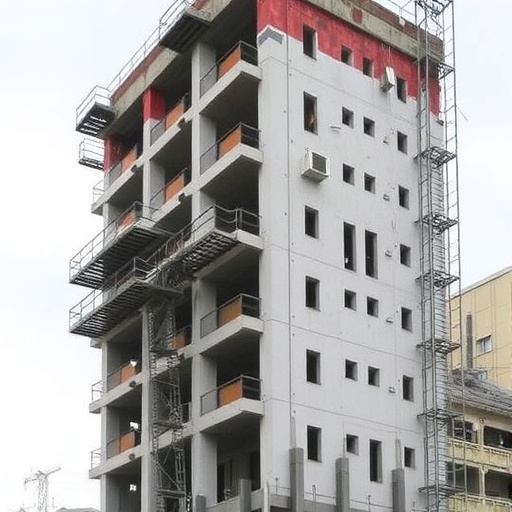
The method, developed by Rita Couto, Gianrocco Mucedero, Besim Yükselen, Rita Bento and Ricardo Monteiro, focuses on what the researchers call storey loss functions. These functions estimate the expected loss associated with each floor of a building as earthquake damage increases. Instead of modelling every beam, column, wall, pipe and electrical component individually, engineers can use a calibrated relationship between a building’s seismic response and the likely financial and environmental consequences on each storey. The approach is intended for poorly detailed reinforced-concrete buildings, a broad category that includes many older structures designed before modern seismic requirements became widespread.
The central insight is that earthquake loss is not distributed uniformly through a building. A floor with extensive masonry infill walls, damaged ceilings, heavily occupied rooms or vulnerable mechanical services may generate much greater repair costs than another floor, even when the primary concrete frame remains standing. Storey loss functions preserve this vertical resolution while reducing the computational burden of a detailed building assessment. They can identify which levels and component groups are likely to dominate total losses, helping analysts compare buildings and helping engineers target retrofitting where it may produce the greatest reduction in risk.
To construct the functions, the team combined several layers of earthquake-engineering information. First, they characterised representative reinforced-concrete building types and identified the structural and non-structural components that can be damaged by seismic shaking. They then used fragility curves to describe the probability that a component will reach a particular damage state as a function of an engineering demand parameter, such as interstorey drift. Drift is the relative horizontal displacement between two adjacent floors, usually expressed as a fraction of the storey height. It is a crucial indicator because excessive drift can crack infill walls, distort partitions, damage façades and overload connections even when the main frame avoids collapse.
A fragility curve converts that physical demand into a probability of damage. At low drift, a wall or service system may have a small chance of being damaged; as drift rises, the probability of slight, moderate or severe damage increases. The researchers linked those damage probabilities to consequence functions, which estimate what each damage state means in practical terms. For economic loss, the consequence may be the cost of labour, replacement materials, equipment and other repair activities. For environmental impact, it may include the impacts associated with producing, transporting and installing replacement materials, as well as removing and disposing of damaged components.
This combination allows a storey-level calculation to retain information about different types of damage. A reinforced-concrete column, a masonry infill wall, a gypsum partition, a façade element and a building service can respond very differently to the same earthquake demand. Their fragility functions may depend on different measures of shaking, and their repairs may involve very different quantities of material and labour. By disaggregating the results, the framework can reveal whether a building’s losses are driven mainly by structural repairs, non-structural damage or systems such as plumbing and electrical installations. That distinction matters because a building that is safe to occupy structurally may still be expensive, carbon-intensive or time-consuming to restore if its non-structural systems are extensively damaged.
The environmental side of the framework is particularly significant because seismic risk assessments have traditionally concentrated on monetary losses, casualties and downtime. Repairing or replacing damaged building components produces what researchers often describe as embodied environmental impacts: emissions and resource use associated with materials and construction processes rather than with a building’s day-to-day operation. Concrete replacement can require cement production, an energy-intensive process; steel repairs involve extraction and manufacturing; and widespread replacement of partitions, finishes and services can create large flows of waste. In this study, environmental impacts are integrated into the same damage-assessment chain as repair costs, making it possible to examine both consequences together rather than treating sustainability as a separate calculation.
The researchers developed generalised functions for poorly detailed reinforced-concrete buildings in Europe and also derived versions tailored to Portugal. The national adaptation does not require rebuilding the entire methodology from the ground up. Instead, it can incorporate country-specific cost conversion factors, repair practices and environmental-impact factors. Labour prices, material costs, construction methods, waste-management systems and the carbon intensity of energy can vary substantially between countries, so a function calibrated in one setting should not automatically be interpreted as a precise prediction elsewhere. The Portuguese functions demonstrate how regional data can refine a broader European model while preserving a common technical structure for comparison.
The study’s case example applied both the storey-based and component-based approaches to a reinforced-concrete building in Portugal. The comparison was designed to test whether the more compact storey functions could reproduce the essential patterns identified by a detailed analysis. According to the researchers, the exercise illustrates the applicability of the proposed framework, while also showing why the two methods serve different purposes. Component-level modelling can provide highly detailed information when a building has been surveyed extensively, but it demands substantial data and computational effort. Storey functions are less granular, yet they can support rapid screening, portfolio-scale risk assessment and early-stage retrofit planning when only limited information is available.
That scalability could make the method useful for cities and national agencies facing large inventories of ageing buildings. A regional seismic model may contain thousands or millions of structures, many of which lack complete drawings, material records or component inventories. Running a fully detailed nonlinear analysis for each one would be impractical. Storey loss functions offer a middle ground between crude building-wide averages and exhaustive simulations. They can be combined with seismic hazard models to estimate losses across a portfolio, compare the expected benefits of retrofit programmes and identify buildings where structural safety and environmental performance should be considered together.
The framework also fits into a broader shift in earthquake engineering toward performance-based assessment. Rather than asking only whether a building collapses, performance-based methods examine several possible damage states, from minor repairable damage to severe damage requiring replacement or demolition. Each state can be associated with consequences for cost, occupancy, functionality and environmental impact. This is important because most earthquake-related losses do not necessarily arise from complete structural collapse. Non-structural damage can interrupt building use, force occupants to relocate and generate substantial repair demand, particularly in residential buildings where walls, finishes and services make up a large portion of the total replacement effort.
The approach may also influence decisions about retrofitting. Strengthening an existing building can reduce the probability of severe earthquake damage, but retrofit work itself consumes materials, energy and money. A decision based only on structural performance might favour the intervention that produces the greatest increase in strength or ductility. A combined economic and environmental assessment can ask a more complicated question: which intervention produces the best balance between reduced future earthquake damage and the impacts created by construction today? The authors’ framework is not presented as an optimisation result for every building, but its ability to identify critical loss contributors could supply the information needed for such comparisons.
The researchers emphasise that the methodology is transferable, not universally fixed. Applying it to another seismic region requires fragility models that represent the local building stock, particularly the behaviour of poorly detailed reinforced-concrete frames and their infill walls. It also requires suitable data on repair costs, construction practices and environmental-impact factors. Regional differences in reinforcement details, masonry materials, workmanship, building layouts and seismic design history can all alter vulnerability. The functions should therefore be treated as generalised tools for estimation rather than substitutes for detailed inspection where safety-critical decisions depend on building-specific evidence.
Data generated and analysed in the study are available from the corresponding author on reasonable request. The work was carried out through research activities associated with CONSTRUCT, CERIS and the SERENE project, with additional support from Italian seismic-risk and building-renovation initiatives. By connecting the mechanics of earthquake damage to both financial and environmental consequences, the study offers a framework for a problem that is becoming harder to ignore: existing buildings must be made safer, but the materials and construction required to repair or strengthen them also affect the planet. Faster, storey-resolved estimates could help turn that trade-off into a measurable part of seismic planning rather than an afterthought discovered only after the ground stops shaking.
Cite Scienmag News
Eleanor C. (August 28, 2026). New Functions Assess Storey Losses and Environmental Impacts in Existing Reinforced-Concrete Buildings. Scienmag. https://scienmag.com/new-functions-assess-storey-losses-and-environmental-impacts-in-existing-reinforced-concrete-buildings/
Eleanor C. "New Functions Assess Storey Losses and Environmental Impacts in Existing Reinforced-Concrete Buildings." Scienmag, 28 August 2026, https://scienmag.com/new-functions-assess-storey-losses-and-environmental-impacts-in-existing-reinforced-concrete-buildings/. Accessed 28 August 2026.
Eleanor C. "New Functions Assess Storey Losses and Environmental Impacts in Existing Reinforced-Concrete Buildings." Scienmag. August 28, 2026. https://scienmag.com/new-functions-assess-storey-losses-and-environmental-impacts-in-existing-reinforced-concrete-buildings/