


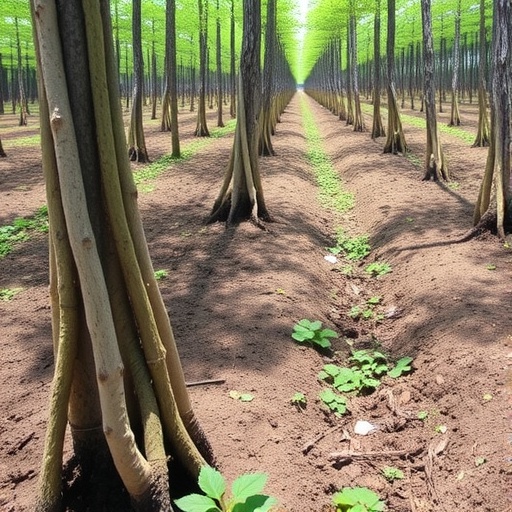
A forest can look orderly from a distance while functioning as a complex three-dimensional network beneath the canopy. Now, a study of poplar plantations suggests that the arrangement of trees may influence that hidden world of soil microbes, nutrients and enzymes—and that making a plantation more random is not necessarily better. The strongest soil responses emerged from an intermediate level of spatial randomness, rather than from the treatment with the greatest proportion of randomly arranged tree neighbourhoods. The finding challenges a simple assumption in ecological restoration: that plantations become more natural, and therefore more functional, as their structure becomes increasingly irregular.
The research, published in Plant and Soil, examined plantations of Populus × euramericana cultivar ‘74/76’ using a framework called the random structural unit. Each unit consists of one reference tree and its four nearest neighbours. Researchers assessed the angles formed between those neighbouring trees around the reference tree. A unit is classified as random when two consecutive angles are smaller than 72 degrees and two are 72 degrees or larger. The geometry can produce two contrasting patterns. In a “dumbbell” configuration, the smaller and larger angles alternate around the reference tree; in a “torch” configuration, the two smaller angles and the two larger angles occur in adjacent pairs. These patterns turn an abstract description of forest structure into a measurable spatial signature.
The team studied 15 plots divided among five plantation arrangements, with three plots representing each treatment. The control, designated CK, had no random structural units and represented a regular planting pattern. The other treatments contained random units at proportions of 80 percent, 75 percent, 60 percent and 63 percent, labelled HR, MHR, MR1 and MR2, respectively. HR, MHR and MR1 were dominated by dumbbell-shaped units, while MR2 was dominated by torch-shaped units. This design allowed the researchers to examine two questions at once: whether the amount of spatial randomness affects soil functioning, and whether the specific geometry of that randomness matters.
To determine how the different layouts influenced the soil ecosystem, the researchers measured nutrients, microbial biomass, enzyme activity and microbial community characteristics. Soil microbial biomass carbon served as an indicator of the living microbial pool—the bacteria, fungi and other microscopic organisms responsible for decomposing organic matter and transforming nutrients. They also calculated the microbial quotient, which relates microbial biomass carbon to total soil organic carbon and can indicate how much of the soil’s carbon is held in living microbial tissue. Enzymes provided a functional readout: protease helps break down proteins and release nitrogen-containing compounds, while alkaline phosphatase helps liberate phosphorus from organic molecules. Together, these measurements capture not only what is present in the soil, but what the soil’s biological community is doing.
The most pronounced integrated biological responses occurred in the two intermediate treatments, MR1 and MR2. Relative to the regular-pattern control, MR1 had higher microbial biomass carbon, a higher microbial quotient, and greater activities of protease and alkaline phosphatase. The result indicates that the MR1 arrangement supported both a larger or more active microbial community and stronger nutrient-processing capacity. Yet the treatment with the highest proportion of random units did not deliver an additional biological advantage. Increasing randomness beyond the intermediate range therefore appeared to produce diminishing returns, at least under the conditions represented by these poplar plots.
The researchers also found evidence linking soil chemistry to the microbial response. Phosphorus and potassium were associated with microbial biomass, suggesting that the availability or distribution of these nutrients helped shape the size of the soil microbial community. Bacterial richness and the relative presence of Acidobacteria were associated with microbial biomass and protease activity. Acidobacteria is a broad bacterial group frequently detected in soils, with members adapted to diverse conditions and involved in carbon and nutrient transformations. The study does not establish that these bacteria directly caused the enzyme changes, but the relationships point to a coordinated system in which tree arrangement, soil nutrients and microbial communities interact.
To analyse those relationships, the authors used redundancy analysis and partial least-squares structural equation modelling. Redundancy analysis is an ordination method that estimates how much variation in a community or response dataset can be related to measured environmental variables. Partial least-squares structural equation modelling, or PLS-SEM, is used to test networks of direct and indirect associations among several groups of variables, particularly when the data do not fit the assumptions required by conventional covariance-based models. In this study, the modelling associated random structural units with microbial biomass and connected enzyme activity indirectly through soil nutrients. The proposed pathway is biologically plausible: spatial arrangement alters local conditions such as light penetration, litter distribution, root activity and moisture, which can influence nutrients; those nutrients then affect microbial growth and enzyme production.
The researchers combined these indicators into a soil quality index, or SQI, designed to summarize several dimensions of soil functioning in a single assessment. SQIs typically integrate variables that represent chemical fertility and biological activity, often after standardizing measurements and assigning weights. Here, MR1 received the highest overall soil quality score, and its ranking remained strongest across different weighting approaches. The dumbbell-dominated treatment also had a higher SQI than the torch-dominated treatment, even though the overall composition of structural units differed between them. That comparison suggests that randomness alone is not the key ecological property: how random units are configured may influence the distribution of resources and biological activity within the stand.
The implications extend beyond one plantation experiment. Poplar plantations are widely used for timber production, ecological restoration and land rehabilitation, but regular spacing can simplify the vertical and horizontal structure of a forest. A more varied arrangement may create a mosaic of root zones, litter layers, canopy gaps and microclimates, giving soil organisms a wider range of habitats and substrates. The study suggests that managers should aim to optimize spatial heterogeneity rather than maximize it. However, the evidence comes from 15 plots within a plantation system and identifies associations rather than proving a universal causal rule. Longer-term experiments across soil types, climates, plantation ages and tree species will be needed to determine whether the intermediate optimum persists. Even so, the central message is strikingly simple: when designing forests to function more like natural ecosystems, the best pattern may lie between rigid order and complete disorder.
Cite Scienmag News
Rosalind W. (August 28, 2026). Varying Structural Diversity Enhances Soil Ecosystem Functions in Poplar Plantations. Scienmag. https://scienmag.com/varying-structural-diversity-enhances-soil-ecosystem-functions-in-poplar-plantations/
Rosalind W. "Varying Structural Diversity Enhances Soil Ecosystem Functions in Poplar Plantations." Scienmag, 28 August 2026, https://scienmag.com/varying-structural-diversity-enhances-soil-ecosystem-functions-in-poplar-plantations/. Accessed 28 August 2026.
Rosalind W. "Varying Structural Diversity Enhances Soil Ecosystem Functions in Poplar Plantations." Scienmag. August 28, 2026. https://scienmag.com/varying-structural-diversity-enhances-soil-ecosystem-functions-in-poplar-plantations/


