A small correction to a paper about waves and instabilities around the Moon has drawn attention to a deceptively important problem in space physics: a single misplaced figure can alter how readers interpret the behavior of plasma in one of the Solar System’s most unusual environments. The corrected publication, appearing in Astrophysics and Space Science, addresses an error in Figure 2 of a study examining how the interplanetary magnetic field influences the generation of two-stream instability during the interaction between the solar wind and the lunar plasma environment. The correction does not announce a new discovery or replace the study’s central analysis. Instead, it restores the appropriate visualization of the calculated growth rate and makes the published record consistent with the underlying work.
The paper, by Vipin K. Yadav of the Space Physics Laboratory at the Vikram Sarabhai Space Centre, Abhinav Singh of the Aryabhatta Research Institute of Observational Sciences, and Rajneesh Kumar of Banaras Hindu University, was published as a correction on 27 August 2026. The original article appeared on 14 August 2026. According to the notice, “a wrong figure was inserted as Fig. 2 in the publication.” The figure has now been corrected in the original article, while the initially published version is displayed in the correction for completeness and transparency. That approach allows readers to identify exactly what changed rather than silently replacing the erroneous image and leaving no visible record of the publication mistake.
The affected figure concerns the growth rate of a two-stream instability under several background magnetic-field strengths. Its panels correspond to magnetic-field values of 5, 10, 25 and 50 nanoteslas, increasing from the top panel to the bottom panel. Growth rate is a key quantity in plasma physics because it describes how quickly a small disturbance can amplify when the system is unstable. A positive and sufficiently large growth rate indicates that wave energy can increase rapidly, whereas a small or vanishing rate implies that perturbations grow slowly or remain effectively stable. In a theoretical plot, the shape and ordering of those curves can therefore determine how readers understand the influence of the magnetic field.
Two-stream instability arises when charged particles move through a plasma with different bulk velocities or when two particle populations have sufficiently distinct distributions. The relative streaming can transfer kinetic energy into electromagnetic or electrostatic waves. In the simplest idealized picture, a fast electron beam passing through a slower background population creates a resonance: particles moving at speeds related to the wave’s phase velocity can exchange energy with the wave. Under the right conditions, more energy flows from the particle streams into the disturbance than returns to the particles, allowing the wave amplitude to grow. In space plasmas, the actual situation is more complicated because particles are magnetized, the plasma may be tenuous and collisionless, and several wave modes can interact.
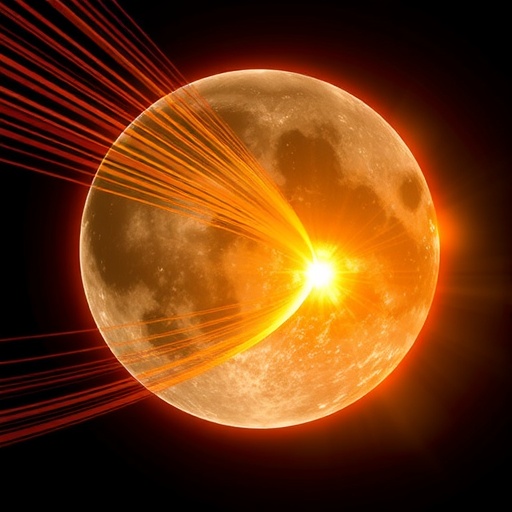
The Moon provides a particularly revealing setting for studying such processes. Unlike Earth, it has no globally sustained intrinsic magnetic field and lacks a dense atmosphere capable of forming a conventional ionosphere. As the solar wind sweeps past the lunar surface, the flow encounters an electrically absorbing body embedded in a magnetized, collisionless plasma. The solar wind consists primarily of electrons and protons moving outward from the Sun, carrying the interplanetary magnetic field with it. The Moon interrupts that flow, creating a wake on its nightside and producing sharp spatial changes in density, velocity and electric potential. Those gradients can separate particle populations and establish the conditions needed for kinetic plasma instabilities.
The interplanetary magnetic field, usually abbreviated IMF, is central to this interaction because it constrains the motion of charged particles. An ion or electron moving through a magnetic field experiences the Lorentz force, which bends its trajectory around magnetic field lines. The characteristic gyroradius depends on particle mass, charge, speed and field strength; increasing the magnetic-field magnitude generally reduces the gyroradius and makes the particle’s motion more tightly tied to the field. The magnetic field can therefore modify how solar-wind particles enter the lunar wake, how counterstreaming populations develop and which wave modes are permitted to grow. Comparing cases from 5 to 50 nanoteslas provides a way to explore how instability behavior changes across substantially different magnetic environments.
The correction matters because scientific figures are not merely decorative summaries. In a stability analysis, a plot often carries the practical meaning of an equation by showing how a calculated quantity changes as parameters vary. Researchers may compare the curves with spacecraft observations, use them to select conditions for numerical simulations or cite them when developing models of wave-particle interactions. If the wrong image is attached to the right caption, the surrounding text can appear internally consistent while readers are led toward an incorrect conclusion about parameter dependence. The error may be especially difficult to detect when the displayed figure contains plausible-looking curves and labels, which is why formal corrections are an important part of the scientific process.
For lunar science, understanding such instabilities has implications beyond a narrow theoretical question. Waves generated near the Moon can influence the redistribution of energy among electrons and ions, alter the structure of the lunar wake and affect the interpretation of measurements made by orbiting spacecraft. Wave activity can also serve as a diagnostic: instruments may detect fluctuating electric and magnetic fields and use their frequencies, wavelengths and propagation directions to infer the properties of otherwise invisible particle populations. During periods when the solar wind or IMF changes, the plasma environment may respond dynamically, making accurate models essential for distinguishing genuine physical variability from artifacts introduced by analysis or presentation.
The correction also highlights the growing importance of transparent publication practices in a field increasingly supported by complex calculations and high-volume spacecraft data. Plasma-instability studies commonly combine dispersion relations, numerical solutions and parameter scans in which small changes in density, temperature, drift velocity or magnetic-field strength can shift the unstable range. A figure may condense thousands of calculations into a few curves, but that compression makes careful verification critical. By preserving the incorrect Figure 2 alongside the corrected record, the authors and publisher provide a clear audit trail. Readers can see that the issue concerned the inserted figure, while the corrected version remains attached to the original paper rather than being treated as an entirely new investigation.
The published correction does not, on its own, establish that a stronger interplanetary magnetic field always suppresses or enhances the lunar two-stream instability; the notice identifies the affected growth-rate figure but does not restate the study’s full theoretical results. Its immediate contribution is more precise and more fundamental: it ensures that the visual evidence associated with the 5, 10, 25 and 50 nanotesla cases is the intended evidence. In a discipline where waves can emerge from subtle competition between particle streaming, magnetic confinement and spatial structure, that distinction is vital. The corrected record gives researchers a reliable basis for evaluating how solar-wind particles interact with the Moon and how instability-generated waves may shape the plasma wake behind it.
Cite Scienmag News
Wesley Brackenford. (August 28, 2026). Correction: Magnetic fields shape two-stream instability around Moon during solar wind interaction. Scienmag. https://scienmag.com/correction-magnetic-fields-shape-two-stream-instability-around-moon-during-solar-wind-interaction/
Wesley Brackenford. "Correction: Magnetic fields shape two-stream instability around Moon during solar wind interaction." Scienmag, 28 August 2026, https://scienmag.com/correction-magnetic-fields-shape-two-stream-instability-around-moon-during-solar-wind-interaction/. Accessed 28 August 2026.
Wesley Brackenford. "Correction: Magnetic fields shape two-stream instability around Moon during solar wind interaction." Scienmag. August 28, 2026. https://scienmag.com/correction-magnetic-fields-shape-two-stream-instability-around-moon-during-solar-wind-interaction/