

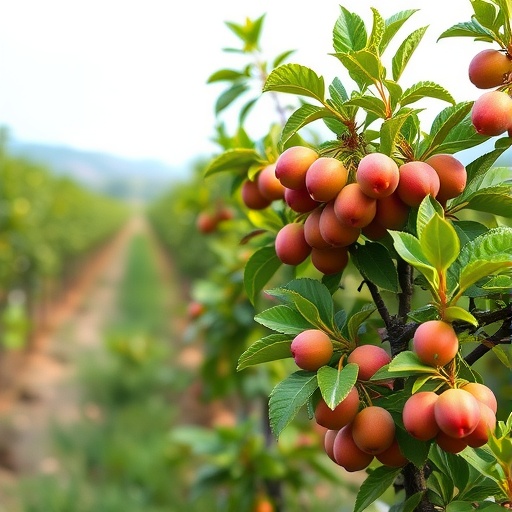
Japan’s fruit farms may need to make a radical change to survive climate change: stop growing the fruits they are known for and plant different ones instead. A new nationwide analysis suggests that switching orchards from apples, cherries, mandarins, persimmons and other traditional crops to varieties better suited to future conditions could generate major economic gains—but only if farmers choose the right crop, timing and scale. The study, examining 506 fruit-producing municipalities and 11 representative locations, found that there is no single adaptation plan that will work everywhere. In some regions, replacing nearly an entire orchard may maximize long-term income. In others, continuing to grow the current crop could remain the safest and most profitable choice for decades.
The research addresses a problem that is often overlooked in climate projections. Most agricultural studies focus on annual crops such as wheat, rice or maize, where farmers can change what they plant from one season to the next. Fruit trees are fundamentally different. An orchard is a long-term investment: trees require years of growth before producing a full harvest, and replacing them means paying for removal, replanting, labor and maintenance while receiving little or no income. The researchers therefore treated crop-switching as a form of “transformative adaptation”—a structural change to farming rather than a minor adjustment such as installing shade or adopting a new cultivar. Their model was designed to capture the financial shock of replanting as well as the potential rewards from growing a more climate-compatible fruit.
The team analyzed 10 major Japanese fruit crops: apples, satsuma mandarins, grapes, Japanese pears, kiwifruits, peaches, cherries, Japanese plums, Japanese apricots and persimmons. To estimate how climate change could affect yields through 2100, the researchers built generalized additive models, or GAMs, linking historical weather observations to annual crop production. GAMs are flexible statistical models that can reveal nonlinear relationships—for example, a crop may perform well as temperatures rise to a threshold, then suffer a steep decline beyond it. The analysis used historical yield records from 1993 to 2005 and meteorological information including daily mean temperature and solar radiation. Future projections were generated under three emissions pathways, from the relatively low-emissions SSP1-2.6 to the high-emissions SSP5-8.5, using five CMIP6 global climate models.
The researchers then converted projected yields into future farm income. For each crop and municipality, income was estimated from yield multiplied by national average selling prices, minus annual management costs. The calculations also included the cost of switching crops, set at 340,000 Japanese yen per 10 ares—equivalent to approximately 22,667 U.S. dollars per hectare at the exchange rate used in the study. The baseline analysis assumed that farmers received no subsidies for adaptation, making the estimate deliberately conservative. Newly planted trees were assumed to produce no harvest during a crop-specific nonproductive period lasting between two and six years. Once fruit production began, yields started at 20 percent of their eventual maximum and increased by 20 percentage points each year until reaching full capacity after five harvest years. This biological growth curve is crucial: a crop that looks highly profitable in the long run can still create severe short-term losses.
To reflect the competing priorities of real-world decision-makers, the model tested three strategies. The first, called total income prioritization, sought to maximize cumulative income between 2030 and 2100. The second, deficit-constrained prioritization, also pursued long-term gains but prohibited annual losses beyond a locally defined threshold. The third, short-term prioritization, optimized income only from 2030 to 2050. The model could select the replacement crop, the year of conversion and the area replanted. It imposed practical limits as well: no more than 25 percent of an orchard could be switched in a single year, only one switching event could begin in a given year, and no new event could take place during the following five years. These constraints mimic the labor, equipment and management limitations that make real orchards difficult to transform overnight.
Hirosaki in Aomori Prefecture, Japan’s leading apple-producing area, provided the clearest example of how dramatically the answer can change with the planning horizon. Under the long-term income-maximizing strategy, apples were progressively replaced by grapes and peaches. In the low-emissions SSP1-2.6 scenario, grapes alone became the preferred alternative, with 90 percent of the cumulative cultivation area switched by 2045 while 10 percent remained in apples. Under the intermediate and high-emissions scenarios, the model switched the entire area, with peaches taking as much as 40 percent under SSP5-8.5. The conversion caused four temporary income declines during the early transition, as replanting and immature trees interrupted production. Yet after the new orchards matured, annual income rose above that of continued apple cultivation, reaching approximately 3 million yen per hectare per year around 2055 before gradually declining toward the end of the century.
The result changed when the model was required to limit annual deficits. In Hirosaki, the deficit-constrained strategy capped a single-year loss at 200,000 yen. Instead of rapidly converting large blocks of apples, the model spread smaller planting events over a longer period. Switching was delayed, income variability during the 2030–2050 transition increased, and the full benefits of the new crops arrived later. This pattern illustrates a central dilemma of climate adaptation: the economically optimal decision over 70 years may be financially impossible for a farm that must pay its bills every year. A strategy that reduces immediate losses can also postpone the point at which a new orchard becomes productive, potentially increasing exposure to future climate risks. In contrast, the short-term strategy largely preserved apple production in Hirosaki, switching only about 20 percent of the area. Within a 20-year window, the initial costs and nonproductive period were not fully offset by later gains.
Across the 11 representative municipalities, the model found that grapes were a frequent source of early income growth, while peaches became more attractive as warming intensified or switching was delayed. In Hamamatsu and Shizuoka, where satsuma mandarins dominate, long-term and short-term plans often favored conversion to apples. But under deficit constraints, the model diversified the transition among apples, kiwifruit and peaches. Kiwifruit was especially useful when investment capacity was limited because its annual management cost was estimated at 2,911,337 yen per hectare and its nonproductive period was only two years. It was selected by five municipalities under the deficit-constrained strategy and three under the short-term strategy, although it was not chosen under the unrestricted long-term plan. The result suggests that the best crop is not necessarily the one with the highest ultimate income; a crop that begins producing sooner may be more valuable when cash flow is tight.
The most urgent cases were Higashine, where cherries are the main crop, and Minabe, known for Japanese apricots. In both municipalities, the yield of the current crop was projected to decline across all emissions scenarios and preference patterns, and switching the entire cultivated area was often necessary to maximize income. Gojo, a persimmon-producing municipality, also showed potential income gains exceeding 90 million yen from crop-switching, although its situation was more complicated. Persimmon yields were projected to decline under the lower and intermediate scenarios but increase under the highest-emissions scenario. The unusually large economic advantage of switching was partly linked to high management costs and an initial structural deficit in persimmon production, meaning that the result may be smaller if local prices and expenses differ from national averages. At the other end of the spectrum, Fuefuki’s grape farms appeared resilient: even a projected yield decline of about 5 percent under SSP5-8.5 did not make switching urgent because current grape production remained highly profitable.
The study also revealed a counterintuitive form of climate adaptation. In Hirosaki, Hirakawa, Suzaka and Fukushima, current-crop yields were projected to increase by more than 5 percent across the scenarios, yet switching could still produce substantial additional income under a long-term plan. These regions would not be adapting because their existing orchards were collapsing; they would be acting proactively to capture new economic opportunities. Under the short-term strategy, however, maintaining the current crop often maximized income, showing how strongly the planning horizon shapes the result. The authors emphasize that the projections are not prescriptions to immediately replace traditional orchards. The analysis does not fully include changing market prices caused by regional shifts in production, labor shortages, machinery and expertise, the economic lifespan of mature trees, cultivar-specific performance, or the cultural value of local brands. New fruits may also require unfamiliar distribution systems, processing facilities and consumer demand. The researchers conclude that climate-resilient fruit production will require flexible, locally tested plans—perhaps beginning with small experimental plantings—rather than an “all or nothing” decision to abandon established crops.
Cite Scienmag News
SCIENMAG. (August 28, 2026). Japanese Fruit Growers’ Crop-Switching Choices Reveal Climate-Adaptation Replanting Strategies. https://scienmag.com/japanese-fruit-growers-crop-switching-choices-reveal-climate-adaptation-replanting-strategies/
SCIENMAG. "Japanese Fruit Growers’ Crop-Switching Choices Reveal Climate-Adaptation Replanting Strategies." Scienmag, 28 August 2026, https://scienmag.com/japanese-fruit-growers-crop-switching-choices-reveal-climate-adaptation-replanting-strategies/. Accessed 28 August 2026.
SCIENMAG. "Japanese Fruit Growers’ Crop-Switching Choices Reveal Climate-Adaptation Replanting Strategies." Scienmag. August 28, 2026. https://scienmag.com/japanese-fruit-growers-crop-switching-choices-reveal-climate-adaptation-replanting-strategies/


