


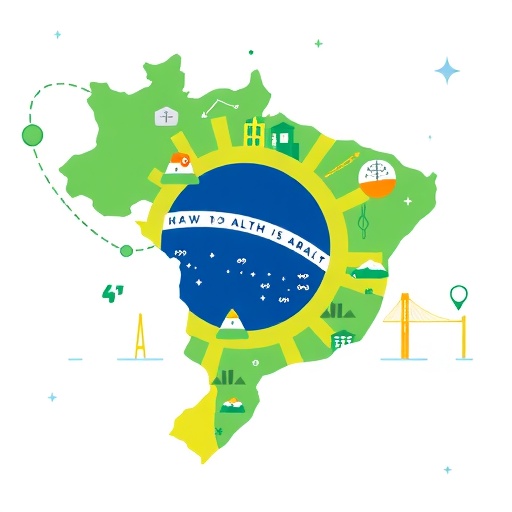
Brazil’s ambition to provide universal healthcare is running into a problem that cannot be solved inside hospitals alone: the condition of the roads, homes, schools, water systems and neighborhoods surrounding them. A scoping review of 68 studies has found that infrastructure is not merely a background feature of public health in Brazil—it actively determines who becomes sick, who reaches medical care and whether treatment can be delivered at all. The analysis, published in Global Health Research and Policy, describes an “Infrastructure-Health Nexus” in which sanitation, transportation, housing, educational facilities, healthcare buildings, electricity and waste management interact with social and institutional systems to shape health outcomes. The consequences are most severe for Indigenous, Black, rural, low-income and urban informal-settlement communities.
The findings are especially important because Brazil’s Unified Health System, known as SUS, is one of the world’s largest publicly organized healthcare systems. Created by the 1988 Federal Constitution, SUS is intended to provide universal access, equity and integrated care to roughly 200 million people. Yet universal coverage on paper does not guarantee that patients can physically reach a clinic, that a clinic has the equipment to treat them or that the surrounding environment is safe enough to prevent disease. The review argues that health policy and infrastructure policy have too often been planned as separate domains. In practice, however, an unpaved road can delay emergency care, contaminated water can drive infectious disease and overcrowded housing can amplify transmission before a patient ever enters the health system.
The researchers searched Scopus, Web of Science and PubMed for studies published primarily during the decade from 2013 onward, using English and Portuguese terms related to sanitation, transport, housing, schools, healthcare access, infectious disease, maternal health, vulnerable populations and Brazil. Their initial search returned 70,425 records. After removing studies outside the date, language and geographic criteria, as well as duplicates and non-article publications, 317 records underwent title and abstract screening. Eighty-two studies were assessed in full, and 68 passed the final quality evaluation. The team used the Critical Appraisal Skills Programme checklist to assess whether studies had clear aims, suitable designs, reliable data collection and sufficiently rigorous analysis. More than four-fifths of the included evidence focused on primary care, reflecting the importance of local infrastructure in prevention and community-level services.
The strongest signal concerned water, sanitation, drainage and waste. Between 1990 and 2015, improvements in basic sanitation in Brazil coincided with a dramatic fall in infant mortality, from 53.4 to 14.0 deaths per 1,000 live births. But the national average conceals large geographic and racial inequalities. In 2021, only 55.8 percent of the population had access to public sewage networks, and Black and Indigenous people represented 47 percent of those lacking sanitation. Approximately 35 million Brazilians were reported to lack access to safely treated water, while access in the North was far below that in the South. The biological pathway is direct: untreated sewage and unsafe water increase exposure to pathogens, while poor drainage and unmanaged waste create breeding conditions for disease vectors such as mosquitoes. The economic pathway is also significant; the review cites estimates that every US$1 invested in sanitation can save US$4.30 in health treatment costs.
Housing adds another layer of risk. Poor ventilation, crowding, inadequate construction materials and ineffective drainage can increase respiratory and infectious disease transmission, while dispersed rural housing can make routine and emergency care difficult to reach. In urban informal settlements, dense housing and exposed sewage combine environmental hazards with limited mobility. In remote Amazonian and Indigenous territories, communities may lack formal sanitation systems altogether. Research involving Guarani and Quilombola communities linked housing conditions to adverse maternal and child health outcomes, including conditions associated with undernutrition and impaired growth. Homelessness represents the most extreme form of housing insecurity. The review reports that the number of homeless families registered in Brazil’s social database rose from approximately 10,000 in 2012 to nearly 300,000 by 2024. Between 68 and 85 percent of homeless people were reported to experience mental health problems, while unstable housing also complicates medication storage, continuity of care and evacuation during emergencies.
Infrastructure determines not only exposure to illness but also the route to diagnosis and treatment. Brazil has striking imbalances in medical equipment: one analysis found a 700 percent excess supply of magnetic resonance imaging units in the Federal District, while four Northeastern states faced substantial shortages. Communities located more than 50 kilometers from major healthcare centers may lack dialysis machines, hospital beds and other essential equipment. In cities, patients in peripheral neighborhoods can face overcrowded buses, long journeys and unsafe walking routes to specialized facilities. In rural and Amazonian regions, roads may be unreliable or nonexistent, leaving rivers as transport corridors for patients and medical supplies. Telehealth networks and river transport have helped compensate for distance, but both depend on reliable electricity, communications infrastructure, maintenance and culturally appropriate services. A digital consultation cannot replace an ambulance, a functioning clinic or the specialist equipment required for complex chronic disease.
Transportation can also harm health directly. Studies from São Paulo found that people who depend on public transport may be exposed to black carbon and toxic metals, including chromium, inside bus terminals. The review describes carcinogenic risks associated with this exposure and cites evidence linking traffic density and nitrogen dioxide concentrations with respiratory cancer, particularly in areas with the lowest socioeconomic status. This creates a paradox: the same transport system that low-income residents need to reach work, education and healthcare may expose them to pollutants that increase disease risk. Infrastructure designed primarily for operational efficiency, rather than health protection, can therefore redistribute environmental hazards toward the populations with the fewest alternatives.
One of Brazil’s most notable responses has been to use human infrastructure to compensate for weaknesses in physical infrastructure. The More Doctors Program, launched in 2013, placed more than 14,000 physicians in over 3,800 municipalities, with 77.7 percent sent to priority or vulnerable areas. Studies included in the review found increases of 5.9 percent in medical appointments, 9.4 percent in consultations and 29.7 percent in home visits. The program reduced the number of municipalities experiencing physician shortages from 1,200 to 777, and participating municipalities recorded fewer hospitalizations for conditions that should normally be manageable through ambulatory primary care. A separate quasi-experimental analysis found that the program increased primary-care doctor density by 15.1 physicians per 100,000 people and was associated with an annual reduction in amenable mortality of 1.06 deaths per 100,000. Community health workers similarly extend care into neighborhoods where clinics are distant or facilities are incomplete.
But the review cautions that personnel cannot permanently substitute for buildings, equipment, roads and utilities. Community workers can identify illness, provide education and support treatment adherence, yet they cannot perform advanced imaging or dialysis in a settlement without the necessary material systems. The challenge is becoming more urgent as Brazil undergoes an epidemiological transition, in which chronic noncommunicable diseases coexist with infectious diseases. The country recorded 583,960 new cases of neglected tropical diseases between 2016 and 2020, often in areas with weak infrastructure, while dengue remains strongly linked to water storage and inadequate waste management. At the same time, diabetes, cardiovascular disease and cancer require long-term monitoring and specialist services. Telemedicine—including eConsults and telecardiology—can improve referrals and provide remote expertise, but its effectiveness depends on connectivity, power and local staff able to act on medical advice.
The third component of the proposed framework is community engagement, and here schools become unexpectedly powerful health infrastructure. Brazilian schools have hosted vaccination campaigns, health education, screening and oral-health programs. In one example, school-based HPV vaccination increased coverage from 16.1 percent to 50.5 percent by bringing healthcare workers, teachers and families into the same setting. Schools in Indigenous and traditional communities can also act as cultural intermediaries, helping combine local practices with biomedical services. Yet the benefits are uneven: urban schools generally have better buildings and resources, while rural schools may struggle to maintain basic facilities. Brazil’s health councils and conferences provide another institutional mechanism for participation, with councils structured to include community members, providers and managers. Indigenous Health Support Centers offer accommodation and care coordination, although standardized institutional procedures can reproduce power imbalances when they override cultural expectations. Taken together, the evidence suggests that Brazil’s health infrastructure must be planned as a connected system rather than a collection of isolated projects. Sanitation, housing, transport, schools, workforce programs, digital networks and clinics all influence the same health outcomes. The review identifies a persistent mismatch between constitutional commitments to universal health coverage and investment patterns that favor urban centers or fluctuate with political change. Infrastructure investment in Brazil has been estimated at less than 2 percent of gross domestic product, below the 5–7 percent reported for comparable economies, while federal sanitation budget execution fell from US$74.5 million in 2014 to US$24.4 million in 2023. The authors argue that major infrastructure decisions should include health-impact assessments and that targeted spending should prioritize sanitation, social housing and transport in underserved communities. The broader message is both simple and scientifically consequential: healthcare begins long before a patient enters a consultation room, and universal coverage cannot be achieved unless the systems that carry water, people, information and services are designed to carry health as well.
Cite Scienmag News
Courtney Benton. (August 27, 2026). Brazil’s Infrastructure-Health Connection: A Scoping Review. Scienmag. https://scienmag.com/brazils-infrastructure-health-connection-a-scoping-review/
Courtney Benton. "Brazil’s Infrastructure-Health Connection: A Scoping Review." Scienmag, 27 August 2026, https://scienmag.com/brazils-infrastructure-health-connection-a-scoping-review/. Accessed 3 September 2026.
Courtney Benton. "Brazil’s Infrastructure-Health Connection: A Scoping Review." Scienmag. August 27, 2026. https://scienmag.com/brazils-infrastructure-health-connection-a-scoping-review/


