

A Culture-Based Learning Experiment Gives Young Children’s Creativity a Significant Boost
A classroom experiment in Makassar, Indonesia, suggests that one of the most powerful tools for nurturing creativity in early childhood may be found not in expensive technology or specialized equipment, but in the cultural practices surrounding children every day. Researchers report that a project-based learning program built around local wisdom produced substantially higher creativity scores among five- and six-year-old children than conventional thematic instruction. The study, conducted at Nobel Playgroup & Kindergarten, involved 40 children and used a quasi-experimental pre-test and post-test design. After taking part in projects inspired by mutual cooperation, traditional arts and local culinary practices, children in the experimental group showed stronger gains in three widely studied dimensions of creativity: fluency, originality and flexibility. The difference between the groups was statistically significant, with an analysis of variance producing an F value of 47.512 and a probability value below 0.001. The finding points to a broader possibility for early education: children may generate more ideas when learning begins with the places, traditions and social relationships they already understand.
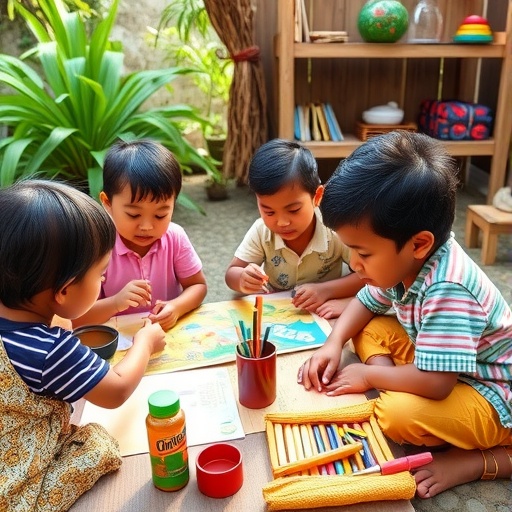
The researchers, led by Herman Herman of Universitas Negeri Makassar, designed the intervention around culturally responsive project-based learning. Project-based learning is a constructivist approach in which children develop understanding by investigating a question, making decisions, producing something tangible and reflecting on the result. Instead of receiving information in isolation, learners connect observation, conversation, experimentation and creation. In early childhood settings, this can involve drawing, building, role-play, storytelling, sorting, measuring or collaborating on a shared product. The culturally responsive element changes the starting point. Rather than treating culture as an occasional topic or decorative theme, the framework uses local knowledge as the raw material for inquiry. Children might explore how a traditional object is made, recreate a local pattern, investigate ingredients used in familiar food or work together according to the principle of gotong royong, an Indonesian value centered on mutual assistance. Such activities can make abstract learning tasks concrete while also signaling that children’s families and communities possess knowledge worth bringing into the classroom.
The 40 participants were divided into two groups of 20. Children in the experimental group engaged in project activities that incorporated local cultural resources and practices, while the control group followed conventional thematic learning aligned with the standard curriculum. Both groups were assessed before and after the learning period, allowing the researchers to examine changes rather than relying only on a single end-point comparison. The study did not use a fully randomized controlled trial, so it is described as quasi-experimental; this means that the groups were compared under planned conditions, but the available evidence does not establish that every child had an equal probability of assignment. Even so, the pre-test and post-test structure gives the researchers a way to estimate whether creativity changed during the intervention. The statistical analysis used ANOVA, a method that tests whether observed differences among group means are larger than would be expected from random variation within the groups. The reported result indicates a clear separation in creativity outcomes, although the study does not provide enough information in the published summary to calculate an independent effect size or determine how durable the gains were.
Creativity in young children is not a single ability, and the researchers examined several components. Fluency refers to the number of ideas or responses a child can produce. A child demonstrating fluency may suggest several uses for an object, generate multiple story endings or produce a series of different drawings. Originality concerns the novelty or uncommonness of those responses, while flexibility describes the ability to shift between categories, perspectives or strategies rather than repeating one type of solution. Elaboration involves adding detail, complexity or refinement to an initial idea. The culturally responsive project program significantly improved fluency, originality and flexibility, according to the study, but elaboration did not show a substantial change. That uneven pattern is scientifically important. It suggests that the program may have encouraged children to explore more possibilities and move between ideas without necessarily giving them enough time, instruction or developmental support to expand each idea in detail. Creativity interventions can therefore influence different cognitive behaviors at different rates, rather than producing a uniform improvement across every measure.
The apparent gains may be explained by several overlapping mechanisms. First, familiar cultural material can reduce the distance between classroom tasks and children’s lived experience. When an activity involves food prepared at home, an art form seen in the community or a social practice children recognize, they may begin with a larger store of relevant memories and concepts. In cognitive terms, those existing representations provide more associations that can be recombined into new ideas. Second, projects typically offer open-ended problems with more than one acceptable answer. This contrasts with tightly prescribed activities, where success may depend on reproducing a model. Open-endedness gives children opportunities to make choices, test alternatives and revise their work. Third, collaborative projects may stimulate creativity through social interaction. Children can observe peers’ approaches, borrow strategies, challenge assumptions and combine separate contributions into a shared outcome. Gotong royong is particularly compatible with this process because it frames cooperation as a meaningful community value rather than simply a classroom management technique. The result is a learning environment in which creative activity is both individual and collective.
The study also links creativity with cultural identity, arguing that local knowledge can support more than cognitive performance. Early childhood is a period when children develop ideas about who they are, where they belong and whose knowledge is valued. A curriculum that consistently presents distant or culturally unfamiliar examples as the main sources of legitimate knowledge may unintentionally position children’s own homes and communities as peripheral. By contrast, incorporating local practices can help children see their experiences reflected in formal education. This does not mean treating tradition as fixed or shielding it from critical examination. A strong culturally responsive curriculum can invite children to ask how practices work, how they have changed and how different families interpret them. In the Makassar study, traditional arts, culinary practices and cooperation were used as learning resources, creating opportunities for children to connect creative expression with community life. The researchers argue that this grounding makes learning more meaningful and may strengthen children’s cultural identity while supporting the broader developmental goals of early education.
The findings arrive amid growing interest in project-based approaches for young learners. Supporters argue that projects can integrate language, mathematics, science, motor development and social-emotional learning in a single extended investigation. A food-related project, for example, might involve naming ingredients, comparing quantities, predicting changes during cooking, drawing procedures, discussing family traditions and sharing responsibilities. An exploration of traditional art could combine pattern recognition, color mixing, fine-motor practice, storytelling and design. These connections are not merely thematic; they allow children to use knowledge across domains, a feature that researchers associate with deeper learning. Earlier studies cited by the authors have linked project-based learning with collaboration, communication, critical thinking and creativity in early childhood. The Makassar research adds a cultural dimension by suggesting that the effectiveness of projects may depend partly on the relevance of the materials and social practices chosen. A project is not automatically engaging because it is hands-on. Its power may increase when children recognize the subject as part of a living world beyond school.
At the same time, the results should not be interpreted as proof that local content alone causes creativity to rise. The sample was small, with only 40 children from one kindergarten, and the research took place in a specific Indonesian cultural and educational setting. Differences in teacher enthusiasm, classroom relationships, prior experience or group composition could have contributed to the outcome. Because the design was quasi-experimental, unmeasured differences between the groups cannot be ruled out. The available report also does not specify the length of the intervention, the precise creativity assessment used, or whether independent observers were blinded to group membership. Those details matter when evaluating the reliability and generalizability of educational research. The absence of a substantial improvement in elaboration further suggests that the intervention’s effects were selective. Larger studies across multiple schools and regions, with random assignment where feasible, standardized and culturally validated measures, follow-up assessments and detailed observations of classroom practice would help determine whether the gains persist and which elements of the framework are most responsible.
For educators, the research offers a practical principle rather than a universal lesson plan: begin with children’s worlds, then use projects to help them investigate those worlds in increasingly sophisticated ways. Teachers might invite families to share knowledge about local materials, celebrations, crafts, songs or food, while ensuring that participation remains inclusive for children from different backgrounds. Community members could serve as knowledgeable partners, and children could document what they learn through drawings, models, performances or explanations. The teacher’s role would be less about delivering a fixed answer than about posing productive questions, supplying materials, encouraging comparison and helping children articulate their reasoning. To support elaboration, which did not significantly improve in this study, teachers could add deliberate revision stages: asking children to explain how a creation works, identify missing details, make a second version or show someone else how to reproduce it. Such practices could transform cultural knowledge from a static classroom display into a platform for questioning, design and invention.
The researchers present their framework as a contribution to twenty-first-century early childhood education, where creativity, collaboration and cultural responsiveness are increasingly treated as interconnected goals. Their experiment does not show that every culturally grounded project will produce the same outcome, nor does it replace the need for carefully designed curricula and skilled teachers. It does, however, provide quantitative evidence that the cultural context of learning can be associated with measurable changes in how young children generate and vary ideas. In the Makassar classrooms, projects connected to mutual cooperation, traditional arts and local culinary life were followed by higher overall creativity outcomes than conventional thematic instruction, with the clearest improvements appearing in fluency, originality and flexibility. The message is unusually resonant for an era of globalized education: innovation does not always begin by moving children away from their communities. Sometimes it begins by giving them a richer opportunity to look closely at what is already there, ask new questions about it and imagine what it might become.


