


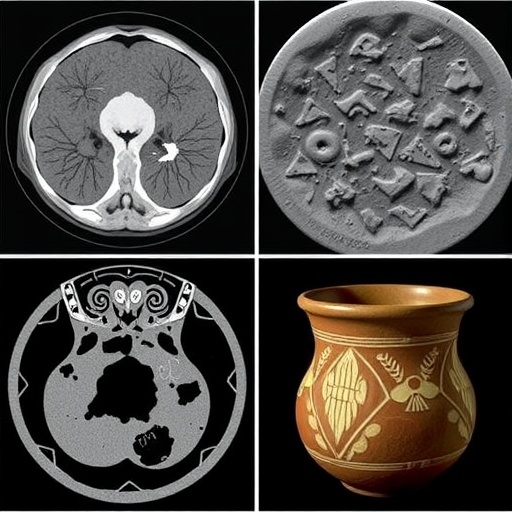
A pot can preserve far more than its contents. Long after its surface has been worn smooth and its original owner has disappeared, the vessel may retain a three-dimensional record of how it was built: the direction of tiny pores, the boundaries between masses of clay and the subtle distortions produced by pressing, joining and reshaping. A new study has used computed tomography to read that hidden record in pottery made by the Únětice culture, an Early Bronze Age society that flourished across parts of central Europe. The research reveals that potters in eastern Bohemia relied overwhelmingly on coiling, but that this shared tradition contained a surprisingly rich range of choices, particularly in the way different sections of a vessel were transformed during manufacture.
The Únětice culture occupied a broad region of central Europe during the third millennium BCE, a period associated with expanding exchange networks, changing social structures and increasingly specialized craft traditions. Eastern Bohemia, in what is now the Czech Republic, was one part of this cultural world. Archaeologists have traditionally classified its pottery by visible features such as shape, decoration and chronological style. Those features are valuable, but they do not necessarily reveal how a vessel was made or whether apparently similar pots were produced by the same people using the same techniques. The new study, by Richard Thér, Michaela Kosová and Eva Schimerová, instead focuses on the technological “chaîne opératoire”—the sequence of practical actions through which raw clay became a finished vessel.
The researchers examined vessels and fragments from four archaeological sites in the Hradec Králové region. The assemblage included material from both settlements and cemeteries, allowing the team to compare pottery used in everyday contexts with vessels deposited in graves. It also covered earlier and later phases of Únětice occupation in the region. That combination gave the study a microregional perspective: rather than treating the Únětice culture as a single, uniform technological entity, the researchers asked how pottery-making practices varied across nearby communities, through time and between different kinds of vessels. The central question was not simply whether a pot was a jar or another recognized type, but how its neck, middle body, lower body and base had been assembled and modified.
To investigate those choices without cutting into the archaeological objects, the team used X-ray computed tomography. CT scanning generates a series of radiographic slices that can be computationally combined into a three-dimensional volume. In medical imaging, the method distinguishes tissues of different density; in ceramics, it can reveal internal cracks, inclusions, voids and the boundaries between constructional units. Clay is not a perfectly homogeneous material. As a potter rolls, stacks, presses or stretches pieces of paste, the particles and empty spaces within the clay become oriented. Firing then fixes much of this structure in place. The resulting internal architecture can survive even when external traces of manufacture have been erased by smoothing or surface treatment.
A particularly important signal is the orientation of pores. When a clay coil is compressed or dragged, elongated voids may become preferentially aligned. In a CT dataset, the distribution and direction of those voids can be measured rather than judged only by eye. The study combined this pore-orientation analysis with structural evaluation based on virtual sections through the vessels. Instead of relying solely on conventional flat slices, the researchers used non-planar parallel sections that follow the curvature of the vessel wall, alongside radial sections extending through the wall. This approach helps distinguish the position of constructional segments from later deformation, making it easier to determine whether a structure represents an original coil, a slab or a heavily transformed mass of clay.
The results point to a dominant technological tradition. Coil building overwhelmingly accounts for the pottery examined, meaning that vessels were generally constructed by stacking or joining elongated strips of clay. Each coil could be added as a distinct unit, then pressed, stretched or blended into the growing wall. Slab building, in which broader pieces of clay are joined to form the vessel, was rare and was mainly associated with jars. The finding does not mean that every coil-built vessel was made in exactly the same way. On the contrary, most of the variation within the dominant tradition came from the degree to which the original segments were transformed. Some vessels preserved clearer traces of their constructional units, while others had been worked so extensively that the boundaries and orientations were partially reorganized.
The strongest differences appeared not between broad vessel types but between parts of the same vessel. Necks showed the clearest technological differentiation, suggesting that potters treated this narrow, structurally demanding zone in distinctive ways. A neck must connect the expanding shoulder or body to the rim while maintaining a stable opening, and its shape can be altered by pinching, drawing, adding or compressing clay. Middle bodies more often retained horizontally organized structures, consistent with the preservation of coil-related arrangements around the vessel’s circumference. Lower bodies frequently showed stronger transformation and greater continuity with the base, where the potter had to integrate the walls with the vessel’s supporting bottom and manage stresses that could lead to cracking during drying or firing.
That pattern has broader implications for how archaeologists interpret craft traditions. If analysis is organized only around complete vessel forms, important technological information may be lost. Two pots that look different may have been made through closely related procedures, while two vessels of the same type may contain different manufacturing histories. Treating the neck, mid-body, lower body and base as analytically meaningful units allows researchers to identify where potters made distinct decisions. Those decisions may reflect practical constraints, learned habits, workshop traditions or the interaction between individual skill and local conventions. The study therefore shifts attention away from the idea of a single, rigid “Únětice technique” and toward a shared repertoire of methods that potters adapted to particular vessel sections.
The findings also complicate assumptions about standardization and specialization in Bronze Age societies. Repeated use of coiling across the assemblage suggests a strong common technical foundation, but the internal variability indicates that uniformity of basic method did not eliminate individual or local choices. Differences in segment transformation may have emerged from training, the desired wall shape, the properties of the clay, the intended function of the vessel or the speed and order of construction. Because the sampled material came from both settlements and cemeteries and from different chronological phases, the study creates a framework for testing whether such choices were stable within communities or changed over time. It cannot, by itself, identify individual potters or prove the existence of specialized workshops, but it demonstrates that those questions can be approached through the internal structure of fired clay.
The researchers’ approach is also significant because it is non-destructive and digitally reproducible. The study’s supporting documentation, experimental reference data and analytical database are provided as supplementary materials, while the CT reconstructions, analytical outputs and three-dimensional shape data are openly available through the ArchaeoVault repository. That makes it possible for other researchers to inspect the evidence, compare analytical methods and build larger datasets across sites and regions. For a material as common as pottery, the payoff could be substantial: millions of fragments worldwide may preserve manufacturing information that is invisible on the surface. By combining medical-style imaging with archaeological knowledge of forming techniques, the new work turns ancient vessels into records of gesture, pressure and construction—evidence that the technological identity of a culture may be encoded not in what its pots look like, but in what lies inside them.
Cite Scienmag News
Courtney Benton. (August 27, 2026). CT Scans Reveal Diverse Pottery-Making Techniques in Early Bronze Age Bohemia. Scienmag. https://scienmag.com/ct-scans-reveal-diverse-pottery-making-techniques-in-early-bronze-age-bohemia/
Courtney Benton. "CT Scans Reveal Diverse Pottery-Making Techniques in Early Bronze Age Bohemia." Scienmag, 27 August 2026, https://scienmag.com/ct-scans-reveal-diverse-pottery-making-techniques-in-early-bronze-age-bohemia/. Accessed 3 September 2026.
Courtney Benton. "CT Scans Reveal Diverse Pottery-Making Techniques in Early Bronze Age Bohemia." Scienmag. August 27, 2026. https://scienmag.com/ct-scans-reveal-diverse-pottery-making-techniques-in-early-bronze-age-bohemia/


