

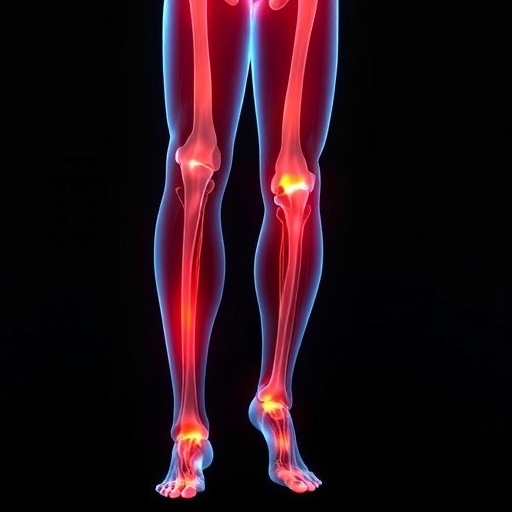
A Muscle Sensor May Offer an Early Warning of Dangerous Blood Clots After Orthopedic Surgery
Deep vein thrombosis, or DVT, often develops silently in the deep veins of the legs, where a clot can obstruct blood flow or break loose and travel to the lungs. Now, a small pilot study suggests that electrical signals recorded from a calf muscle could reveal physiological changes associated with the risk of postoperative venous congestion before conventional imaging confirms a thrombosis. The approach, described by researchers in South Korea, uses surface electromyography, or EMG, to monitor the medial gastrocnemius—the large calf muscle that helps push blood upward through the leg’s veins during movement. In one of eight patients considered at high risk of DVT after orthopedic surgery, the system generated an alarm one day before imaging identified a clot. The result is intriguing, but the signal appeared in the opposite leg, and the study was far too small to establish that EMG can diagnose DVT reliably.
The clinical problem is substantial because major orthopedic operations, particularly procedures involving the hip or knee, combine several risk factors for venous thromboembolism. Surgery can injure tissue and activate clotting pathways, while anesthesia, pain and immobilization reduce the muscle contractions that normally assist venous return. The calf muscles act as a biological pump: when they contract, they compress nearby veins and propel blood toward the heart, while valves help prevent backward flow. After surgery, this pump may become less effective, allowing blood to pool in the lower extremities. Sluggish flow, changes in the vessel wall and increased coagulation together create the conditions described by Virchow’s triad, the classic framework for thrombosis risk. DVT may cause swelling, pain, warmth or discoloration, but symptoms can be mild or absent. If part of the clot becomes a pulmonary embolus, it may impair blood flow through the lungs and become life-threatening.
The researchers reasoned that impaired venous drainage might alter not only blood-flow measurements but also the mechanical and electrical behavior of the muscles surrounding congested tissue. Their study examined eight people who had been diagnosed as being at high risk of DVT following orthopedic surgery. Surface electrodes were placed over the medial gastrocnemius to detect the tiny voltage changes produced when groups of muscle fibers activate. Unlike needle EMG, surface EMG is non-invasive and can potentially be incorporated into wearable monitoring systems. Participants were assessed while the muscle was relaxed, with recordings collected three to six times on different days. Repeated measurements were intended to capture postoperative changes over time rather than relying on a single snapshot. Such monitoring could, in principle, provide a continuous or regularly repeated physiological record during a period when patients may be unable to exercise normally and when clinical staff must watch for subtle complications.
An EMG signal does not measure a clot directly. It reflects the summed electrical activity of motor units—the functional groups consisting of a motor neuron and the muscle fibers it controls. The amplitude, frequency content and temporal pattern of that activity can change with muscle activation, fatigue, pain, swelling, altered tissue pressure and changes in the interaction between nerves and muscle. Venous congestion could influence these signals through several routes. Accumulating fluid may increase pressure within tissues, alter muscle stiffness and affect the distance or electrical properties between active fibers and electrodes. Swelling and discomfort may also change the way a patient involuntarily recruits the calf muscle, even when asked to remain relaxed. In addition, reduced venous return may be associated with broader neuromechanical disturbances. These possibilities make EMG a potentially sensitive indicator of abnormal limb physiology, but they also make it vulnerable to signals unrelated to thrombosis, including electrode movement, changes in posture, wound pain and ordinary day-to-day biological variation.
The study found a statistically significant negative relationship between the frequency of EMG-based alarms and two measures in the operated leg: peak volume velocity of venous return and elasticity. Peak volume velocity describes how quickly blood volume moves through the venous system at its maximum measured rate, providing an indication of the effectiveness of venous drainage. Elasticity, as used in the study, reflects mechanical properties of the limb or muscle tissues that may change with postoperative swelling and congestion. The negative correlations suggest that more frequent alarms tended to occur when venous return was slower and the tissue was less elastic. That pattern is consistent with the researchers’ hypothesis that abnormal EMG activity might track neuromechanical changes accompanying impaired circulation. Yet correlation does not establish causation. The data cannot determine whether the electrical changes arose from venous congestion, surgical recovery, altered muscle use or another factor that happened to vary alongside blood-flow measurements.
The most attention-grabbing observation involved a participant whose EMG alarm appeared one day before DVT was confirmed by imaging. The apparent early warning was not recorded in the leg where the thrombosis was later found, however, but in the contralateral limb. This mismatch complicates the interpretation. A system intended to identify the location of a clot would need to produce a signal that reliably corresponds to the affected extremity. Alternatively, the alarm might be detecting a systemic or compensatory response rather than a local clot, but the pilot study does not provide enough evidence to support that explanation. A second participant generated persistent alarms even though imaging found no thrombosis. This is a false-positive pattern, and it highlights the central challenge of translating a sensitive physiological monitor into a useful clinical test. In a hospital, frequent unexplained alerts could lead to additional scans, anxiety and unnecessary treatment, while an alarm that fails to appear when a clot is present could create dangerous reassurance.
The findings therefore represent a feasibility signal rather than a validated screening technology. Only eight people were studied, and the participants were already selected because they were at high risk after orthopedic surgery. The abstract does not establish the number or timing of confirmed DVT events needed to calculate sensitivity, specificity, positive predictive value or negative predictive value. Those metrics are essential for judging whether a monitor can distinguish patients who need urgent imaging from those experiencing normal postoperative changes. Imaging remains necessary to confirm DVT, commonly through techniques such as duplex ultrasonography, which visualizes blood flow and assesses whether a vein can be compressed. EMG cannot currently replace that diagnostic process. The authors explicitly caution that their work does not establish diagnostic accuracy and call for prospective validation. Larger studies will need repeated EMG recordings before and after surgery, standardized electrode placement, careful tracking of medications and mobility, and imaging performed according to a predefined schedule rather than only when symptoms arise.
Future versions could combine calf EMG with other non-invasive measurements, creating a multimodal system that is less dependent on any one biological signal. Pressure, skin temperature, limb circumference, ultrasound-derived flow, tissue stiffness and movement data could help distinguish a true circulatory abnormality from an artifact or a change in muscle recruitment. Machine-learning methods may then identify an individual’s postoperative baseline and flag deviations from it, rather than applying one threshold to every patient. That strategy is important because EMG varies naturally with age, body composition, electrode contact and muscle anatomy. Any automated system would also need rigorous testing across different operations, body types, rehabilitation schedules and levels of clotting risk. For now, the Korean team’s results offer a provocative glimpse of a wearable future in which the body’s electrical activity could provide an early warning of hidden vascular trouble. But the study’s strongest message is caution: a promising alarm is not yet a diagnosis, and only larger, carefully designed clinical trials can show whether muscle signals will genuinely improve the detection and prevention of postoperative DVT.


