

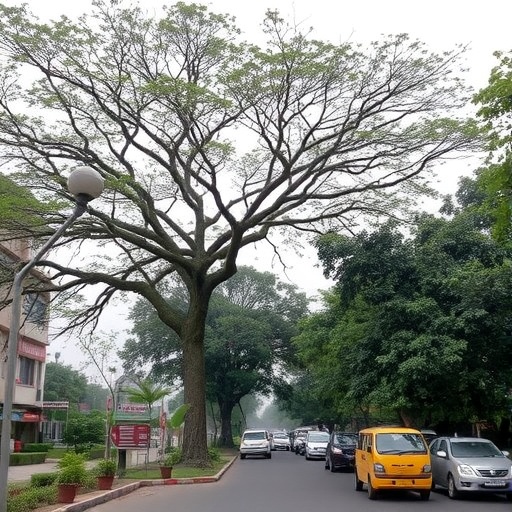
Trees planted along polluted city roads are often treated as a single solution to dirty air, but a study in Nagpur, India, suggests that the choice of species may determine whether an urban greenbelt becomes a useful pollution barrier or little more than decoration. Researchers have combined three measures of plant performance—Air Pollution Tolerance Index (APTI), dust capture capacity (DCC), and Anticipated Performance Index (API)—to identify trees that can both survive roadside stress and trap airborne particles. Their results point to a division of labor among urban trees: the species most capable of enduring pollution was not necessarily the one that captured the most dust.
The study, published in Air Quality, Atmosphere & Health, examined five tree species growing under roadside conditions in Nagpur, a rapidly developing city in Maharashtra where traffic, construction and urban expansion are contributing to deteriorating air quality. Roadside vegetation is exposed to a complex mixture of stressors. Exhaust gases can enter leaves through stomata, the microscopic pores that regulate gas exchange, while particles settle on leaf surfaces and may block light or interfere with stomatal function. Heat, limited soil moisture and repeated physical disturbance add to the burden. The researchers therefore assessed not only how much particulate matter leaves retained, but also how their internal physiology responded.
To estimate pollution tolerance, the team measured several biochemical and physiological traits used to calculate APTI. These included total chlorophyll, leaf-extract pH, relative water content and ascorbic acid concentration. Chlorophyll is essential for photosynthesis, and a decline in its concentration can indicate damage to the photosynthetic apparatus or reduced pigment production under stress. Relative water content reflects the hydration state of leaf tissue and its ability to maintain cellular function. Leaf pH can influence enzyme activity and the plant’s response to acidic pollutants, while ascorbic acid acts as an antioxidant that helps neutralize reactive oxygen species generated by pollution. Together, these variables provide a composite picture of how well a plant may withstand a contaminated environment.
The measurements revealed that roadside exposure altered the trees’ physiology. A two-way analysis of variance found significant effects of both site and species on total chlorophyll, leaf pH and relative water content, with probabilities below 0.001. The significant site-by-species interactions for chlorophyll and pH were especially important: they indicate that species did not respond identically to the same roadside conditions. Pollution and associated environmental stress could therefore not be represented by a universal effect across the urban forest. Some trees maintained more stable physiological characteristics, whereas others showed changes consistent with greater stress.
Overall, APTI values fell under roadside conditions, suggesting that pollution reduced physiological resilience across the trees examined. Yet the decline was not uniform. Pongamia pinnata recorded the highest polluted-site APTI, with a value of 8.0, while Lagerstroemia speciosa had the lowest value, 6.4. These numbers should not be interpreted as a direct measure of pollutant removal or as a universal ranking for every city. APTI is an index derived from plant traits, and its meaning depends on local climate, pollution composition, soil conditions and the particular species being tested. In Nagpur, however, the results identify Pongamia as the strongest physiological candidate among the trees studied.
The dust measurements told a different story. The researchers quantified DCC using a gravimetric method, weighing the particulate material retained on leaf surfaces after collection and processing. Ficus hispida captured the greatest amount, holding 1.26 milligrams of dust per square centimetre of leaf area. Leaf texture, hairiness, waxiness, surface roughness, orientation and canopy structure can all affect this capacity. Rough or complex surfaces create more opportunities for particles to adhere, while dense foliage can slow air movement and encourage deposition. The result is a form of passive filtration: leaves intercept some airborne material, although wind, rain and leaf movement can later redistribute or remove it.
The contrast between Pongamia pinnata and Ficus hispida exposed a central complication in designing pollution-fighting vegetation. A weak negative correlation was observed between APTI and DCC, with a correlation coefficient of −0.242 and a probability value of 0.090. In practical terms, trees that were more tolerant according to their internal biochemical traits did not necessarily retain more dust, and the relationship was not statistically strong. Survival and particle capture are distinct biological functions. A tree may protect its photosynthetic machinery effectively while presenting a relatively smooth leaf surface, whereas another may collect substantial dust but experience greater physiological stress as a result.
To combine these different qualities, the researchers used the Anticipated Performance Index. API extends the interpretation of APTI by incorporating additional characteristics relevant to urban planting and greenbelt performance. Such composite assessments can account for traits including growth form, canopy structure, evergreen or deciduous behavior and other practical features, rather than relying on a single biochemical score. In this analysis, Pongamia pinnata achieved the highest API score, followed by Ficus hispida. Both were categorized as good performers, while Tabebuia rosea recorded the lowest API performance. The ranking reinforces the idea that urban tree selection should be based on multiple functions rather than visual appeal or availability alone.
The findings do not suggest that planting trees can replace emission controls. Leaves can intercept particles, but they do not eliminate the sources of nitrogen oxides, sulfur dioxide, carbon monoxide or fine particulate matter, and vegetation may have complex effects on airflow in narrow streets. Dense canopies can sometimes reduce pollutant dispersion if poorly designed, while maintenance activities, resuspension of deposited dust and seasonal changes can alter the net benefit. The study also measured dust retained on leaves rather than directly demonstrating reductions in human exposure or ambient PM2.5 concentrations. A tree covered in particles is not automatically proof that nearby residents are breathing cleaner air.
Instead, the research offers city planners a more precise way to build layered green infrastructure. Species with high physiological tolerance could be positioned where pollution and heat are most intense, reducing the likelihood that a roadside planting will rapidly decline. Species with strong dust-capture characteristics could be incorporated into buffer zones, traffic dividers or vegetation barriers, provided they can remain healthy under local conditions. Mixing species may also reduce vulnerability to pests, drought and disease while combining complementary functions. The authors emphasize that such decisions should be adapted to pollution-affected areas, rather than copied unchanged from one city to another.
Nagpur’s roadside trees could also serve as living monitors of environmental stress. Changes in chlorophyll, leaf pH, water status and antioxidant chemistry can reveal that plants are being affected before visible injury becomes obvious. Repeated measurements across seasons and traffic environments could help distinguish the effects of exhaust emissions from those of drought, heat or poor soil. The authors acknowledge that the study’s data are available on reasonable request and that further work will be needed to connect leaf-level measurements with pollutant concentrations, canopy-scale removal and public-health outcomes.
The broader message is that a city’s greenbelt is a biological system, not a decorative strip of uniform foliage. Urban forests work through a combination of chemistry, physiology and physical structure, and their performance changes with species and location. In Nagpur, Pongamia pinnata emerged as the most promising all-round candidate according to the study’s combined index, while Ficus hispida distinguished itself as a highly effective dust collector. Using both kinds of evidence could help planners avoid a common mistake: choosing trees that look resilient or attractive without testing whether they can tolerate pollution, capture particles and continue growing. The most effective urban canopy may ultimately be one designed as carefully as an engineered air-filtration system.


