

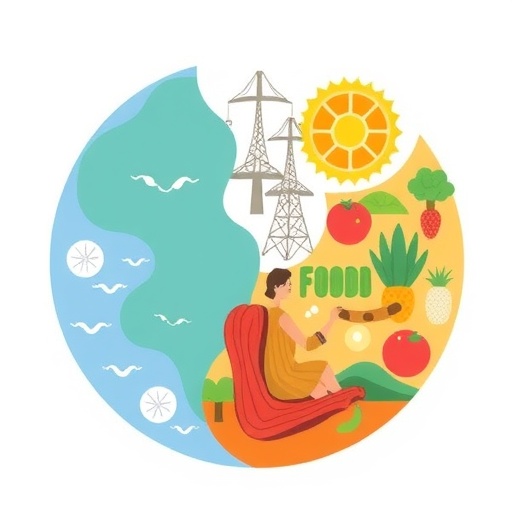
The Missing Human Dimension in Water, Energy and Food Science
A glass of water, a kilowatt-hour of electricity and a meal on a plate may appear to belong to separate worlds, yet they are bound together by a web of physical systems, institutions and everyday decisions. Water is needed to grow crops and generate power; energy is required to pump, treat and heat water; food production consumes both resources while shaping land use, pollution and household livelihoods. This interconnected system is known as the water–energy–food nexus, or WEF nexus, and researchers have spent more than a decade developing models to understand its trade-offs. A new review suggests that one crucial part of the system has remained comparatively underexamined: the human stories, political conflicts and social relationships that determine how resources are actually managed.
In a review published in the Journal of Environmental Studies and Sciences, J. Leah Jones-Crank and Aisha Al Masroori examined 211 research articles that used qualitative methods to investigate the WEF nexus. Their analysis found that qualitative research has increased over time, but still represents only a small share of the broader WEF literature. The authors argue that this imbalance matters because resource systems are not governed by equations alone. Decisions about dams, irrigation, energy infrastructure, food markets and household technologies are made by people with different forms of power, knowledge and access. Quantitative models can estimate flows and predict outcomes, but qualitative approaches can reveal why a technically attractive policy may be rejected, who benefits from an intervention, and whose costs remain invisible.
The WEF nexus emerged prominently in the early 2010s as an alternative to managing water, energy and food in isolated policy compartments. Traditional planning often treats each sector as a separate domain: water agencies focus on supply, energy authorities on generation, and agricultural departments on production. Yet changes in one sector can generate consequences elsewhere. Producing electricity from thermal power stations, for example, generally requires water for cooling, while water treatment and distribution consume energy. Expanding irrigation can increase food production but deplete groundwater and raise electricity demand for pumping. Biofuel crops may reduce dependence on fossil fuels while competing with food crops for arable land and water. Nexus analysis attempts to map these linkages and identify strategies that maximize co-benefits while limiting unintended trade-offs.
Much of that work has relied on quantitative tools, including life-cycle assessment, system-dynamics models, optimization algorithms, input–output analysis and scenario modelling. These techniques translate complex resource relationships into measurable variables such as water withdrawals, energy demand, crop yields, emissions and economic costs. A model might calculate how changing irrigation technology affects electricity consumption and agricultural output, or compare the environmental consequences of different urban wastewater systems. Such tools are essential for testing possible futures, but they require assumptions about how people and institutions behave. A model may represent water demand as a fixed number, for instance, without capturing informal access arrangements, distrust of authorities, cultural preferences or the unequal ability of households to respond to shortages.
Qualitative research approaches address those less visible dimensions by examining meaning, experience, behaviour and power. Interviews can document how farmers, utility managers, government officials or residents understand a resource problem. Focus groups can expose disagreements that would disappear in an average statistic. Ethnographic observation can show how households adapt when water supplies are intermittent or energy prices rise. Document and discourse analysis can trace how governments, companies and advocacy groups frame concepts such as “security,” “efficiency” or “sustainability.” Participatory mapping and mental modelling allow communities to represent relationships that formal datasets may overlook, while workshops, games and co-design exercises can help stakeholders explore competing strategies together.
The review by Jones-Crank and Al Masroori systematically identified both the ways researchers collected qualitative data and the methods they used to analyse it. It also categorized the purposes for which qualitative methods were applied. Across the literature, these approaches were used to understand stakeholder perspectives, explore social practices, examine governance arrangements, investigate narratives and identify relationships among sectors. Some studies focused on household-level experiences, such as cooking, diet, access to infrastructure and vulnerability. Others examined regional or transboundary systems, where water allocations, energy projects and agricultural policies cross administrative boundaries. Still others explored how collaboration is formed—or blocked—among organizations responsible for different parts of the nexus.
That emphasis on collaboration is particularly important because WEF systems are often fragmented across agencies and jurisdictions. A water authority may prioritize river flows for ecosystems or cities, while an energy agency supports hydropower, and agricultural interests demand irrigation security. Each institution may possess specialized data, legal responsibilities and technical language, creating what the authors describe as a need to understand social and political dynamics between nexus sectors. Qualitative methods can investigate how these institutional boundaries operate in practice. They can identify coordination failures, reveal conflicts over authority and show how apparently neutral indicators may favour one group’s objectives over another’s. In this sense, qualitative research does not simply add human interest to a technical assessment; it can change the definition of the problem itself.
The review also points to the importance of equity and participation. Communities affected by infrastructure projects or resource restrictions are not always represented in official planning processes, and the people with the least political influence may face the greatest exposure to shortages, pollution or rising costs. Participatory research can bring local knowledge into the design of scenarios, indicators and policy options, but participation is not automatically equitable. Meetings may privilege fluent speakers, technical experts or property owners, while women, renters, low-income households, Indigenous communities and informal workers remain unheard. The authors therefore call for more creative and participatory approaches that engage communities meaningfully rather than treating them as sources of information to be extracted.
The findings do not suggest that qualitative methods should replace quantitative analysis. Instead, the review supports combining the two. Interviews and participatory workshops can help define variables and relationships before a model is built; modelling can then test how those relationships behave under different scenarios. Results can be taken back to stakeholders for discussion, correction and refinement. This iterative process, sometimes described as knowledge co-production or mixed-methods research, can improve both scientific relevance and democratic accountability. A community may challenge a model’s assumption that households can easily switch appliances, for example, while a model may help stakeholders see how a local decision could affect resource flows across an entire region.
The authors conclude that WEF research needs a broader methodological balance, with greater attention to collaboration, political dynamics and the lived experience of resource insecurity. As climate change, urbanization and geopolitical disruption place additional pressure on water, energy and food systems, the consequences of poorly designed decisions are likely to spread across sectors. A new pipeline, power plant or irrigation scheme can create benefits in one location and burdens in another; an efficiency measure can reduce total consumption while making essential services less affordable for vulnerable households. Understanding those outcomes requires measurements, models and forecasts—but also careful listening. The review’s central message is that the nexus is not merely a network of physical resources. It is a social system, and its sustainability will depend on who gets to define the future and take part in building it.


