

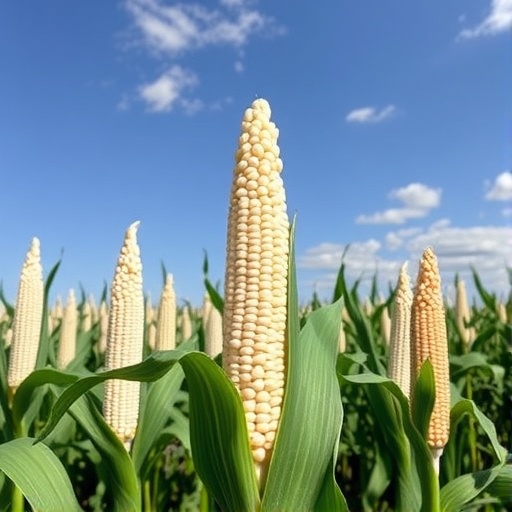
A new generation of maize seeds engineered for higher methionine content has shown an unexpected bonus: stronger early growth. In a study of biofortified maize inbred lines, researchers found that seeds carrying mutant versions of three genes not only accumulated substantially more of the essential amino acid methionine but also produced more vigorous seedlings, longer root systems and stronger antioxidant defenses. The findings suggest that improving the nutritional quality of maize kernels could also help crops establish themselves more reliably after planting—a potentially valuable trait as farmers contend with erratic rainfall, poor soils and increasingly stressful growing conditions. The work, published in 3 Biotech, is described by its authors as the first report linking kernel methionine accumulation with germination and seedling-vigour traits in maize.
The study focused on 18 biofortified maize inbreds developed through marker-assisted backcross breeding, a method that allows breeders to introduce a desired gene into an elite variety while retaining most of its original genetic background. The lines carried mutant alleles of floury2, known as fl2, delta zein regulator1, or dzr1, and aspartate kinase2, or ask2. These genes influence different parts of the biochemical and genetic machinery that determines how sulfur-containing amino acids and storage proteins accumulate in the maize kernel. The researchers compared the new lines with two original inbreds, PMI-PV5 and PMI-PV6, across three genetic backgrounds. On average, the introgressed lines retained 94.5 percent of the recurrent parent genome, indicating that the breeding process had changed a relatively small portion of the plants’ overall genetic makeup.
Methionine is an essential amino acid for humans and many animals, meaning it must be obtained from food because the body cannot synthesize enough of it. Conventional maize is often limited in methionine and other nutritionally important amino acids, despite being a major staple crop. In plants, methionine is part of the aspartate-family amino-acid pathway, a network that also contributes to the synthesis of lysine, threonine and isoleucine. It is also incorporated into storage proteins, including methionine-rich zeins in maize endosperm. The fl2 mutation affects alpha-zein accumulation and protein-body formation, dzr1 regulates methionine-rich delta-zein, and ask2 encodes an enzyme involved near the beginning of the pathway that supplies carbon skeletons for several amino acids. Altering these components can redirect how nitrogen and sulfur are stored inside the developing kernel.
The biochemical difference between the two groups was pronounced. Kernels from lines carrying fl2 accumulated an average of 0.354 percent methionine, while dzr1 lines averaged 0.342 percent and ask2 lines 0.260 percent. The original inbreds contained about 0.183 percent. These concentrations remain modest when expressed as a percentage of kernel mass, but they represent a substantial relative increase over the conventional backgrounds. More importantly for the researchers, the higher methionine levels were accompanied by measurable differences during the earliest stage of plant development. Germination percentage itself was almost identical: 97.43 percent in the introgressed lines compared with 97.50 percent in the original inbreds. The advantage appeared not in whether seeds germinated, but in how rapidly and robustly the resulting seedlings developed.
Seedling vigour is a broader measure than germination. It captures the speed and uniformity of emergence, the accumulation of seedling biomass and the ability of a young plant to develop roots and shoots quickly. The researchers calculated two vigour indices that combine germination performance with seedling growth. The first, VI-I, averaged 2,291.48 in the methionine-rich lines, compared with 1,838.82 in the original lines. The second, VI-II, was 106.16 in the introgressed material and 98.49 in the controls. Such measurements matter because a seed that germinates but produces a weak seedling may still fail to establish in the field. Rapid early growth can help maize reach light, access water and nutrients, and compete with weeds before environmental stress becomes severe.
The roots offered some of the clearest evidence of the difference. Methionine-rich introgression lines produced an average of 2.22 seminal roots, compared with 1.63 in the original inbreds. Their total root length averaged 28.28 centimetres, versus 20.88 centimetres in the controls. Seminal roots are among the first roots to emerge from a maize seed, anchoring the seedling and exploring the surrounding soil while the plant’s later crown-root system is still developing. A larger early root system can increase the surface area available for water and mineral uptake, although the benefits in mature plants would need to be tested under field conditions. The researchers observed only a minor influence from the broader background genome, suggesting that the relationship between the mutant loci, methionine accumulation and early vigour was relatively consistent across the genetic backgrounds examined.
The study also examined electrical conductivity, a common physiological indicator of seed quality and membrane integrity. When seeds absorb water, damaged cell membranes leak electrolytes into the surrounding solution, increasing its electrical conductivity. Lower conductivity generally indicates that membranes have remained more intact during storage and imbibition. The methionine-rich lines recorded an average conductivity of 7.01 microsiemens per centimetre per gram, compared with 7.77 in the original inbreds. The difference was accompanied by a marked increase in antioxidant enzyme activity. Superoxide dismutase, or SOD, averaged 59.85 units per milligram of protein in the introgressed lines, more than twice the 27.09 units measured in the controls. Peroxidase activity reached 1.90 micromoles per millilitre per gram of dry weight, compared with 0.51 in the original material.
These enzymes are central to the seed’s response to oxidative stress. Germination is metabolically demanding: as a dry seed takes up water, respiration resumes, mitochondria become active and reactive oxygen species are generated. At controlled levels, these molecules act as signals that help coordinate germination. At excessive levels, they can oxidize membrane lipids, proteins and nucleic acids, damaging the machinery required for growth. SOD converts the highly reactive superoxide radical into hydrogen peroxide, which is then processed by enzymes such as peroxidase. The higher enzyme activities observed in the biofortified lines may therefore help seedlings keep reactive oxygen species within a manageable range. Their lower electrolyte leakage is consistent with better membrane stability, although the experiments do not establish that methionine directly caused every biochemical change.
Statistical analysis supported a connection between kernel methionine and several early-growth traits, but the relationships were moderate rather than overwhelming. Methionine content showed positive correlations with VI-I, with a correlation coefficient of 0.39, and VI-II, at 0.42. It was also positively associated with total root length at 0.38, SOD activity at 0.24 and peroxidase activity at 0.32. Electrical conductivity showed a negative correlation of –0.31 with methionine, meaning that higher methionine tended to occur alongside lower leakage. Correlation does not prove a direct molecular mechanism, and the researchers acknowledge that several linked genetic and metabolic effects could contribute. The mutant genes may alter storage proteins, sulfur allocation, redox balance or the mobilization of reserves during germination, with methionine acting as one marker of a broader physiological state rather than the sole driver of vigorous growth.
The results nevertheless point to a promising direction for maize improvement. Breeding programs have traditionally treated nutritional enhancement and agronomic performance as separate goals, and some quality traits can reduce seed performance if they alter starch, protein bodies or reserve mobilization in unfavorable ways. The new findings suggest that selected high-methionine alleles can improve nutritional value without lowering germination, while also supporting stronger early root and seedling development. The lines were created by conventional crossing and marker-assisted selection rather than by transgenic modification, and the study provides a set of candidate materials for further testing. Before farmers can benefit, however, the traits will need validation across soils, temperatures, moisture regimes, storage periods and field environments. If the advantage persists beyond controlled seedling tests, methionine biofortification could offer a rare double dividend: maize kernels with improved nutritional quality and seedlings better equipped to get a fast start.


