


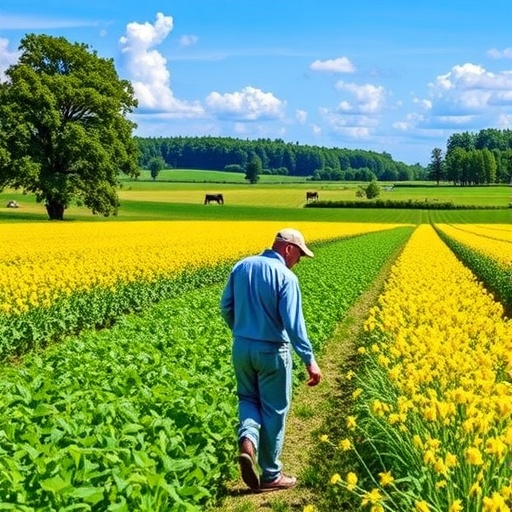
A new study of Iowa farmers is offering one of the clearest statistical portraits yet of who participates in the United States’ Conservation Reserve Program—and why. The analysis suggests that the strongest factor associated with enrollment is not simply a farmer’s income, environmental attitudes, or access to government programs, but the physical character of the land itself. Farms with steeper terrain were dramatically more likely to contain land enrolled in CRP, while technical assistance, conservation cost-share payments, farm size, education, and participation in watershed groups also showed important associations. The findings arrive as Congress considers how to reauthorize and redesign the program, which is the largest federal initiative devoted to conservation on privately owned agricultural land.
Established in the 1985 Farm Bill, CRP pays farmers and landowners to remove environmentally sensitive acreage from commodity production and establish long-term vegetative cover. Contracts generally last 10 to 15 years, during which enrolled fields may be planted with grasses, trees, wetlands, or other conservation vegetation. The program is designed to reduce soil erosion, improve water quality, store carbon, and create habitat for wildlife and pollinators. According to U.S. Department of Agriculture estimates cited in the study, CRP conservation practices enrolled in fiscal year 2021 prevented approximately 161 million kilograms of nitrogen, 32 million kilograms of phosphorus, and 136 million metric tons of sediment from entering waterways. The same practices were estimated to mitigate more than 12 million metric tons of carbon dioxide equivalent.
Despite those benefits, CRP enrollment has remained below its authorized ceiling for more than a decade. The program reached a high point of approximately 14.9 million hectares in 2007, but enrollment later fell as commodity prices rose and farmers faced stronger financial incentives to return conservation land to production. By the end of 2023, about 10 million hectares were enrolled nationally, roughly 1 million hectares below the program’s cap. The decline matters because land leaving CRP can rapidly become cropland again. Earlier studies found that large portions of expired contracts in the Midwest were converted to row-crop agriculture, particularly in areas where corn and soybean production is highly profitable. The new research therefore focuses on a central policy question: what characteristics make farmers more likely to participate voluntarily?
The researchers analyzed responses from the Iowa Nutrient Reduction Strategy Survey, conducted between 2015 and 2019. The survey was sent to 14,139 Iowa farmers and received 6,006 completed responses, producing a response rate of 42 percent. Participants were row-crop producers operating at least 60 hectares, a group that represents approximately half of Iowa’s farmers but manages about 90 percent of the state’s farmland. After incomplete responses were removed, the statistical analysis included 3,151 farmers. About one-third of those respondents reported that some of their land was enrolled in CRP. The researchers then used binary logistic regression, a statistical technique designed to estimate how multiple factors are associated with the probability of a yes-or-no outcome—in this case, whether a farmer reported CRP participation.
The model included 28 variables covering social, economic, and ecological characteristics. These included age, education, gender, crop and pasture acreage, farm sales, rented land, livestock ownership, water-body proximity, average field slope, nutrient-management planning, conservation attitudes, perceived economic and agronomic capacity, information sources, technical assistance, cost-share participation, and watershed-group involvement. The analysis also controlled for survey year and used the Benjamini-Hochberg procedure to limit false discoveries caused by testing many variables simultaneously. The overall model was statistically significant and produced a Nagelkerke R² of 63 percent, a measure suggesting that the variables collectively accounted for a substantial share of the observed variation in reported enrollment. After the multiple-testing correction, 13 variables remained significant predictors.
Mean percent slope emerged as the most powerful factor. The researchers found that a one-unit increase in average farm slope was associated with approximately a threefold increase in the odds of CRP enrollment. In practical terms, a farmer whose land fell at the 75th percentile of the slope distribution had a predicted enrollment probability of 50.3 percent, even when the other characteristics in the model were held at their average values. The finding is consistent with the program’s purpose: steep cropland is often more vulnerable to erosion, more difficult to farm efficiently, and potentially less profitable than flatter fields. However, the researchers caution that slope should not be interpreted as a direct cause of enrollment. It may also represent several unmeasured features, including soil productivity, erosion history, highly erodible land classifications, production risk, expected yields, rental rates, and farmers’ perceptions of marginal land.
Several forms of support were also associated with participation. Farmers who had received technical assistance from nongovernmental organizations were 88 percent more likely, in odds terms, to report CRP enrollment. Those who had received cost-share assistance for conservation practices had 65 percent higher odds of participation. Involvement in watershed-management groups was associated with a 42 percent increase in the odds, while access to public information sources—such as Iowa State University Extension, the Natural Resources Conservation Service, or another government agency—was associated with a 17 percent increase for each additional public source reported. These results suggest that conservation information may be most influential when it is translated into specific, trusted, locally relevant advice. Online maps and soil databases may identify eligible or environmentally valuable land, but farmers may still need advisers, watershed groups, or community networks to turn that information into an actionable enrollment decision.
Economic and personal characteristics added further detail to the pattern. Cropland area was positively associated with participation: the study reports that a one-unit increase in crop area, measured in hectares, corresponded to a 47 percent increase in the odds of enrollment. Farmers with CRP land operated an average of 350 hectares, compared with 299 hectares among those without reported enrollment. Larger operations may be better able to place a portion of their acreage into a long-term conservation contract while retaining enough land in production to manage financial and yield risks. Education was also positively associated with enrollment, with each additional unit of education corresponding to an 18 percent increase in the odds. Age had a smaller positive effect, with each additional year associated with an approximately 3 percent increase. A more favorable attitude toward nutrient retention, and higher reported agronomic capacity—or, in the study’s wording, a greater perceived lack of agronomic capacity—were also positively associated with participation.
The analysis identified two notable negative relationships. Farmers with more pasture acreage were less likely to report CRP enrollment, with each additional unit of pasture associated with an 18 percent decrease in the odds. A higher proportion of rented cropland was also associated with lower participation: each percentage-point increase in rented cropland corresponded to an approximately 1 percent reduction in the odds. On average, CRP participants rented 37.6 percent of the land they farmed, compared with 53.1 percent among nonparticipants. Tenants may face eligibility restrictions, shorter planning horizons, or less authority to make long-term land-use decisions. Pasture-based producers may also place greater value on haying, grazing, livestock flexibility, and family farming traditions than on retiring land from production. Other variables, including gross farm sales, livestock ownership, cropland bordering water, perceived economic capacity, gender, and the influence of specific stakeholder groups, were not statistically significant in the final analysis.
The researchers used predicted probabilities to show why statistical significance does not always translate into a decisive real-world effect. A farmer with average characteristics across all predictors had an estimated 21.6 percent probability of enrolling in CRP. Technical assistance from a nongovernmental organization combined with cost-share support raised that probability to 39 percent, still below the point at which enrollment would be more likely than non-enrollment. But when high slope and larger cropland area were combined with both forms of support, the predicted probability climbed to 75 percent. A farmer with low slope, a smaller operation, no nongovernmental technical assistance, and no cost-share had an estimated probability of only 1.9 percent. The pattern indicates that financial and advisory interventions may work best when directed toward land that already has strong ecological or production-related reasons for entering conservation.
The study’s authors emphasize that the findings are associative, not causal. Because the data came from an observational survey, the analysis cannot prove that technical assistance, cost-share, or watershed participation directly caused farmers to enroll. Farmers who seek advice or join conservation groups may already be more conservation-oriented, more familiar with CRP, or more likely to own environmentally sensitive land. The study is also geographically limited to Iowa row-crop producers operating at least 60 hectares, so its results may not apply equally to small farms, tenant farmers, historically underserved producers, ranchers, or other regions. The survey did not distinguish among General CRP, Continuous CRP, and Grassland CRP, which have different eligibility rules and management requirements. Even with those limitations, the results offer a timely blueprint for policy. The authors recommend targeting outreach and technical assistance toward farms identified through slope, soil, and erosion data; strengthening watershed-level peer learning; improving flexibility in contracts; considering smaller or shorter-term enrollment pathways; and reassessing restrictions that reduce the program’s appeal to haying and grazing operations. As lawmakers debate the future of CRP, the message from Iowa is strikingly clear: conservation incentives may be most effective when they are matched to the landscape—and delivered through trusted local relationships.
Cite Scienmag News
Margaret Porter. (August 26, 2026). What Drives Farmers to Join the U.S. Conservation Reserve Program? Scienmag. https://scienmag.com/what-drives-farmers-to-join-the-u-s-conservation-reserve-program/
Margaret Porter. "What Drives Farmers to Join the U.S. Conservation Reserve Program?" Scienmag, 26 August 2026, https://scienmag.com/what-drives-farmers-to-join-the-u-s-conservation-reserve-program/. Accessed 3 September 2026.
Margaret Porter. "What Drives Farmers to Join the U.S. Conservation Reserve Program?" Scienmag. August 26, 2026. https://scienmag.com/what-drives-farmers-to-join-the-u-s-conservation-reserve-program/


