


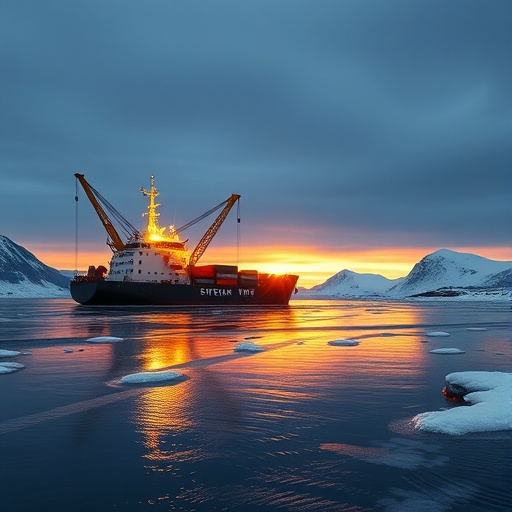
The Arctic is opening a new maritime frontier, and with it comes a high-stakes climate calculation: how much economic value can be extracted from shorter shipping routes before their environmental costs outweigh the gains? A new global assessment finds that Arctic transit shipping could save companies time and money by cutting voyage distances between selected ports, but the same activity would release black carbon, a powerful short-lived climate pollutant that can accelerate the melting of snow and sea ice. The study, published in Nature Sustainability, evaluates the commercial potential and climate consequences of Arctic shipping through 2050, revealing a trade-off that could shape the future of international trade in a rapidly warming region.
Researchers assessed 295 port-to-port connections where an Arctic route would be shorter than the conventional alternative. Shorter distances do not automatically translate into profits, however. A vessel’s economic performance depends on a complex collection of costs, including fuel consumption, canal or transit charges, insurance, vessel capital costs, operating expenses and the value of completing voyages more quickly. After accounting for these factors, the researchers found that only 249 of the 295 port pairs produced a positive net economic benefit. In other words, the Arctic route may appear attractive on a map, but the financial advantage disappears for some connections once the full risk and cost structure of polar shipping is included.
The potential rewards are nevertheless substantial. Under the study’s projections, Arctic transit shipping could generate as much as US$2.3 billion in annual economic benefits by 2050. Those gains would arise from shorter voyages, reduced fuel use in some cases and increased vessel turnover. A ship that spends fewer days at sea can potentially complete more trips within a given period, allowing its owner to earn revenue from additional cargo movements. The economic effect is particularly important for high-value shipping networks, where time savings can influence fleet scheduling, delivery reliability and the utilization of expensive vessels. Yet the researchers emphasize that these benefits are unevenly distributed across routes and depend heavily on future market conditions.
The climate concern centers on black carbon, a fine particulate material produced by the incomplete combustion of fossil fuels. Ships emit black carbon through their engines and, depending on the fuel and operating conditions, through other combustion equipment. In the atmosphere, the particles absorb sunlight and contribute to warming. When they settle on snow or ice, they darken the surface, reducing its albedo—the ability to reflect incoming solar radiation back into space. A clean snowfield can reflect much of the sunlight it receives, while a soot-contaminated surface absorbs more energy. That additional absorption can hasten melting, expose darker underlying surfaces and create a feedback loop that intensifies regional warming.
According to the assessment, black-carbon emissions from Arctic transit shipping could reach approximately 2,200 tons by 2050. The quantity is small compared with global carbon dioxide emissions by mass, but black carbon has an outsized influence in sensitive polar environments because its effects are concentrated where snow and ice regulate the climate system. The researchers estimate a regional maximum temperature response of roughly 2.0 to 2.9 millikelvin for every US$1 billion in economic benefit generated by Arctic transit shipping. A millikelvin is one-thousandth of a degree Celsius, so the number may sound modest. Its significance lies in the geographic concentration of the response and in the fact that the warming is associated with a pollutant that can affect cryospheric surfaces directly.
The Arctic’s growing accessibility is itself a consequence of climate change. Declining sea-ice coverage has made some northern passages navigable for longer periods, although conditions remain dangerous, variable and far from ice-free. Ships operating in the region face rapidly changing weather, drifting ice, limited search-and-rescue capacity, sparse ports and challenging communications. These hazards raise insurance costs and can require specialized vessels, ice-strengthened hulls, trained crews and additional planning. The study’s inclusion of insurance and capital costs is therefore crucial: a route that saves fuel may still be commercially unattractive if it exposes a vessel to greater operational risk or demands expensive adaptations.
Fuel prices could significantly alter that calculation. The researchers report that rising fuel prices are expected to increase the economic attractiveness of Arctic transit shipping because shorter routes may reduce the quantity of fuel needed per voyage. This relationship is not straightforward in every case. Arctic navigation can require slower speeds, icebreaker assistance or detours around difficult ice conditions, all of which can reduce expected savings. Nevertheless, when conventional routes become more expensive to operate because of fuel costs, the relative value of a shorter Arctic passage may increase. Shipping companies could respond by reconsidering routes that are currently marginal, potentially expanding traffic into northern waters as economic conditions change.
The future climate impact will also depend on how quickly the shipping industry moves away from carbon-intensive fuels. A faster energy transition could reduce black-carbon emissions from Arctic vessels and allow economic benefits to become decoupled from climate damage earlier. Cleaner propulsion systems, low-emission fuels, improved engine design, particulate controls and more efficient voyage planning could all reduce the amount of soot released into the Arctic atmosphere. However, the study warns that a slower transition would leave a longer period in which shipping profits and climate impacts rise together. In that scenario, policymakers may need to intervene before the market fully reflects the environmental costs of Arctic operations.
Possible measures include transit fees, insurance premiums linked to emissions or ecological risk, and other forms of economic regulation designed to make polluters pay for the damage they create. A fee on black-carbon-intensive voyages could reduce the advantage of dirtier vessels while helping finance monitoring, emergency response and Arctic environmental protection. Insurance markets could also incorporate emissions and route-specific climate risks into premiums, rewarding ships that use cleaner technologies and penalizing practices that increase the probability of environmental harm. Such policies would need to be carefully designed: excessive costs could suppress beneficial trade, while weak rules could allow private companies to capture economic gains while Arctic communities and ecosystems absorb the damage.
The study ultimately presents Arctic shipping not as an inevitable commercial revolution, but as a rapidly evolving decision shaped by economics, technology and climate policy. Of the hundreds of port pairs examined, only a portion can deliver clear financial benefits, and even those advantages may change as fuel prices, ice conditions, insurance markets and regulations shift. The central warning is that a route can be profitable in conventional accounting while still imposing a measurable climate burden on the region it crosses. By 2050, the Arctic may offer billions of dollars in annual shipping benefits, but whether those gains represent sustainable progress will depend on how quickly the industry reduces black carbon and how effectively governments ensure that the price of polar commerce reflects its consequences.
Cite Scienmag News
Sloane Callahan. (August 26, 2026). Cost-saving Arctic shipping through 2050: Black carbon emissions and climate impacts. Scienmag. https://scienmag.com/cost-saving-arctic-shipping-through-2050-black-carbon-emissions-and-climate-impacts/
Sloane Callahan. "Cost-saving Arctic shipping through 2050: Black carbon emissions and climate impacts." Scienmag, 26 August 2026, https://scienmag.com/cost-saving-arctic-shipping-through-2050-black-carbon-emissions-and-climate-impacts/. Accessed 4 September 2026.
Sloane Callahan. "Cost-saving Arctic shipping through 2050: Black carbon emissions and climate impacts." Scienmag. August 26, 2026. https://scienmag.com/cost-saving-arctic-shipping-through-2050-black-carbon-emissions-and-climate-impacts/


