


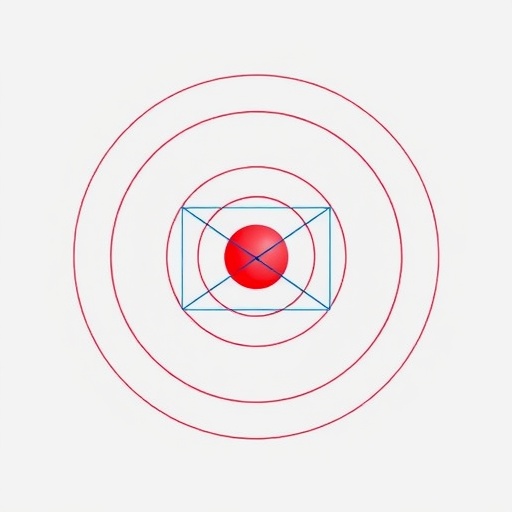
A new study has brought an unexpectedly familiar shape into one of celestial mechanics’ most demanding laboratories: the rose. In research published in Celestial Mechanics and Dynamical Astronomy, Yusuke Nagai of Kyoto University reports the numerical discovery and analysis of “rose-like” periodic orbits in the Earth–Moon restricted three-body problem. These are not decorative patterns imposed on a computer screen, but recurring three-dimensional trajectories generated by the gravitational interaction of two massive bodies and a much smaller spacecraft or particle. Their planar projections resemble the looping petals of mathematical rose curves, while their vertical motion introduces an additional frequency that can lock into resonance with the orbit’s in-plane dynamics. The result is a family of highly structured paths that may offer new insight into how complex motion emerges near the Moon.
The restricted three-body problem is a classic model in gravitational dynamics. It considers two primary bodies—in this case, Earth and the Moon—that orbit one another, while a third body has negligible mass and does not alter their motion. Despite its apparently simple setup, the equations are nonlinear and can produce a remarkable range of behavior, including escape trajectories, temporary capture, unstable passages, libration-point orbits and long-lived periodic motions. In the circular restricted three-body problem, or CRTBP, Earth and Moon are assumed to travel in circular orbits. The elliptic version, known as the ERTBP, allows their separation and orbital speed to vary as they follow an ellipse. That seemingly modest change removes an important symmetry and makes the search for repeating trajectories substantially more difficult.
Nagai’s work focuses on resonant periodic orbits, in which different components of a spacecraft’s motion return to their original configuration after a precise number of cycles. The key idea is frequency matching. A trajectory can oscillate horizontally around the Earth–Moon system while also moving above and below the orbital plane. When the vertical oscillation frequency bears a rational relationship to the principal orbital frequency, the motion can close after a finite period instead of drifting indefinitely. The study concentrates on 1:n resonances, a class in which the relevant frequencies are related by an integer ratio. Such resonances are central to periodic-orbit theory because they transform what might otherwise be a quasiperiodic, non-repeating path into a closed orbit with a recognizable geometric pattern.
To identify these paths, the study begins with a simplified approximation of the equations of motion near the Moon. In that region, the gravitational influence of the Moon dominates the local motion, while Earth’s field and the rotating reference frame continue to shape the trajectory. The approximation makes it possible to understand the essential structure before confronting the full nonlinear equations. Nagai shows that the in-plane part of the approximate solutions is consistent with the rose curves associated with the Italian mathematician Guido Grandi, who studied these curves in the early eighteenth century. In polar-style form, the radial distance varies sinusoidally while the angular position advances with time. The resulting trajectory repeatedly expands and contracts, creating lobes or “petals” around a central region. The number and arrangement of these petals depend on the ratio of the frequencies and on the initial phases.
The mathematical connection is more than a visual coincidence. A rose curve can be written parametrically so that its radial amplitude follows one sinusoidal function while the direction of motion follows another. In Nagai’s formulation, the coordinates contain a factor of the form (\sin((n/N)t-\phi_1)), multiplied by the rotating directional terms (\sin(t-\phi_2)) and (\cos(t-\phi_2)). Here, (n) and (N) are positive integers, and the phase parameters determine the initial orientation and timing of the pattern. When the frequencies are commensurate—meaning their ratio is rational—the curve repeats. In the restricted three-body setting, however, the physical orbit is not merely a two-dimensional textbook curve. The rose-like form is the projection of a dynamical solution, and the vertical component must satisfy its own resonance condition for the full three-dimensional motion to become periodic.
The approximate trajectories serve as initial guesses for a numerical single-shooting procedure. This is a standard but delicate technique in periodic-orbit computation. A trial state—typically including position and velocity—is integrated forward for a proposed period. At the end of that integration, the numerical state is compared with the starting state. If the position and velocity do not match, the initial conditions and, when necessary, the period are adjusted. An iterative correction process then seeks a solution for which the final and initial states coincide within a specified tolerance. In effect, the method solves a boundary-value problem by repeatedly asking the equations of motion to “shoot” from one point and return precisely to it. Using the rose-like approximation as a guide greatly improves the chances of converging on the desired family rather than landing on an unrelated orbit.
The first accurate solutions are computed in the Earth–Moon CRTBP, where the primaries move on circular paths and the rotating frame provides a comparatively stable environment for numerical analysis. Once the 1:n resonant periodic orbits have been found there, Nagai continues them into the ERTBP by gradually increasing the eccentricity of the Earth–Moon orbit. This continuation strategy avoids trying to discover every elliptic solution from scratch. Instead, a known periodic orbit at zero eccentricity is used as the starting point, and the equations are modified in small increments. At each step, the preceding solution supplies the initial estimate for the next one. The procedure traces how the orbit’s shape, period and stability evolve as the idealized circular model becomes more realistic.
Stability is one of the most important questions surrounding any periodic orbit. A trajectory may close perfectly in a mathematical model but be so sensitive to small disturbances that a spacecraft could not remain near it without frequent correction. Nagai analyzes the linear stability of the rose-like periodic orbits during the continuation in eccentricity. In practical terms, linear stability examines how tiny deviations from the reference orbit grow or shrink over time. This information is commonly extracted from the state-transition or monodromy matrix, which maps a small perturbation through one complete period. Its eigenvalues, often called characteristic multipliers, indicate whether perturbations remain bounded, oscillate or expand. The study therefore does not stop at drawing unusual trajectories; it follows their dynamical response as the Earth–Moon model changes.
The work also places these solutions within a long history of three-dimensional periodic orbits in the restricted three-body problem. Earlier studies identified halo orbits, vertical self-resonant satellite orbits and other families that pass near the Earth–Moon libration points. Such trajectories have influenced both theoretical celestial mechanics and mission design, including concepts for spacecraft operating near gravitational balance regions. Rose-like orbits belong to a different visual and dynamical category, but they emerge from the same fundamental principle: nonlinear gravitational systems can support organized families of repeating motion. Their existence illustrates how planar oscillations and vertical resonances can combine to create geometry that is simultaneously simple to recognize and difficult to derive.
The potential significance of the results lies in the bridge they create between classical geometry, modern numerical dynamics and spaceflight applications. The rose curve was developed centuries ago as a mathematical object; here, a related pattern appears naturally in a gravitational model involving the Earth and Moon. That connection could make complicated resonant behavior easier to classify and communicate, while also supplying useful starting points for searches through the enormous catalogue of possible periodic trajectories. The study does not claim that every rose-like orbit is immediately suitable for a mission, nor does it provide operational designs for a spacecraft. Instead, it establishes a computational pathway: approximate the local dynamics, identify resonant structure, refine the orbit in the circular problem, continue it into the elliptic problem and test its stability. As future missions increasingly explore cislunar space, families of structured periodic orbits may become valuable maps of what gravity can make possible—and of where a spacecraft can repeatedly go without simply following an ordinary Keplerian ellipse.
Cite Scienmag News
Grant Pearson. (August 26, 2026). Rose-Shaped Periodic Orbits Emerge in the Restricted Three-Body Problem. Scienmag. https://scienmag.com/rose-shaped-periodic-orbits-emerge-in-the-restricted-three-body-problem/
Grant Pearson. "Rose-Shaped Periodic Orbits Emerge in the Restricted Three-Body Problem." Scienmag, 26 August 2026, https://scienmag.com/rose-shaped-periodic-orbits-emerge-in-the-restricted-three-body-problem/. Accessed 3 September 2026.
Grant Pearson. "Rose-Shaped Periodic Orbits Emerge in the Restricted Three-Body Problem." Scienmag. August 26, 2026. https://scienmag.com/rose-shaped-periodic-orbits-emerge-in-the-restricted-three-body-problem/


