


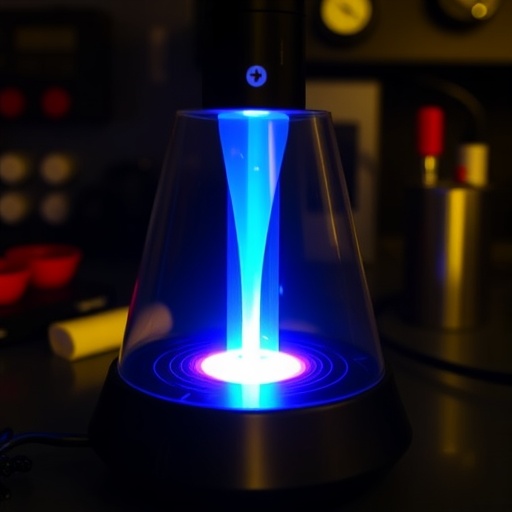
A new method could dramatically accelerate the production of MXenes, a family of two-dimensional materials widely regarded as promising candidates for next-generation energy technologies, electromagnetic shielding and advanced electronics. In a study published in Nature Synthesis, researchers report that they produced diverse, high-quality MXenes from nine different precursor materials in as little as 30 seconds. The process replaces conventional, time-consuming chemical etching with a sequential combination of flash Joule heating, chlorination and fluorination, creating a rapid route that the researchers say reduces energy use, reagent consumption and environmental hazards.
MXenes are ultrathin transition-metal carbides, nitrides or carbonitrides with structures only a few atoms thick. Their unusual combination of electrical conductivity, mechanical flexibility, chemical tunability and large accessible surface area has made them attractive for batteries, supercapacitors, electromagnetic interference shielding, sensors and a range of emerging electronic devices. Unlike many two-dimensional materials, MXenes can be dispersed in liquids and processed into films, coatings and composite structures. Their properties can also be adjusted through changes in composition and surface chemistry, giving researchers a broad platform for designing materials with specific functions.
Most MXenes are produced from layered ceramic precursors known as MAX phases. These compounds contain alternating layers of transition-metal atoms and “A-site” elements, typically aluminium or related elements. Chemical etching removes the A layers while preserving the more strongly bonded transition-metal carbide or nitride sheets. Once the weaker interstitial layers have been selectively extracted, the remaining structure can be separated into thin MXene flakes. The challenge is to remove the desired atoms without damaging the robust two-dimensional framework, a balance that has traditionally required aggressive chemicals, extended reaction times and multiple purification steps.
Conventional synthesis routes include hydrofluoric acid etching, Lewis-acid etching and molten-salt treatment. Hydrofluoric acid can efficiently attack MAX phases, but it is highly corrosive and poses serious risks during handling, storage and waste treatment. Lewis-acid and molten-salt methods can avoid some of those hazards, yet they often require elevated temperatures, lengthy processing or substantial energy input. These limitations become increasingly important as demand grows and laboratories seek to move MXene production from small-scale experiments to industrial manufacturing. A synthesis route that is both fast and controllable could therefore influence not only the cost of MXenes but also the safety and environmental footprint of the entire materials pipeline.
The new approach, described by Xu, Yang, Zhu and colleagues, uses flash Joule heating to deliver an intense electrical pulse to the precursor material. Flash Joule heating can raise a material to very high temperatures in a fraction of a second, then allow it to cool rapidly once the pulse ends. In the reported process, the heating step is integrated with sequential chlorination and fluorination reactions. Rather than relying on slow diffusion through a liquid etchant, the method uses carefully controlled reaction conditions to promote selective chemical conversion and removal of the interstitial atoms within the MAX structure. The result is a rapid transformation from a layered precursor into a layered MXene product.
The central scientific challenge is selectivity. The atoms targeted for removal must react readily enough to leave the structure, while the transition-metal carbide or nitride layers must remain intact. According to the study, the researchers controlled both thermodynamic and kinetic parameters to guide this process. Thermodynamics determines which chemical transformations are favorable under the reaction conditions, while kinetics governs how quickly those transformations proceed and which pathways dominate. By tuning factors such as the reaction environment and heating profile, the team was able to promote the removal of the MAX phase’s interstitial atoms without triggering extensive decomposition of the desired two-dimensional framework.
The researchers applied the strategy to nine distinct MAX phases, demonstrating that the method is not limited to a single composition. This breadth is important because different MXenes offer different combinations of conductivity, surface reactivity, mechanical behavior and electrochemical characteristics. Producing multiple compositions through one general platform could make it easier to match a material to a specific application, whether the goal is rapid ion storage, electromagnetic absorption or integration into a flexible electronic device. The resulting MXenes were reported to have high structural quality and excellent electrochemical performance, suggesting that the rapid processing did not sacrifice the functional properties that make the materials valuable.
To understand how the transformation occurs, the team combined computational simulations with high-resolution transmission electron microscopy. The simulations were used to examine the selective-etching mechanism and identify how the chemical environment favors the removal of the targeted atoms. Meanwhile, electron microscopy provided direct views of structural evolution at the atomic scale, following the precursor as it changed from a MAX phase into a MXene. Such observations are especially significant for a rapid reaction, because many intermediate structures may exist only briefly. Connecting predicted reaction pathways with experimentally observed atomic arrangements gives researchers a stronger basis for refining the process and extending it to additional precursor chemistries.
The reported 30-second synthesis time places the method among the fastest approaches proposed for producing complex two-dimensional materials. Speed alone, however, is not enough for a manufacturing technology: the process must also deliver consistent products, use manageable quantities of reagents and maintain performance across different compositions. The study’s results indicate that sequential flash Joule heating-chlorination and fluorination, referred to as the FJH-ClF strategy, can address several of these requirements at once. Its rapid electrical heating may reduce the energy associated with long furnace treatments, while the selective chemistry could reduce the need for highly hazardous liquid etchants and intensive downstream processing.
The development arrives as researchers and manufacturers search for scalable ways to produce MXenes in quantities suitable for practical technologies. MXenes have already shown promise in laboratory demonstrations involving electrochemical energy storage, conductive coatings and electromagnetic shielding, but translating those demonstrations into commercial products requires reliable control over composition, layer structure, surface terminations and defect density. The FJH-ClF method could provide a route to that control by coupling short reaction times with a chemistry that is adaptable to multiple MAX phases. Its potential impact will ultimately depend on further studies of long-term stability, waste streams, reactor design, process uniformity and the performance of materials produced at larger scales. Even so, the work offers a striking example of how extreme, precisely controlled heating can replace slower and more hazardous chemical processing. By converting a difficult etching problem into a rapid sequence of thermal and chemical events, the researchers have presented a potentially safer and more sustainable pathway for manufacturing the MXenes that may underpin future energy, shielding and electronic technologies.
Cite Scienmag News
Bethany Barker. (August 25, 2026). Flash Joule Heating Enables Rapid Synthesis of MXenes. Scienmag. https://scienmag.com/flash-joule-heating-enables-rapid-synthesis-of-mxenes/
Bethany Barker. "Flash Joule Heating Enables Rapid Synthesis of MXenes." Scienmag, 25 August 2026, https://scienmag.com/flash-joule-heating-enables-rapid-synthesis-of-mxenes/. Accessed 4 September 2026.
Bethany Barker. "Flash Joule Heating Enables Rapid Synthesis of MXenes." Scienmag. August 25, 2026. https://scienmag.com/flash-joule-heating-enables-rapid-synthesis-of-mxenes/


