


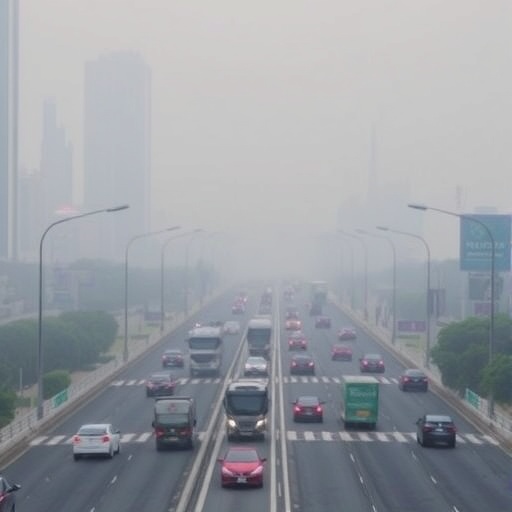
A new international study has linked short-term exposure to traffic-related fine particulate matter with a substantially elevated risk of death among people with cancer, suggesting that vehicle pollution may play a far larger role in acute cancer mortality than its share of total urban air pollution would imply. The analysis, covering nearly 9.23 million cancer deaths recorded across eight countries over two decades, found that a 10-microgram-per-cubic-meter increase in traffic-sourced PM2.5 was associated with a 3.87 percent rise in the risk of dying from cancer over the following two days. By comparison, the same increase in fine particles from all sources was associated with a 0.77 percent increase in cancer mortality risk.
The findings come from research conducted across Australia, Brazil, Canada, Chile, South Korea, Mexico, New Zealand and Thailand, using daily mortality records collected between 2000 and 2019. The researchers examined deaths according to cancer site and compared pollution exposure on the day of death and the previous day with exposure during control days for the same individual. This time-stratified case-crossover design is commonly used to investigate the short-term health effects of environmental exposures because each person effectively serves as their own control. That approach helps reduce the influence of characteristics that do not change over a few days, such as genetics, long-term health history or socioeconomic background.
Fine particulate matter, known as PM2.5, consists of airborne particles no larger than 2.5 micrometers in diameter—small enough to penetrate deep into the lungs and, in some cases, enter the bloodstream. These particles can carry metals, organic compounds, acids and other toxic substances on their surfaces. Traffic-related PM2.5, referred to in the study as TSPM2.5, is a specific fraction associated with vehicle exhaust, fuel combustion, brake and tire wear, and the resuspension of particles from roads. Because its chemical composition and sources differ from those of particles generated by dust, industry, agriculture or natural processes, traffic-related pollution may trigger biological effects that are not captured by measurements of total PM2.5 alone.
The investigators focused on a two-day moving average of exposure, known as lag 0–1, combining pollution levels on the day of death with those on the preceding day. This window was selected to capture rapid physiological responses to pollution. In susceptible individuals, inhaled particles can provoke airway irritation, oxidative stress and systemic inflammation. They may also affect blood clotting, vascular function and immune regulation. For people already living with cancer, whose organs and immune systems may be compromised by the disease or by treatments such as chemotherapy and radiotherapy, these acute disturbances could worsen existing complications or accelerate fatal events.
The contrast between the two pollution measures was striking. Traffic-related particles made up only 14.72 percent of total PM2.5 concentrations in the study population, yet the researchers estimated that they accounted for 73.55 percent of cancer deaths attributable to PM2.5 during the study period. In absolute terms, traffic-sourced particles were estimated to contribute to 1.21 percent of all cancer mortality, with a 95 percent confidence interval ranging from 1.03 to 1.39 percent. A confidence interval describes the range of values compatible with the study’s data and statistical model; the relatively narrow interval indicates that the overall estimate was measured with considerable precision, although it does not eliminate uncertainty.
The researchers also examined whether the pollution–mortality association differed according to age, sex or socioeconomic status. None of these factors significantly modified the observed relationship. That result suggests that the short-term hazard associated with traffic particles may extend across broad sections of the cancer population rather than being concentrated in a single demographic group. The analysis additionally considered mortality by cancer site, allowing the team to investigate whether some cancers appeared more sensitive to acute particle exposure. The summary findings emphasize the overall cancer association, while the detailed site-specific patterns provide a basis for future work on why certain tumors or treatment pathways might confer greater vulnerability.
The results do not mean that traffic pollution directly caused every death included in the analysis, nor do they establish that exposure to a particular vehicle or roadway was responsible for an individual outcome. The study is observational, meaning that it detects population-level associations rather than proving causation in the way a randomized experiment might. Although the case-crossover design controls for many stable personal characteristics and the statistical analysis accounts for short-term patterns, factors such as weather, infections, indoor exposure, healthcare access and measurement error may still influence the results. Pollution estimates are also generally assigned from monitoring systems or models rather than from personal sensors, so they may not perfectly represent what each person inhaled.
Even with those limitations, the findings add to evidence that the health effects of air pollution depend not only on how much particulate matter is present but also on where it comes from and what it contains. Two locations with the same total PM2.5 concentration could expose residents to different chemical mixtures, depending on the balance between traffic, industrial combustion, residential heating, wildfires and other sources. Traffic emissions often occur close to where people live, work and travel, producing concentrated exposures along busy roads and in dense urban corridors. The study therefore points toward source-specific pollution control as a potentially more efficient public-health strategy than treating all particulate matter as chemically and biologically equivalent.
For people undergoing cancer treatment, the findings reinforce the value of practical measures that reduce exposure during periods of heavy traffic or elevated pollution. Public-health agencies could use the evidence to support cleaner vehicle technologies, stricter emissions standards, improved public transportation and urban planning that separates major roads from homes, hospitals and care facilities. At the individual level, avoiding high-traffic areas when pollution is elevated, improving indoor filtration and following local air-quality guidance may reduce exposure, although such measures cannot remove the broader risk faced by populations living in polluted environments. The researchers’ central message is that reducing traffic-related PM2.5 could lower acute pollution-associated mortality among people with cancer, turning cleaner transportation policy into a potentially important component of cancer protection.
Cite Scienmag News
Nathaniel Bowman. (August 25, 2026). Traffic’s Contribution to Daily PM2.5 Exposure Linked to Cancer Mortality. Scienmag. https://scienmag.com/traffics-contribution-to-daily-pm2-5-exposure-linked-to-cancer-mortality/
Nathaniel Bowman. "Traffic’s Contribution to Daily PM2.5 Exposure Linked to Cancer Mortality." Scienmag, 25 August 2026, https://scienmag.com/traffics-contribution-to-daily-pm2-5-exposure-linked-to-cancer-mortality/. Accessed 4 September 2026.
Nathaniel Bowman. "Traffic’s Contribution to Daily PM2.5 Exposure Linked to Cancer Mortality." Scienmag. August 25, 2026. https://scienmag.com/traffics-contribution-to-daily-pm2-5-exposure-linked-to-cancer-mortality/


