


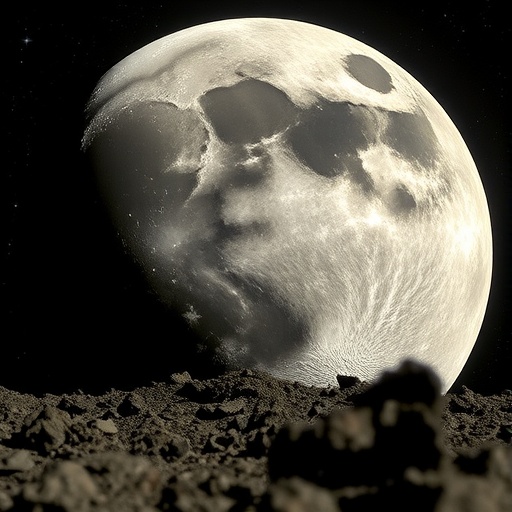
A few atoms forged in the violent death of distant stars may be hiding beneath the Moon’s gray, seemingly lifeless surface. A new study led by University of Hawai‘i at Mānoa researcher Emily Costello suggests that lunar soil could function as a cosmic time capsule, preserving a record of supernova explosions across tens of millions of years. Unlike Earth, where oceans, tectonic activity and erosion continually erase traces of ancient cosmic events, the Moon has no atmosphere, liquid water or active geology to destroy its surface history. Instead, its regolith—an accumulation of dust, rock fragments and impact debris—slowly stores material delivered from space. The challenge is that the lunar surface is not static. Meteorite impacts constantly churn it, scrambling the original layers in a process scientists call “impact gardening.” Costello and her collaborators have developed a mathematical framework designed to reconstruct that scrambled history and reveal when stellar debris arrived.
Supernovae occur when massive stars reach the end of their lives or when certain stellar remnants undergo catastrophic explosions. These events can briefly outshine entire galaxies and scatter newly formed elements and radioactive isotopes into interstellar space. Some explosions occurring hundreds of light-years from Earth have sent traces of this material across the Solar System. On Earth, researchers have identified evidence of such events in deep-sea sediments, including radioactive iron-60 associated with supernova activity approximately 2.3 million and 7.3 million years ago. Yet terrestrial records are limited. Ocean sediments are disturbed, dissolved, buried or recycled by geological processes, and the oldest accessible deposits preserve only a relatively short portion of the planet’s cosmic history. The Moon offers a dramatically longer archive. According to the study, lunar regolith may preserve evidence of supernova debris deposited over 80 million to 100 million years ago, provided scientists can account for the physical processes that rearranged it.
Costello, a research scientist at the Hawai‘i Institute of Geophysics and Planetology within the University of Hawai‘i at Mānoa’s School of Ocean and Earth Science and Technology, approached the problem as a kind of cosmic cryptography. Her team created a unified stochastic model, meaning a mathematical model that incorporates both physical processes and the random nature of individual impacts. The model describes lunar impact gardening as a competition between downward transport and upward excavation. New material can be buried as dust accumulates, while meteorite strikes can excavate older layers and distribute particles through the surrounding soil. Small impacts may disturb microscopic grains, whereas larger collisions can penetrate deeper and spread material over broader areas. Because each location on the Moon has experienced a different sequence of impacts, no two core samples contain exactly the same scrambled record. The model is intended to distinguish that local randomness from the wider signal produced by interstellar debris.
Technically, the framework treats the movement and alteration of radioactive material through the regolith using an advection-diffusion approach. Advection represents the directed movement of particles as layers are buried or excavated, while diffusion captures the random mixing caused by repeated impacts. The calculation also includes radioactive decay, which progressively reduces the abundance of unstable isotopes after they arrive on the Moon. Other relevant processes include impact compaction, excavation, space weathering and the delivery of fresh material during episodic cosmic events. By combining these mechanisms into a single continuum model, the researchers can estimate how an isotope originally deposited at the lunar surface would migrate through the soil over time. The result is not a simple vertical timeline in which the deepest layer is always the oldest. Instead, it is a probability-based reconstruction of how concentrations should be distributed with depth after millions of years of bombardment.
The team tested the model against measurements from Apollo lunar samples and existing evidence from terrestrial sediments. Radioactive isotopes found in deep-sea deposits and lunar soil indicate that supernova material reached both Earth and the Moon in distinct pulses. Once delivered to the lunar surface, however, those isotopes did not remain in pristine layers. Impact gardening gradually mixed them downward and upward, altering the concentration profile that astronauts and laboratory scientists would observe in a core. Costello’s model was able to reproduce the depth-concentration patterns measured in Apollo regolith samples whose ages had been independently constrained using cosmic-ray tracks and radionuclide benchmarks. These independent markers provide a geological clock, allowing researchers to compare the model’s predictions with samples whose history is not based solely on the model itself. The agreement gave the researchers a way to test whether their description of lunar mixing reflected real physical behavior.
The strongest validation came from iron-60, a radioactive isotope that is not produced in significant quantities by ordinary processes on Earth’s surface and is considered a useful indicator of nearby stellar explosions. The researchers found that their calculations accurately predicted how iron-60 should be distributed through Apollo regolith. They then used the validated framework in the opposite direction: rather than starting with a measured concentration and reconstructing its past, they began with known supernova timelines and simulated how those events would appear after being mixed into lunar soil. This forward modeling showed how the same stellar pulse could be recorded at different depths depending on local impact history, burial rates and the isotope’s radioactive half-life. The ability to reproduce observations and then forecast the preservation of independently known events is important because it suggests the model may be useful for interpreting future lunar samples rather than simply explaining existing data.
The model also provides predictions for other radioactive elements that could expand the Moon’s role as a stellar archive. Among the isotopes considered are plutonium-244, iodine-129, hafnium-182 and curium-247. Each has a different half-life and chemical history, meaning each would leave a distinct pattern in the regolith. Comparing several isotopes could allow researchers to separate the timing of multiple supernova events, identify changes in the composition of incoming debris and determine how efficiently different materials were mixed after reaching the surface. Such measurements would offer more than a catalog of ancient explosions. They could help scientists investigate how the Solar System moved through the Milky Way, how often nearby supernovae affected its environment and how stellar explosions distributed heavy elements into space. The lunar surface may therefore preserve a record of both local impact events and the broader galactic journey of Earth and its companion world.
The timing of the study is especially significant as NASA’s Artemis program prepares to return astronauts to the Moon and collect new geological samples. Apollo missions retrieved cores from relatively shallow depths and from a limited number of locations, leaving much of the lunar regolith unexplored. Future missions could target deeper cores, older surfaces and regions selected for their potential to preserve interstellar material. The new model can help determine which depths are most likely to contain detectable concentrations of long-lived isotopes and how many samples may be needed to distinguish a genuine cosmic signal from local impact-related variation. Because a single core can reflect a highly individual sequence of disturbances, sampling strategy will be crucial. Deeper and better-characterized cores, combined with precise laboratory measurements, may reveal supernova pulses that have never been detected in terrestrial records.
The study transforms the familiar image of lunar dust into something far more dynamic and scientifically valuable. Every meteorite impact that disturbed the Moon’s surface may have blurred the original signal, but that same mixing also spread rare stellar atoms through accessible layers of soil. Costello’s results indicate that the apparent disorder is not an insurmountable obstacle; with a physically grounded statistical model, it can become information. Future astronauts may collect material that contains radioactive remnants of stars that exploded millions of years before humans existed, while the depth and concentration of those atoms could preserve clues to when the explosions occurred. If Artemis missions recover the right cores and laboratories detect the predicted isotopes, the Moon could become the most enduring nearby record of the Solar System’s encounters with exploding stars. In that sense, lunar regolith is not merely dust beneath astronauts’ boots. It is a scrambled but potentially readable history of stellar violence, cosmic migration and the deep past of Earth’s neighborhood.
News Publication Date: 14 August 2026
Web References: https://journals.aps.org/prl/abstract/10.1103/14kh-nkgl; https://www.higp.hawaii.edu/; http://www.soest.hawaii.edu
References: Physical Review Letters; DOI: 10.1103/14kh-nkgl
Keywords
Moon, lunar regolith, supernova, supernova debris, impact gardening, radioactive isotopes, iron-60, Artemis program, lunar samples, cosmic archive, astrophysics, planetary science, space weathering, interstellar material
Cite Scienmag News
Grant Pearson. (August 25, 2026). Moon soil preserves ancient signatures of exploding stars. Scienmag. https://scienmag.com/moon-soil-preserves-ancient-signatures-of-exploding-stars/
Grant Pearson. "Moon soil preserves ancient signatures of exploding stars." Scienmag, 25 August 2026, https://scienmag.com/moon-soil-preserves-ancient-signatures-of-exploding-stars/. Accessed 3 September 2026.
Grant Pearson. "Moon soil preserves ancient signatures of exploding stars." Scienmag. August 25, 2026. https://scienmag.com/moon-soil-preserves-ancient-signatures-of-exploding-stars/


