


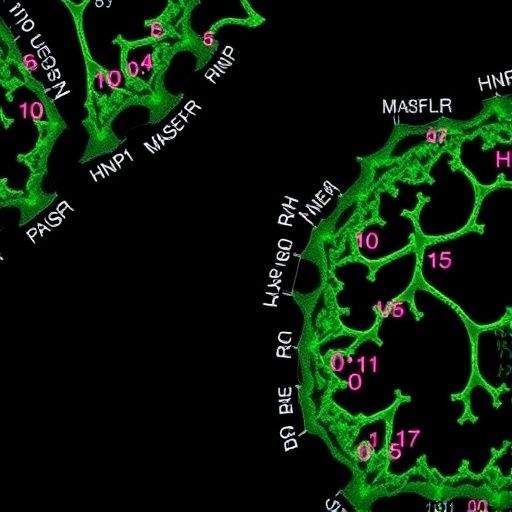
Scientists have identified a molecular organizer that helps connect distant regulatory regions of the genome with the genes they control, solving a longstanding question about how enhancer RNAs contribute to enhancer–promoter communication. In a study published in Nature Genetics, Ye, Zhao, Chen and colleagues report that the RNA-binding protein hnRNPK acts as a general structural regulator of gene activation. The protein preferentially associates with newly transcribed RNA at both enhancers and promoters, bringing these genomic regions into physical proximity and helping recruit RNA polymerase II, the enzyme responsible for producing messenger RNA. The findings place hnRNPK at the center of a mechanism in which RNA molecules, protein assemblies and chromatin architecture cooperate to determine whether developmental genes are switched on.
Enhancers are regulatory DNA elements that can be located thousands or even hundreds of thousands of bases away from the promoters of the genes they regulate. Their activity depends in part on the formation of three-dimensional chromatin loops that allow enhancer-bound regulatory factors to contact promoter-bound transcription machinery. Although researchers have known that many enhancers produce short-lived transcripts called enhancer RNAs, or eRNAs, the precise role of these molecules has remained difficult to define. Promoter regions also generate nascent RNAs as transcription begins, creating an opportunity for RNA molecules from the two regulatory regions to interact. The new study proposes that hnRNPK recognizes and organizes these emerging transcripts, converting RNA–RNA contacts into a stable molecular bridge between enhancer and promoter.
Rather than functioning only as a conventional RNA-binding factor, hnRNPK appears to provide an architectural framework for transcriptional regulation. The researchers found that it binds preferentially to nascent RNAs produced from active enhancers and promoters. These RNAs are generated locally while the relevant chromatin regions are being transcribed, placing them close to the DNA sites that need to communicate. By associating with both classes of transcript, hnRNPK may concentrate enhancer- and promoter-derived RNAs in the same molecular environment. Such proximity could stabilize interactions between the RNAs and help fold the intervening chromatin into a loop. The model offers a mechanistic explanation for how transient RNA molecules can influence a much larger and more persistent structure in the genome.
The study further indicates that hnRNPK can assemble into phase-separated condensates. These are dynamic, concentrated compartments formed when proteins and nucleic acids cluster through numerous weak interactions rather than through a single permanent molecular bond. Phase separation is increasingly recognized as a way for cells to organize biochemical reactions without enclosing them in a membrane. In the case of hnRNPK, the condensates were described as containing cavities that encapsulate RNA polymerase II. This arrangement could create a specialized transcriptional environment in which regulatory RNAs, chromatin-associated factors and the polymerase are brought together at high local concentrations, making productive transcription more likely.
A particularly important feature of the proposed mechanism involves the RPB3 subunit of RNA polymerase II. The investigators report that hnRNPK interacts with Pol II through RPB3, providing a direct protein-based route for incorporating the transcriptional enzyme into hnRNPK condensates. Once Pol II is concentrated within these assemblies, enhancer-associated complexes may be able to influence its delivery to nearby or physically connected promoters. The researchers suggest that hnRNPK dimerization could contribute to this process: one portion of an hnRNPK assembly could engage enhancer-derived RNA and regulatory factors, while another connects with promoter-associated RNA and Pol II. In this framework, enhancer–promoter looping is not merely a passive consequence of chromatin folding but an active process coordinated by RNA-binding proteins.
This mechanism also helps explain why enhancer transcription may be functionally important even when eRNAs are rapidly degraded and do not encode proteins. Their role may depend less on their final abundance than on their production at the correct genomic location and time. As these RNAs emerge from the DNA, they can serve as temporary molecular signals or scaffolds for proteins such as hnRNPK. The resulting assemblies could integrate several signals at once, including the identity of the enhancer, the activity state of the promoter and the availability of Pol II. By linking these signals, hnRNPK may help ensure that developmental genes are activated only when the appropriate regulatory elements are engaged.
The biological significance of the findings was tested using a mutation in hnRNPK associated with Au–Kline syndrome, a rare developmental disorder. The mutation, designated c.953+1dupG, altered the physical properties of hnRNPK condensates. Instead of remaining liquid-like and dynamic, the mutant condensates became more gel-like. Liquid-like condensates can continuously exchange their molecular components with the surrounding nucleus, allowing them to assemble, reorganize and dissolve as transcriptional requirements change. A gel-like state may restrict this exchange, trapping components or preventing the rapid rearrangements required for enhancer–promoter communication. The results suggest that the material state of a condensate is not a cosmetic property but a critical determinant of gene regulation.
Knock-in mice carrying the disease-associated mutation developed developmental defects, providing evidence that the molecular changes have consequences at the level of the organism. Fibroblasts derived from these animals showed reduced enhancer–promoter looping and diminished recruitment of Pol II to the promoters of key developmental genes. These observations connect the mutation’s effects across several scales: it changes the physical behavior of hnRNPK condensates, weakens three-dimensional contacts between regulatory DNA elements, reduces transcriptional machinery at gene promoters and ultimately contributes to developmental abnormalities. The findings are consistent with the idea that many congenital disorders may result not only from loss of a protein’s biochemical activity but also from changes in the dynamics and material properties of nuclear assemblies.
The work presents hnRNPK as a general structural regulator of gene expression rather than a factor restricted to a small set of specialized genes. By mediating interactions between enhancer and promoter RNAs, organizing phase-separated condensates and engaging Pol II through RPB3, hnRNPK may provide a common platform for communication across the genome. The proposed model also broadens the view of noncoding transcription: RNAs produced from regulatory DNA may act as active architectural components, even when they do not persist as stable cellular molecules. Further research will be needed to determine how hnRNPK selects particular RNA sequences, how its condensates are regulated by signaling pathways and whether similar defects in condensate dynamics contribute to other human diseases. For now, the study identifies a molecular link between nascent RNA, chromatin looping and transcriptional activation, revealing how the genome’s distant control elements can work together with remarkable precision.
Cite Scienmag News
Juliet Wilcox. (August 24, 2026). hnRNPK condensates boost enhancer–promoter looping and RNA polymerase II recruitment. Scienmag. https://scienmag.com/hnrnpk-condensates-boost-enhancer-promoter-looping-and-rna-polymerase-ii-recruitment/
Juliet Wilcox. "hnRNPK condensates boost enhancer–promoter looping and RNA polymerase II recruitment." Scienmag, 24 August 2026, https://scienmag.com/hnrnpk-condensates-boost-enhancer-promoter-looping-and-rna-polymerase-ii-recruitment/. Accessed 3 September 2026.
Juliet Wilcox. "hnRNPK condensates boost enhancer–promoter looping and RNA polymerase II recruitment." Scienmag. August 24, 2026. https://scienmag.com/hnrnpk-condensates-boost-enhancer-promoter-looping-and-rna-polymerase-ii-recruitment/


