


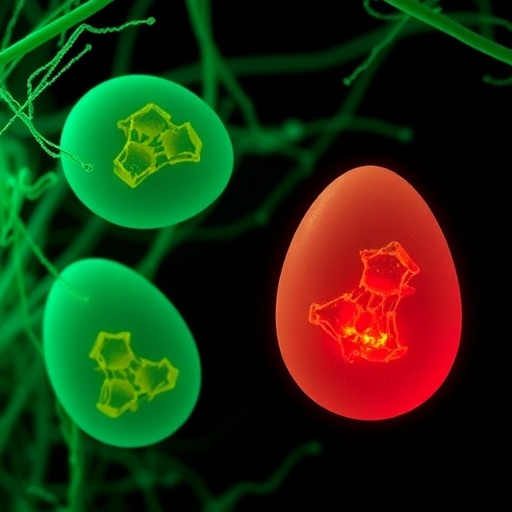
A new study reports that mammalian eggs do not simply contain a passive mixture of proteins waiting for fertilization. Instead, they appear to organize key molecular machinery into structured cytoplasmic lattices—large, stable assemblies that can store both degradative systems and cytoskeletal components in a developmentally poised state. The finding, published in Nature Structural & Molecular Biology by Y. Li, W. Zheng, J. Leem and colleagues, offers a fresh view of how an egg prepares for the dramatic biological transformation that begins when sperm and egg meet. By positioning essential complexes before fertilization, the egg may be able to activate major cellular programs with exceptional speed and precision.
The egg is one of the most unusual cells in the mammalian body. It is unusually large, packed with molecular supplies, and required to support the earliest stages of embryonic life before the embryo’s own genome becomes fully active. During this period, the newly fertilized egg must reorganize its interior, control protein quality, remodel its cytoskeleton and coordinate cell division, all while operating largely on maternal resources. The study’s central message is that these resources are not randomly distributed. Cytoplasmic lattices function as a type of intracellular staging ground, bringing together molecular machines that will be needed at distinct but critical points in early development.
The term “cytoplasmic lattice” describes a network-like structure within the cell’s cytoplasm. In biological systems, such networks can provide physical support, create local environments for biochemical reactions or act as storage sites for molecules that must remain available but inactive. In mammalian eggs, the researchers identify these lattices as repositories for two particularly important categories of complexes: degradative machinery and cytoskeletal machinery. Their co-storage is significant because these systems perform seemingly opposite tasks. Degradative complexes dismantle or recycle cellular components, while cytoskeletal complexes build and reorganize the internal framework that gives the cell shape and directs the movement of chromosomes and organelles.
Degradation is not simply cellular housekeeping. It is a central regulatory process. Protein complexes involved in degradation can remove damaged, obsolete or inhibitory molecules, allowing the cell to change state rapidly. In an egg and early embryo, this capacity is essential because fertilization triggers a wave of molecular transitions. Some proteins must be destroyed to release the egg from its arrested state, while others must be preserved or activated to initiate embryonic development. Storing degradative components within an organized lattice could protect them from premature activity while ensuring that they are immediately accessible when developmental signals arrive. The arrangement may therefore provide both restraint and readiness.
The cytoskeleton is equally important to the egg’s transformation. Built from polymers such as actin filaments and microtubules, the cytoskeleton acts as a dynamic transport and positioning system. It helps distribute organelles, establish cellular polarity and organize the machinery that separates chromosomes. Following fertilization, the egg must coordinate the formation of pronuclei, the movement of genetic material and the first mitotic divisions. These events require rapid remodeling rather than slow construction from scratch. By storing cytoskeletal complexes in a poised configuration, the egg may reduce the time needed to assemble functional structures after activation.
The idea of developmental poising is crucial to understanding the study. A poised complex is not necessarily operating at full capacity. Instead, it is held in a condition that allows rapid deployment when the appropriate signal appears. This strategy is common in biology: cells often prepare molecular components in advance when timing is critical. In the egg, the consequences of such preparation may be especially pronounced because the cell must transition from a mature, arrested state to an actively dividing embryo. The lattices described in the study could act as molecular launch platforms, maintaining a concentrated supply of machinery close to the locations where it will eventually function.
This organization may also help explain how the egg balances stability with flexibility. A large cell containing thousands of molecular components faces a logistical problem: materials must remain available without interfering with one another. Unstructured diffusion would make it difficult to control when and where complexes interact. A lattice can solve part of that problem by physically concentrating selected components while limiting their activity until the cell receives the right developmental cue. Such spatial regulation is particularly valuable for degradative systems, whose premature activation could damage the egg, and for cytoskeletal systems, whose untimely assembly could disrupt chromosome organization or cellular architecture.
The study also raises broader questions about how intracellular storage is adapted to a cell’s life history. Many cells maintain protein complexes in assemblies, condensates or scaffolded compartments, but an egg has an unusual obligation: it must preserve a developmental program through a period of arrest and then execute that program almost immediately after fertilization. The cytoplasmic lattice may represent a specialized solution to this challenge. Rather than treating the egg as a container filled with dormant supplies, the findings portray it as a carefully preassembled system in which molecular geography is part of developmental regulation. Where a complex is stored may be nearly as important as what the complex does.
For reproductive biology, the discovery could provide a new framework for studying egg quality and early embryonic failure. If cytoplasmic lattices are responsible for maintaining the readiness, stability or correct localization of essential complexes, age-related changes or cellular stress might alter their organization. Such defects could compromise the egg’s ability to activate degradation pathways, remodel its cytoskeleton or support the first embryonic divisions. The work does not by itself establish a clinical diagnostic or treatment, but it identifies a structural layer of egg biology that may become relevant to fertility research. Understanding this layer could eventually help researchers distinguish between eggs that contain the necessary molecules and eggs that can organize those molecules properly.
The findings ultimately shift attention from molecular inventory to molecular architecture. Mammalian eggs carry an extraordinary reserve of proteins and complexes, but development depends on more than abundance. The cell must store those components in the right place, in the right state and with the right degree of accessibility. By revealing cytoplasmic lattices as sites that house developmentally poised degradative and cytoskeletal complexes, Li, Zheng, Leem and colleagues present the egg as a preconfigured molecular machine. Fertilization may be the trigger for development, but the groundwork is laid beforehand, through an internal organization that allows the cell to move from dormancy to division with remarkable speed.
Cite Scienmag News
Drew Townsend. (August 24, 2026). Mammalian Eggs Store Ready-to-Activate Degradative and Cytoskeletal Complexes in Cytoplasmic Lattices. Scienmag. https://scienmag.com/mammalian-eggs-store-ready-to-activate-degradative-and-cytoskeletal-complexes-in-cytoplasmic-lattices/
Drew Townsend. "Mammalian Eggs Store Ready-to-Activate Degradative and Cytoskeletal Complexes in Cytoplasmic Lattices." Scienmag, 24 August 2026, https://scienmag.com/mammalian-eggs-store-ready-to-activate-degradative-and-cytoskeletal-complexes-in-cytoplasmic-lattices/. Accessed 3 September 2026.
Drew Townsend. "Mammalian Eggs Store Ready-to-Activate Degradative and Cytoskeletal Complexes in Cytoplasmic Lattices." Scienmag. August 24, 2026. https://scienmag.com/mammalian-eggs-store-ready-to-activate-degradative-and-cytoskeletal-complexes-in-cytoplasmic-lattices/


