


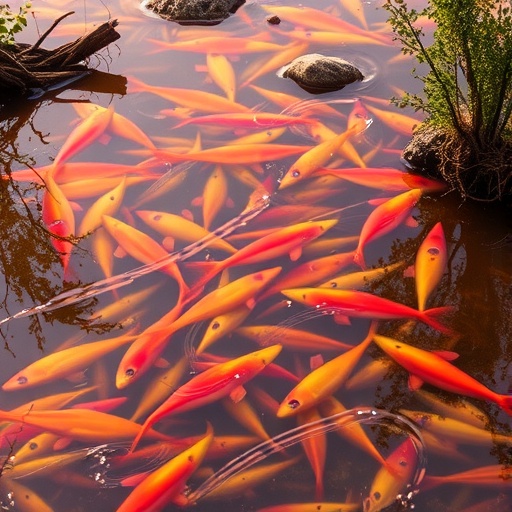
Climate change is reshaping freshwater ecosystems in a way that may be faster, more abrupt and more disruptive than long-term warming trends alone suggest. A new study by Wang, Liu, Holden and colleagues reports that rising temperatures are driving increasingly severe thermal shocks in rivers, streams and other freshwater habitats, while simultaneously accelerating the fragmentation of the places where aquatic organisms can survive. The findings point to a compound threat: species are not merely being exposed to warmer water, but to rapid temperature swings and a landscape in which suitable thermal conditions are becoming separated into isolated patches.
Freshwater environments are especially sensitive to temperature because water temperature governs nearly every major biological and chemical process within them. It affects the metabolic rate of fish and invertebrates, the growth of algae and aquatic plants, the solubility of oxygen and the timing of reproduction, migration and emergence. Many freshwater species occupy narrow thermal niches, meaning that even modest departures from their preferred temperature range can reduce feeding efficiency, impair development or increase mortality. When temperatures change suddenly, organisms may have little time to acclimate, making short-lived thermal events potentially as consequential as sustained warming.
The study’s central concern is the rise of these abrupt disturbances, known as thermal shocks. A thermal shock occurs when water temperature changes rapidly over a relatively short period, rather than gradually following seasonal conditions. Such events can be produced by intense heat, sudden changes in streamflow, the loss of shading vegetation, warm water entering a channel or shifts between connected and isolated water bodies. Climate warming can intensify several of these drivers at once. Hotter air raises the temperature of exposed water, while altered rainfall and drought patterns reduce flow, shrink thermal buffers and leave remaining pools more vulnerable to rapid heating.
The biological consequences can unfold through several interacting mechanisms. Warmer water generally accelerates metabolism, increasing the amount of oxygen an organism requires. At the same time, warm water holds less dissolved oxygen, creating a physiological mismatch that can place fish and aquatic invertebrates under severe stress. Thermal shocks can also disrupt the timing of spawning, egg development and larval growth. Species that depend on precise seasonal temperature cues may begin breeding too early or too late, while organisms unable to move quickly toward cooler conditions can become trapped in unsuitable water. Repeated exposure may weaken populations even when individual shocks do not cause immediate, large-scale mortality.
The research links this thermal instability to habitat fragmentation, a process traditionally associated with dams, water extraction, channel modification, pollution and land-use change. In a warming climate, fragmentation can also occur thermally. A river may remain physically connected, yet become divided into stretches with sharply different temperature conditions. Cool headwaters, groundwater-fed reaches, shaded refuges and deep pools may function as isolated islands of suitable habitat within a broader network of water that has become too warm or too variable. For species that cannot cross hostile thermal zones, connectivity on a map no longer guarantees ecological connectivity.
This distinction is crucial because freshwater animals often depend on movement to complete their life cycles. Fish may migrate between feeding grounds, spawning sites and overwintering habitat. Invertebrates can recolonize areas after floods or local disturbances, while amphibians may rely on a chain of suitable pools and streams. If warming creates thermal barriers between these locations, movement becomes more difficult and populations can lose access to essential resources. Fragmentation also reduces gene flow, increasing the risk that isolated populations will suffer from inbreeding, random population fluctuations or the loss of locally adapted traits. Over time, a network of small, disconnected populations may be less resilient to drought, disease and additional temperature extremes.
The study’s message is therefore more complex than the familiar projection that climate change will simply move species toward higher latitudes or elevations. Some organisms may be able to track cooler conditions upstream, northward or into deeper water, but those routes are not always continuous. A species may encounter dams, culverts, depleted flows, polluted reaches or stretches of river that have become thermally unsuitable. Even where cooler habitat exists, it may be too small to support a viable population or too isolated to permit regular movement. The result is a potential “double squeeze”: suitable temperatures contract while the pathways between them break apart.
This emerging pattern also complicates conservation planning. Protecting a fixed area may not be enough if its thermal conditions change rapidly. Management strategies will need to identify and preserve cold-water refuges, maintain environmental flows, restore streamside vegetation and protect groundwater sources that moderate temperature extremes. Riparian forests can shade channels and reduce solar heating, while healthy floodplains and connected wetlands can store water and help stabilize local thermal conditions. Removing or modifying barriers may allow organisms to reach cooler habitat, but connectivity projects will be most effective when the water along the route remains within a tolerable temperature range.
The findings arrive as freshwater ecosystems are already experiencing intense pressure from pollution, abstraction, invasive species and physical alteration. Thermal shocks add a fast-moving climate hazard that can interact with all of these stresses. A population weakened by habitat loss may be less able to withstand a sudden heat event; low flows can concentrate pollutants while also increasing water temperature; and invasive species may gain an advantage when native organisms are pushed beyond their thermal limits. The study suggests that monitoring programs should therefore measure not only average temperatures, but also the speed, duration and frequency of thermal changes across connected freshwater networks.
For scientists and conservationists, the work highlights the need to treat temperature as a dynamic feature of habitat rather than a single environmental number. High-resolution sensors, remote observations, hydrological models and biological surveys can help reveal where thermal shocks occur and whether refuges remain connected during extreme conditions. Such information could support early-warning systems for vulnerable rivers and guide restoration toward locations with the greatest potential to protect biodiversity. The broader warning is unmistakable: as the planet warms, freshwater habitat may disappear not only when water becomes permanently too hot, but also when repeated thermal shocks divide once-continuous ecosystems into isolated fragments. Preserving freshwater life will require reducing greenhouse-gas emissions while restoring the physical and thermal connectivity that allows species to move, reproduce and recover.
Cite Scienmag News
Sloane Callahan. (August 24, 2026). Climate warming intensifies thermal shocks, accelerating fragmentation of freshwater habitats. Scienmag. https://scienmag.com/climate-warming-intensifies-thermal-shocks-accelerating-fragmentation-of-freshwater-habitats/
Sloane Callahan. "Climate warming intensifies thermal shocks, accelerating fragmentation of freshwater habitats." Scienmag, 24 August 2026, https://scienmag.com/climate-warming-intensifies-thermal-shocks-accelerating-fragmentation-of-freshwater-habitats/. Accessed 3 September 2026.
Sloane Callahan. "Climate warming intensifies thermal shocks, accelerating fragmentation of freshwater habitats." Scienmag. August 24, 2026. https://scienmag.com/climate-warming-intensifies-thermal-shocks-accelerating-fragmentation-of-freshwater-habitats/


