


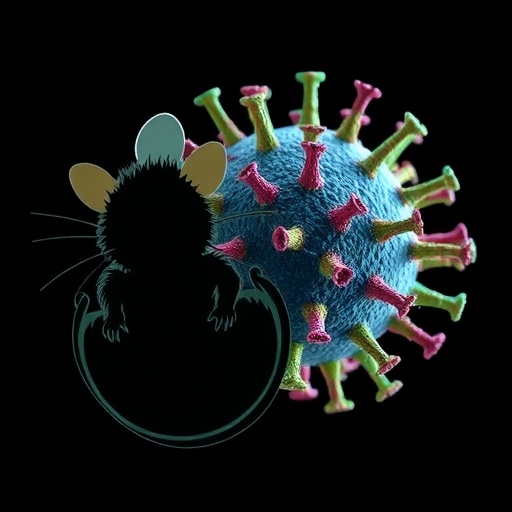
Wild rodents are emerging as important subjects in the effort to understand how coronaviruses evolve outside human populations. A new study in npj Viruses examines the genomes and evolutionary history of betacoronaviruses detected in wild Peromyscus mice and other terrestrial small mammals. The research by J.D. Kotwa, S.P. Jeeves, L. Crawshaw and colleagues focuses on a group of viruses that includes some of the most consequential pathogens known to infect humans and animals. By studying these viruses in their natural hosts, the researchers aim to clarify how coronavirus diversity is generated, maintained and potentially reshaped before viruses cross species boundaries.
The work is significant because coronavirus surveillance has historically concentrated on domesticated animals, bats and human cases, while many small terrestrial mammals remain comparatively understudied. Peromyscus mice, commonly known as deer mice, are widespread across North America and occupy a broad range of habitats, including forests, grasslands, agricultural landscapes and areas close to human settlements. Their abundance, ecological flexibility and close contact with diverse microbial communities make them useful sentinels for wildlife disease research. Examining viruses circulating in these hosts can reveal evolutionary patterns that may not be visible through clinical surveillance alone.
Betacoronaviruses are defined by their placement within the broader coronavirus family, a group of enveloped viruses with large, positive-sense single-stranded RNA genomes. Their genetic material functions directly as messenger RNA after entering a host cell, allowing the virus to produce proteins that replicate the genome and construct new viral particles. The family includes viruses with highly different biological behaviors, ranging from agents associated with mild respiratory disease to pathogens capable of causing severe human infections. Their genomes also evolve through mutation and recombination, creating a continually changing landscape that requires genomic analysis rather than classification based solely on symptoms or host species.
The researchers’ genomic approach enables viruses found in wildlife samples to be compared across their complete or near-complete genetic sequences. Such comparisons can identify conserved regions, rapidly changing genes and distinctive genomic arrangements. Particular attention in coronavirus research is often given to the spike protein, which helps the virus attach to receptors on host cells, and to other structural and nonstructural proteins involved in replication, immune evasion and particle assembly. However, evolutionary interpretation depends on the entire genome. A virus that appears similar to another species in one region may have a different history elsewhere in its genome, especially if recombination has occurred.
Recombination is a central feature of coronavirus evolution. When two related coronaviruses infect the same cell, the replication machinery can switch between RNA templates, generating a genome that contains segments from different viral lineages. This process can complicate the construction of evolutionary trees and can create new combinations of traits without requiring every genetic change to arise independently. By placing sequences from Peromyscus mice alongside those from other terrestrial small mammals and known coronavirus lineages, the study provides a framework for examining whether these viruses share recent ancestry, exchange genetic material or represent long-standing, host-associated branches.
The value of the research extends beyond identifying individual viruses. Viral genomes can act as records of ecological history, preserving evidence of host associations and transmission patterns over time. If related viruses are found in multiple mammal species, scientists can investigate whether the pattern reflects frequent spillover, shared environmental exposure or an older evolutionary relationship. Conversely, viruses restricted largely to a particular host may offer clues about ecological specialization. These distinctions matter for risk assessment because a virus that repeatedly encounters several host species may have more opportunities to adapt than one circulating within a narrowly defined ecological niche.
The study also highlights why wildlife sampling must be interpreted carefully. Detecting viral RNA in an animal does not by itself demonstrate active disease, sustained transmission or an ability to infect humans. RNA may come from a transient infection, material present in the digestive tract or environmental contamination. Genomic evidence must therefore be combined with information about the sampled animal, location, season, tissue type and related viruses in the surrounding ecosystem. Even when a virus is not an immediate threat, its presence can be valuable for establishing a baseline against which future changes in prevalence, host range or genetic composition can be measured.
For public health, the central importance of this type of work lies in preparedness rather than prediction. Most viruses discovered in wildlife will not become human pathogens, and genetic similarity alone cannot establish zoonotic potential. Nevertheless, a broader catalogue of coronavirus genomes gives researchers the tools to recognize unusual changes more quickly. Laboratory studies can then test whether particular viral proteins interact with receptors from different species, whether the virus replicates in relevant cell types and how effectively it evades immune defenses. Those experiments, together with field surveillance, can help distinguish ordinary wildlife diversity from signals that warrant closer investigation.
The findings from wild Peromyscus mice and other small mammals add to a growing view of coronavirus evolution as an ecological process shaped by host movement, habitat overlap, viral competition and genetic exchange. Rather than treating emergence as a sudden event with no detectable history, scientists increasingly seek to map the viral diversity that exists before a spillover occurs. The genomic insights reported by Kotwa, Jeeves, Crawshaw and their colleagues contribute to that effort by expanding attention beyond familiar reservoir hosts and by placing terrestrial small mammals within the wider evolutionary history of betacoronaviruses. Continued sampling across regions and seasons will be essential for determining how stable these viral communities are and how they respond to environmental change.
Cite Scienmag News
Juliet Wilcox. (August 22, 2026). Genomic Study Reveals Betacoronavirus Evolution in Wild Mice and Small Mammals. Scienmag. https://scienmag.com/genomic-study-reveals-betacoronavirus-evolution-in-wild-mice-and-small-mammals/
Juliet Wilcox. "Genomic Study Reveals Betacoronavirus Evolution in Wild Mice and Small Mammals." Scienmag, 22 August 2026, https://scienmag.com/genomic-study-reveals-betacoronavirus-evolution-in-wild-mice-and-small-mammals/. Accessed 4 September 2026.
Juliet Wilcox. "Genomic Study Reveals Betacoronavirus Evolution in Wild Mice and Small Mammals." Scienmag. August 22, 2026. https://scienmag.com/genomic-study-reveals-betacoronavirus-evolution-in-wild-mice-and-small-mammals/


