


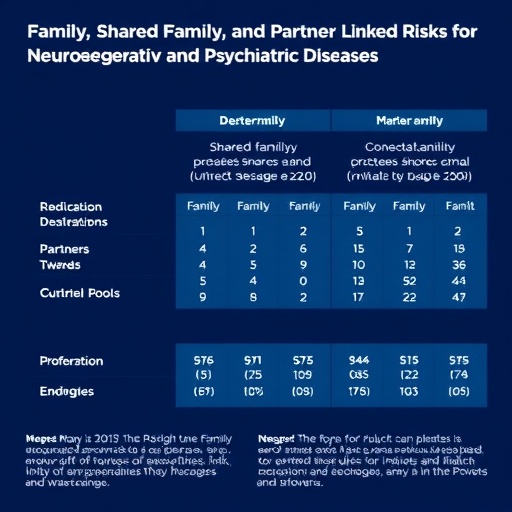
A new study published in Translational Psychiatry examines how vulnerability to neurodegenerative and psychiatric diseases may travel through families, appear across different diagnoses, and emerge between partners who are not biologically related. The research, led by J.I.R. Dijkstra, M. Hulsman, L. Waterink and colleagues, addresses one of the most difficult questions in modern medicine: when several members of a family develop brain-related disorders, how much of that pattern reflects inherited biology, how much reflects a shared upbringing or environment, and how much may be linked to the life circumstances of adult partners? By placing these three forms of association side by side, the study offers a broader view of neurological and psychiatric risk than conventional genetic studies, which often focus on DNA alone.
Neurodegenerative and psychiatric diseases are frequently investigated as separate categories. Alzheimer’s disease, Parkinson’s disease and other neurodegenerative conditions are typically associated with progressive loss of neuronal function, while depression, bipolar disorder, schizophrenia and related illnesses are classified primarily through symptoms, behavior and changes in mood or cognition. Yet the boundary between these groups is biologically porous. They can involve overlapping processes, including inflammation, altered neurotransmitter systems, vascular injury, sleep disruption, stress-response mechanisms and changes in brain network connectivity. The new analysis is important because it investigates whether a family history of one disorder may be associated with risk of another, potentially revealing shared pathways that remain hidden when diseases are studied in isolation.
The concept of familial risk is broader than inherited risk. If a condition occurs more often among the biological relatives of affected individuals than in the general population, researchers describe this as familial aggregation. Such aggregation can arise from genetic variants passed between generations, but it can also reflect shared diet, education, socioeconomic conditions, exposure to toxins, access to medical care, cultural habits or patterns of stress. Even prenatal conditions and early-life experiences can contribute. A family-based association therefore does not prove that a disease is genetically determined. Instead, it signals that something connected to family relationships may be influencing susceptibility, and it creates a starting point for separating biological inheritance from environmental transmission.
The study also considers shared familial risk, a particularly revealing pattern in which relatives show elevated rates of different disorders rather than the same diagnosis. For example, if a person with a neurodegenerative disease has relatives with psychiatric conditions, that could indicate overlapping biological liability. This liability may involve common genetic architecture: many brain disorders are polygenic, meaning that thousands of genetic variants, each exerting a tiny effect, collectively influence risk. Genes affecting synaptic signaling, immune regulation, neuronal maintenance or energy metabolism could theoretically contribute to more than one disease. Shared familial risk may also reflect common environmental exposures, diagnostic practices or family-level behaviors, so it must be interpreted as evidence of connection rather than proof of a specific mechanism.
A distinctive feature of the research is its attention to partner-associated risk. Spouses and long-term partners generally do not share most of their inherited DNA, particularly when they come from unrelated backgrounds. If partners develop similar diseases, or if one partner’s diagnosis is associated with the other partner’s later diagnosis, the pattern may point toward non-genetic influences. Couples often share homes, neighborhoods, diets, sleep schedules, financial pressures, social networks and health behaviors. They may also influence each other’s willingness to seek medical care. In addition, people are not paired randomly: similarities in education, personality, socioeconomic position and health behaviors can shape partner selection, a phenomenon known as assortative mating.
Partner associations are therefore a valuable comparison for interpreting family findings. A strong association among biological relatives but a weak association among partners would be more consistent with inherited or early-life factors, although it would not establish a purely genetic cause. Conversely, comparable associations among relatives and partners could suggest that shared adult environments, social conditions or health behaviors play a substantial role. The distinction is not absolute. Partners may also share exposures indirectly, while biological relatives may live apart for decades. The study’s three-part framework—familial risk, cross-disease familial risk and partner-associated risk—helps researchers estimate the relative contribution of these overlapping influences without treating any single source as definitive.
Technically, this kind of investigation relies on comparing disease occurrence across connected groups and estimating whether diagnoses appear more often than expected. Researchers must account for age, sex, calendar period and the fact that medical diagnoses are recorded unevenly across populations. Statistical models may express the association as a relative risk or hazard ratio, comparing the probability or rate of disease in people connected to an affected relative or partner with that of an appropriate reference group. Such estimates are not individual predictions. A raised relative risk may correspond to a small absolute increase when the underlying disease is rare, while a modest relative risk can still matter at the population level if millions of people are exposed to the relevant factor.
The findings are especially relevant to the emerging idea of shared brain-health biology. Neurodegenerative diseases and psychiatric illnesses do not arise from one pathway, and the study does not reduce them to a single inherited explanation. Instead, it supports a model in which vulnerability is distributed across multiple layers: genetic predisposition, early development, immune and metabolic health, social environment, behavior and the timing of diagnosis. Some risk factors may operate across disease categories, while others may be specific to an individual disorder. Recognizing that complexity could help researchers design studies that measure cognition, mood, inflammation, sleep and vascular health together rather than placing every patient into a single diagnostic box.
The results could eventually influence clinical conversations about family history. At present, family history is often collected as a simple checklist: a parent, sibling or child had a particular disease. A more informative approach would record the type of disorder, the age at diagnosis, the number of affected relatives and whether diagnoses cluster across neurological and psychiatric categories. However, the study does not mean that people with an affected relative or partner are destined to develop a brain disorder. Familial associations are probabilistic, not deterministic, and they can reflect factors that are modifiable. Exercise, cardiovascular-risk control, sleep, social connection, treatment of depression and protection from head injury may all remain important regardless of inherited vulnerability.
The research also highlights why prevention studies must move beyond the idea of a single “disease gene.” Genetic data can identify biological pathways, but family and partner comparisons reveal how those pathways interact with lived experience. Future investigations combining national health records, genomic information, electronic medical histories, environmental measurements and long-term behavioral data may clarify which associations are inherited, which are shared, and which arise through mutual influence. For now, the study’s central message is both scientifically cautious and widely relevant: the origins of brain disease are written neither entirely in DNA nor entirely in personal choice. They unfold through relationships, biology and time, and understanding that network may be one of the most promising routes toward earlier detection and more precise prevention.
Cite Scienmag News
Glenn Wilkins. (August 22, 2026). Family, Shared Family, and Partner-Linked Risks for Neurodegenerative and Psychiatric Diseases. Scienmag. https://scienmag.com/family-shared-family-and-partner-linked-risks-for-neurodegenerative-and-psychiatric-diseases/
Glenn Wilkins. "Family, Shared Family, and Partner-Linked Risks for Neurodegenerative and Psychiatric Diseases." Scienmag, 22 August 2026, https://scienmag.com/family-shared-family-and-partner-linked-risks-for-neurodegenerative-and-psychiatric-diseases/. Accessed 4 September 2026.
Glenn Wilkins. "Family, Shared Family, and Partner-Linked Risks for Neurodegenerative and Psychiatric Diseases." Scienmag. August 22, 2026. https://scienmag.com/family-shared-family-and-partner-linked-risks-for-neurodegenerative-and-psychiatric-diseases/


