


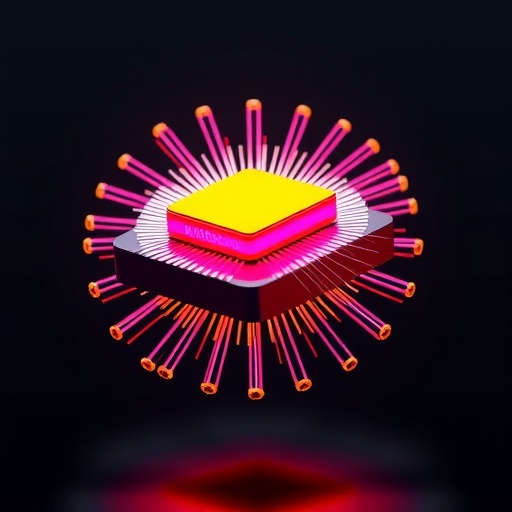
Researchers at the FAMU-FSU College of Engineering and the Florida State University-headquartered National High Magnetic Field Laboratory have proposed a new architecture for quantum computers that could eliminate one of the most frustrating sources of unpredictability in electron-on-neon qubits: microscopic imperfections in the surface where the qubit must operate. Their design uses superconducting magnetic circuits to levitate tiny solid-neon particles above a chip, creating clean, deliberately positioned platforms for electrons rather than relying on random nanoscale features that form during fabrication. The approach, described in the journal PRX Quantum, could offer a new route toward reproducible quantum processors built from arrays of individually engineered qubits.
Quantum computers depend on quantum bits, or qubits, which can exist in a combination of logical states before measurement rather than being restricted to the binary 0 or 1 used by conventional computers. This unusual behavior allows quantum algorithms to manipulate probabilities and correlations in ways that have no direct classical equivalent. However, the same fragility that makes qubits powerful also makes them difficult to manufacture. A qubit can be disturbed by electrical noise, material defects, vibrations, temperature changes or tiny variations in its surrounding environment. At the scale of a few nanometers, even a minute bump or depression on a surface can alter how an electron is confined and can cause different devices fabricated on the same chip to behave differently.
Electron-on-neon qubits are designed to avoid many of the impurities associated with conventional solid-state systems. In this platform, a single electron is held above a layer or particle of solid neon. Neon is chemically inert and can provide an exceptionally clean environment, allowing the electron to retain its quantum information for comparatively long periods. The electron’s motion and energy can be manipulated using microwave signals delivered through circuits patterned into a nearby chip. Yet the apparent simplicity of the concept hides a serious engineering problem. When neon is deposited directly onto a surface, its microscopic landscape can contain random features that act as accidental traps. Some traps may confine electrons in useful ways, while others can destabilize them or make them difficult to control.
The new proposal changes the geometry of the device instead of attempting to manufacture a perfectly uniform surface. The researchers envision nearly spherical solid-neon microparticles held just above a chip by superconducting loops. These loops would generate magnetic fields strong enough to support and position the particles without requiring them to rest directly on the substrate. The result is a floating, clean neon carrier that can serve as a controlled home for an electron qubit. Rather than searching for a favorable nanoscale defect after fabrication, engineers could determine where each neon particle belongs and design the surrounding circuitry to interact with it at that location.
Magnetic levitation is central to the architecture because it separates the quantum material from the roughness and contamination of the underlying chip. The superconducting loops are intended to provide the forces needed to stabilize the particles, while microwave resonators and patterned electrical structures would control and read the electron states. In practical terms, the neon particle would act like a tiny floating island, and the chip beneath it would function as the infrastructure connecting that island to the rest of the quantum processor. This division of roles could allow researchers to combine the cleanliness of a cryogenic quantum material with the precision and scalability of lithographically fabricated electronics.
According to the researchers, the design incorporates several ingredients needed for a useful quantum device. The electron must remain confined above the neon, its energy levels must be adjustable, and its state must be coupled strongly enough to microwave circuits for initialization, manipulation and measurement. Neighboring qubits must also be able to communicate, since entangling operations are essential to quantum computation. The proposed layout is intended to support these functions through carefully arranged superconducting loops and resonators. By making the position of each qubit a design choice, the researchers hope to reduce device-to-device variation, limit unwanted charge noise and make the construction of larger arrays more predictable.
The concept does not represent a complete quantum computer, and the researchers emphasize that an experimental demonstration is still required. The paper is a device architecture and feasibility study rather than a report of a working processor containing a large number of levitated qubits. Important challenges remain, including reliably producing and positioning uniform solid-neon particles, maintaining stable levitation at the extremely low temperatures required for superconducting circuits and ensuring that the magnetic fields do not interfere with qubit control. Researchers will also need to demonstrate that electrons can be loaded onto the particles, held there without loss and coupled efficiently to the microwave hardware.
Even so, the proposal addresses a problem that becomes more serious as quantum processors grow. In a small laboratory experiment, researchers may be able to identify and tune individual devices by hand. A scalable processor containing hundreds or thousands of qubits cannot depend on every element having a different, unpredictable microscopic landscape. Reproducibility is therefore as important as coherence: engineers need qubits that can be fabricated in known locations, characterized using similar procedures and connected through a regular architecture. Floating neon particles could provide a modular way to create such arrays, allowing the quantum carriers and the control circuitry to be developed as complementary components rather than forcing both functions into one imperfect material surface.
The work was led by researchers affiliated with Florida State University, the FAMU-FSU College of Engineering and the National High Magnetic Field Laboratory, with contributions from the University of Notre Dame. Wei Guo, Yinghe Qi and Yiming Xing were among the study’s authors, along with FSU researchers Sosuke Inui and Charles Peretti and Notre Dame’s Dafei Jin. The team plans to use the proposed design as a foundation for a working electron-on-neon prototype. If the technology can be demonstrated experimentally, it could help transform electron-on-neon qubits from a promising but highly specialized platform into a more systematic approach to quantum-device engineering—one in which the location and environment of each qubit are engineered deliberately rather than discovered by chance.
Web References:
https://eng.famu.fsu.edu/
https://nationalmaglab.org/
https://journals.aps.org/prxquantum/abstract/10.1103/j7mn-x9f2
References:
DOI: 10.1103/j7mn-x9f2
Cite Scienmag News
Katie Riggs. (August 21, 2026). FAMU-FSU Engineers Create Magnetically Levitated Quantum Bit. Scienmag. https://scienmag.com/famu-fsu-engineers-create-magnetically-levitated-quantum-bit/
Katie Riggs. "FAMU-FSU Engineers Create Magnetically Levitated Quantum Bit." Scienmag, 21 August 2026, https://scienmag.com/famu-fsu-engineers-create-magnetically-levitated-quantum-bit/. Accessed 4 September 2026.
Katie Riggs. "FAMU-FSU Engineers Create Magnetically Levitated Quantum Bit." Scienmag. August 21, 2026. https://scienmag.com/famu-fsu-engineers-create-magnetically-levitated-quantum-bit/


