


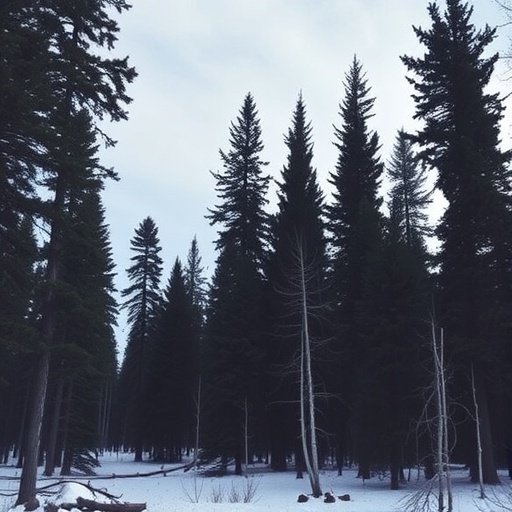
Richmond Hill, Ontario, 20 August 2026 — Canada’s boreal forests are often presented as a powerful natural climate solution: trees remove carbon dioxide from the atmosphere, store carbon in biomass and soils, and help offset emissions. But a new analysis warns that some forests may be delivering considerably less cooling than their carbon balance suggests. In snow-covered regions, dense evergreen plantations can absorb large amounts of winter sunlight, creating surface warming that may cancel out 6 to 20 percent of their reported carbon-related climate benefit. The finding, presented in a new Policy Brief from the United Nations University Institute for Water, Environment and Health, challenges a central assumption behind many reforestation and carbon-crediting programs: that more stored carbon automatically means greater climate protection.
The report, “From Carbon Accounting to Net Cooling: Securing the Albedo-Carbon Double Win in Canada’s Boreal Forest,” argues that Canada should evaluate forest restoration according to its net effect on the climate rather than carbon storage alone. The authors, from UNU-INWEH, the University of Waterloo and Polytechnique Montréal, say current accounting systems generally recognize carbon absorbed by growing trees but fail to fully account for changes in the land surface’s reflectivity, or albedo. That omission is especially important in the far North, where snow can cover the ground for months. Bright, open snow reflects much of the incoming solar radiation back into space. A dark spruce canopy, by contrast, absorbs more of that energy, warming the land surface even while the trees remove carbon dioxide from the atmosphere.
The physical mechanism is straightforward but often absent from carbon ledgers. Albedo describes the fraction of sunlight reflected by a surface. Fresh snow has a high albedo, while conifer foliage has a much lower one. When evergreen trees rise above a snow-covered landscape, their needles and branches intercept sunlight that would otherwise have been reflected by the snowpack. The absorbed radiation increases surface energy, potentially affecting local temperatures, snowmelt timing and the exchange of heat between the land and atmosphere. This warming influence does not erase the carbon uptake of the forest, but it reduces the forest’s overall cooling effect. In the Taiga Plains, the evidence reviewed by the authors indicates that the additional heat absorbed by dark spruce stands can offset between 6 and 20 percent of the climate benefit calculated from their carbon gains.
That percentage becomes consequential when multiplied across large restoration programs and carbon markets. Afforestation and reforestation are central components of Canada’s climate commitments, and public funds are increasingly directed toward planting or regenerating forests as a way to remove carbon from the atmosphere. If projects receive credit for carbon storage while ignoring the warming caused by reduced snow reflectivity, their climate performance may be overstated. The report describes this as a policy failure rather than a lack of scientific knowledge. “Canada has an opportunity here that few countries have,” said Professor Kaveh Madani, Director of UNU-INWEH. He said the country could become the first to verify forests according to what they do to the climate, rather than what they store in carbon inventories, protecting both public investment and the credibility of the credits issued.
The missing calculation is not the only weakness identified by the researchers. Carbon stored in a forest is not necessarily permanent, particularly in a boreal region experiencing warmer temperatures, longer fire seasons and more frequent drought stress. A plantation may accumulate carbon for decades and then release much of it rapidly through wildfire. In that case, the original carbon benefit is reversed, while the albedo effect may have contributed to additional warming during the years when the forest was standing. “A forest can pass a carbon audit and still leave the surface warmer than it was,” said Professor Pooneh Maghoul, Lead for Sustainable Infrastructure in Cold Regions at UNU-INWEH. “The ledger is incomplete, and in the North the missing entry is large enough to change the answer.”
The report’s modeling suggests that forest design can determine whether a project produces a durable climate benefit. Mixed stands containing approximately 25 to 40 percent deciduous trees, planted at moderate densities of about 600 to 1,400 trees per hectare, can retain substantial carbon while preserving more of the landscape’s reflective winter surface. Deciduous species such as aspen shed their leaves, allowing more sunlight to reach and reflect from the snow during the coldest months. Their presence may also interrupt the continuity of fuels that allows fires to spread rapidly through dense conifer stands. The authors identify a mixed stand containing roughly 25 percent aspen as a particularly effective configuration, combining rapid early growth with longer-term carbon retention and a stronger cooling effect than conifer-only plantations.
Planting density also matters because it influences both the water balance and the probability of severe fire. Dense evergreen stands can create intense competition for soil moisture, especially as temperatures rise and evaporation increases. When drought conditions develop, stressed trees become more vulnerable to insects, disease and fire. Closely spaced trees and continuous layers of needles, branches and understory vegetation can then provide the connected fuel needed for high-severity burning. “The question isn’t how many trees we plant,” Maghoul said. “It’s what we plant, how densely, and whether the site can still hold water in thirty years.” The report concludes that in a warming boreal system, wildfire—not growth rate or planting volume—is the primary constraint on the durability of forest-based carbon removal.
The researchers recommend that Canada establish a Net Cooling Standard for publicly supported reforestation. Under such a system, projects would receive credit for atmospheric carbon removal but would also be assessed for their “Albedo Penalty,” the warming associated with reduced surface reflectivity. Projects would additionally be screened for wildfire permanence risk, hydrological viability and the likelihood that carbon storage will persist under future climate conditions. The authors call for restoration to be concentrated on under-stocked land capable of supporting trees without exhausting available soil moisture. They also propose a satellite-supported national monitoring platform that could track forest cover, snow reflectivity, soil moisture, fuel accumulation and changes in fire risk over time.
Such monitoring would allow forest policies to be adjusted as conditions change rather than treating a planting project as successful once seedlings are established. Satellite observations can measure surface reflectivity across large and remote areas, while thermal data can help identify changes in land-surface energy and moisture stress. Repeated observations could also reveal whether a forest is becoming denser, drier or more vulnerable to fire than anticipated. The report recommends partial harvesting followed by prompt mixed-species replanting as a more stable alternative to full clearcut cycles, which can produce abrupt changes in albedo, carbon storage, fuel conditions and local hydrology. The authors say the goal is not to reject forests as a climate solution, but to replace a one-dimensional carbon metric with a fuller accounting of how forests interact with snow, sunlight, water and fire.
The findings arrive as governments and companies increasingly rely on forests to balance emissions and generate carbon credits. The Policy Brief argues that the next generation of forest climate policies must measure net temperature impact, not simply the number of trees planted or tonnes of carbon reported. Canada’s boreal forest can still provide major benefits, but those benefits depend on species composition, density, water availability, snow conditions and long-term fire resilience. A forest that grows quickly but burns easily or absorbs substantially more winter sunlight may be a weaker climate asset than a slower-growing, mixed stand that stores carbon more reliably while keeping the land surface brighter. The central message is therefore both simple and technically demanding: climate-positive reforestation must win twice, by removing carbon from the atmosphere and by maintaining the reflective, resilient landscapes that help keep the planet cool.
News Publication Date: 20 August 2026
Web References: https://unu.edu/publication/carbon-accounting-net-cooling-securing-albedo-carbon-double-win-canadas-boreal-forest-0; https://unu.edu/inweh
References: Ofosu, E., Dsouza, K. B., Amaogu, D. C., Pigeon, J., Boudreault, R., Shokri, N., Moreno-Cruz, J., Matin, M., Madani, K., Maghoul, P., and Leonenko, Y. (2026). From Carbon Accounting to Net Cooling: Securing the Albedo-Carbon Double Win in Canada’s Boreal Forest. United Nations University Institute for Water, Environment and Health. DOI: 10.53328/INR26RPM001
Cite Scienmag News
Courtney Benton. (August 20, 2026). Canada’s dark boreal forests absorb heat, erasing up to one-fifth climate benefits. Scienmag. https://scienmag.com/canadas-dark-boreal-forests-absorb-heat-erasing-up-to-one-fifth-climate-benefits/
Courtney Benton. "Canada’s dark boreal forests absorb heat, erasing up to one-fifth climate benefits." Scienmag, 20 August 2026, https://scienmag.com/canadas-dark-boreal-forests-absorb-heat-erasing-up-to-one-fifth-climate-benefits/. Accessed 3 September 2026.
Courtney Benton. "Canada’s dark boreal forests absorb heat, erasing up to one-fifth climate benefits." Scienmag. August 20, 2026. https://scienmag.com/canadas-dark-boreal-forests-absorb-heat-erasing-up-to-one-fifth-climate-benefits/


