


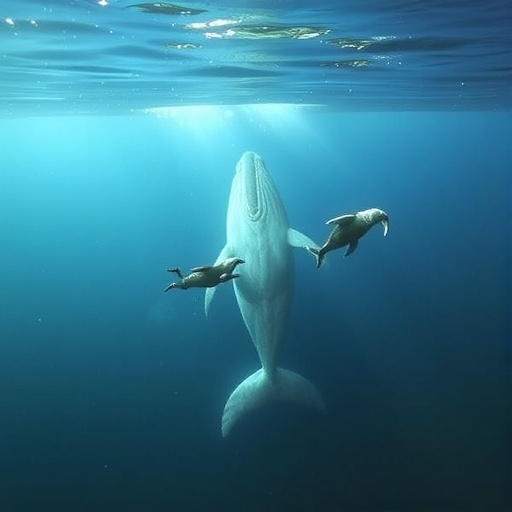
A dramatic transformation is unfolding along Greenland’s eastern coast, where warming seas and retreating summer sea ice have opened a new feeding ground for thousands of baleen whales. Fin whales, humpback whales, and common minke whales are now gathering in remarkable numbers in the Greenland Sea, including waters north of the Arctic Circle where these species were once rarely seen. Researchers say the change is more than an unusual wildlife spectacle: it is evidence that climate change is reorganizing one of the Arctic’s marine ecosystems from the bottom of the food web upward.
The findings, reported by researchers from Greenland, Denmark, and Iceland in Frontiers in Marine Science, show that baleen whales have become a regular presence along the East Greenland coast as far north as 70°N. The whales appear to be following the movement of capelin, a small, cold-water fish that has shifted its feeding grounds toward the Greenland Sea since the mid-2000s. Because baleen whales consume large quantities of prey by filtering seawater through keratin plates in their mouths, the arrival of thousands of animals could significantly alter the flow of energy through the region’s food chain.
“The rising ocean temperatures and declining sea-ice cover have facilitated the widespread occurrence of baleen whales along the East Greenland coast,” said Professor Mads Peter Heide-Jørgensen of the Greenland Institute of Natural Resources. The newly established feeding areas have brought together three species that historically were only sporadically observed in coastal East Greenland. Fin whales, humpbacks, and minkes have been documented feeding side by side, sometimes forming mixed aggregations that resemble vast, coordinated hunting events.
The environmental conditions that made this possible have changed rapidly. The North Atlantic and much of the Arctic are warming faster than the global average, and sea-surface temperatures east of Greenland have increased by approximately 2°C since the 1990s. At the same time, the summer ice edge moved substantially northward after the mid-2000s, reducing the concentration of pack ice along the coast. Baleen whales generally avoid heavily ice-covered waters, so the retreat of sea ice has created a longer, more accessible season in which open-water predators can exploit prey that was previously difficult to reach.
To track the shift, the scientists assembled one of the most comprehensive records yet compiled for baleen whales in the Greenland Sea. They carried out systematic aerial surveys up to 50 kilometres offshore in August 2015 and 2024, supplemented those observations with additional flights in 2022, and incorporated reports from Inuit hunters collected between 2023 and 2025. The team also examined records from ship-based North Atlantic Sighting Surveys dating back to 1987 and analyzed movement data from 15 satellite-tagged baleen whales tracked at different times between 2019 and 2025.
The researchers used a mathematical model to compare whale occurrence with environmental variables including sea-surface temperature, salinity, and the concentration of sea ice. This approach allowed them to distinguish a sustained ecological trend from the random fluctuations that can occur when animals are observed across a vast and difficult-to-survey ocean. Across the different data sources, the pattern was consistent: baleen whales became increasingly common along the East Greenland coast north of 60°N and west of 29°W.
The most striking increase involved humpback whales. Ship-based surveys recorded no humpbacks in the region until 2006, followed by seven sightings in 2007, 26 by 2015, and more than 150 by 2024. Minke whale sightings were also rare until the mid-1990s, but after 2001 vessels began encountering between 10 and 20 animals almost every year. Fin whale observations rose sharply as well. In August 2025, a ship crew reported aggregations of as many as 50 baleen whales at a time near 69°N, while aerial surveys in 2015 and 2024 found an almost continuous distribution of all three species between 60°N and 70°N.
Using the survey results, the researchers estimated that approximately 4,000 humpback whales, 6,000 fin whales, and 6,000 minke whales visited the Greenland Sea during the summer of 2024. The animals were not merely passing through. Their distribution, behavior, and the timing of their arrival indicate that they were using East Greenland’s coastal waters primarily as a seasonal feeding ground. The likely target is capelin, a small schooling fish that plays a pivotal ecological role because it transfers energy from plankton to larger predators, including whales, seals, seabirds, and commercially important fish.
Capelin are strongly associated with cold-water environments, but their feeding grounds have shifted since the mid-2000s from relatively warmer waters north of Iceland toward the Greenland Sea. The whales appear to have followed this redistribution of prey. This is a classic example of a climate-driven “match” between predator movement and prey movement: as ocean conditions alter where capelin can feed, whales adjust their migration and foraging patterns to remain near dense concentrations of fish. The effect can be rapid because baleen whales are highly mobile and can travel hundreds or thousands of kilometres between seasonal habitats.
The ecological consequences could extend well beyond the whales themselves. East Greenland is already experiencing what the researchers describe as a major regime shift, in which species adapted to sea ice increasingly share space with, or are displaced by, temperate species that prefer open water. Narwhals and other ice-associated animals may face growing competition for habitat as large baleen whales expand northward. The new whale aggregations could also influence capelin availability for seabirds and other predators, redistribute nutrients through whale feeding and waste, and increase the risk of entanglement or ship strikes as marine traffic expands in newly ice-free waters.
For now, direct competition with commercial fisheries appears limited because capelin has never been commercially harvested in this part of Greenland. That could change if the region becomes economically accessible or if shifting fish populations attract new fishing interest. The researchers emphasize that the whale influx should not be interpreted simply as a climate success story. Some species may benefit temporarily from warmer, more productive waters, while others lose habitat, face unfamiliar competitors, or encounter new human pressures. The gathering of thousands of whales off East Greenland is therefore both a spectacular wildlife event and a warning signal: the Arctic marine ecosystem is being rapidly rearranged, and its future will depend on how quickly its predators, prey, ice, and human activities continue to change.
News Publication Date: 20-Aug-2026
Web References: https://www.frontiersin.org/journals/marine-science/articles/10.3389/fmars.2026.1839547/full
References: Frontiers in Marine Science, DOI: 10.3389/fmars.2026.1839547
Cite Scienmag News
Gavin Prescott. (August 20, 2026). Warming Waters Trigger Summer Whale Feeding Frenzies Off Greenland. Scienmag. https://scienmag.com/warming-waters-trigger-summer-whale-feeding-frenzies-off-greenland/
Gavin Prescott. "Warming Waters Trigger Summer Whale Feeding Frenzies Off Greenland." Scienmag, 20 August 2026, https://scienmag.com/warming-waters-trigger-summer-whale-feeding-frenzies-off-greenland/. Accessed 4 September 2026.
Gavin Prescott. "Warming Waters Trigger Summer Whale Feeding Frenzies Off Greenland." Scienmag. August 20, 2026. https://scienmag.com/warming-waters-trigger-summer-whale-feeding-frenzies-off-greenland/


