


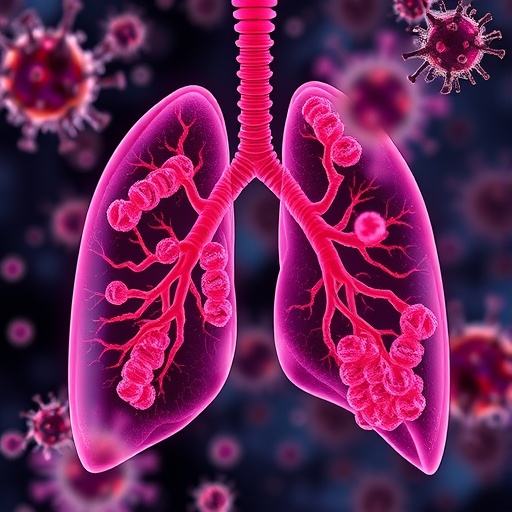
Researchers at the Johns Hopkins Kimmel Cancer Center and the Bloomberg~Kimmel Institute for Cancer Immunotherapy have identified a potential way to turn bacteria living inside lung tumors into partners for cancer treatment. In a preclinical study published Aug. 18 in Proceedings of the National Academy of Sciences, the team reported that tumor-associated bacteria can amplify the activity of mucosal-associated invariant T cells, or MAIT cells, when they are exposed to a metabolite derived from vitamin B2. The findings suggest that the interaction between bacterial molecules and immune cells may be harnessed to stimulate antitumor immunity, although the strategy remains at an experimental stage and has not yet been tested as a treatment in people.
The mechanism centers on a molecule called MR1, a protein displayed on the surface of antigen-presenting immune cells. These cells, which include dendritic cells and macrophages, normally process molecular signals from microbes or damaged tissue and use surface proteins to alert specialized lymphocytes. MR1 is unusual because it presents small molecules produced during the synthesis and breakdown of vitamin B2, also known as riboflavin. MAIT cells carry receptors specifically adapted to recognize these MR1-bound metabolites, allowing them to respond rapidly to bacterial activity. Unlike conventional T cells, which often recognize highly individualized protein fragments, MAIT cells are tuned to a relatively conserved microbial pathway.
The Johns Hopkins researchers focused on a vitamin B2 metabolite known to interact with the MR1-MAIT cell system. In laboratory experiments, they combined the metabolite with bacteria isolated or identified in lung tumors and observed a marked increase in MR1 expression on antigen-presenting cells. Higher levels of MR1 created more molecular platforms through which MAIT cells could be stimulated. Once activated, MAIT cells can release inflammatory signaling proteins, including interferon-gamma and tumor necrosis factor, and can develop cytotoxic activity that enables them to attack abnormal cells. The study therefore points to a two-part biological trigger: bacteria provide the surrounding microbial context, while the metabolite helps raise the visibility of that context to the immune system.
The result was unexpected because the investigators initially assumed that the most effective bacteria would be those capable of producing vitamin B2 metabolites themselves. Instead, one strain of Enterococcus that did not produce the relevant metabolite substantially enhanced MAIT cell activation when the metabolite was added to cell cultures. This observation indicates that tumor-associated microbes may influence immunity without directly supplying the activating compound. Bacteria can alter the behavior of neighboring cells through surface structures, secreted products, nutrient consumption and inflammatory signals. In this case, the enterococcal species appeared to create conditions in which the vitamin B2 metabolite could more effectively increase MR1 expression and promote communication between antigen-presenting cells and MAIT cells.
The discovery emerged from an interdisciplinary analysis that combined microbiome sequencing, RNA sequencing of immune cells from patient samples and controlled cell culture experiments. By examining the bacterial communities present in human lung tumors alongside gene-expression patterns in immune cells, the researchers found evidence that the microbial composition of the tumor could be linked to regulation of the MR1 pathway. These findings are important because solid tumors are not sterile masses of cancer cells. They contain immune cells, blood vessels, connective tissue, metabolites and, in many cases, complex microbial communities. Those communities may shape whether the tumor microenvironment suppresses immune activity or permits immune cells to recognize and attack malignant tissue.
MAIT cells have received less attention in oncology than the conventional T cells targeted by many modern immunotherapies. Immune checkpoint inhibitors, including drugs that block the PD-1 pathway, are designed to release inhibitory signals that restrain adaptive T cells. When successful, this treatment can restore the ability of those cells to recognize tumor-associated antigens and kill cancer cells. MAIT cells belong to a different branch of immune defense. They are abundant in tissues exposed to the outside environment, such as the lungs and intestines, where they act as rapid responders to infection or injury. Their semi-invariant T-cell receptors allow them to recognize microbial metabolites presented by MR1 rather than the highly variable peptide antigens recognized by most adaptive T cells.
Evidence from patient samples provided an additional clue about the possible relevance of the pathway. In an earlier study of people with lung cancer who received neoadjuvant PD-1 blockade before surgery, Pakhi Birla, who led the new work during her doctoral research, examined immune features associated with treatment response. One patient who responded particularly well had a large population of MAIT cells in the tumor. This observation does not establish that MAIT cells caused the response, but it is consistent with the possibility that these cells contribute to effective immunotherapy in at least some tumors. The new laboratory findings offer a potential explanation for how bacterial signals could help activate MAIT cells within the tumor microenvironment.
The investigators are now conducting studies in mice to determine whether delivering the vitamin B2 metabolite directly into lung tumors can produce a measurable immune response. Such experiments will be necessary to establish whether the pathway can influence tumor growth, whether activated MAIT cells can reach and destroy cancer cells, and whether the treatment can be administered safely. A metabolite that stimulates immune activity in a culture dish may behave differently in a living organism, where it could be rapidly degraded, distributed to healthy tissues or blocked by the tumor’s immunosuppressive environment. The researchers will also need to determine which bacterial species, combinations of species or bacterial products are required for the response.
A second direction involves engineering T cells to recognize MR1. Current cell-based immunotherapies, such as some forms of engineered T-cell therapy, generally require receptors that target antigens differing among patients and tumor types. Because MR1 is expressed across many human tissues and presents metabolites from a conserved biochemical pathway, an MR1-directed therapy could, in principle, have broader application than highly personalized approaches. However, this possibility carries substantial safety challenges. MR1 is found on normal cells, and an engineered immune cell that recognizes MR1-associated signals must distinguish malignant tissue from healthy tissue. Before any human trial could be considered, researchers would need to demonstrate precise tumor selectivity, control excessive inflammation and prevent damage to essential organs.
The study’s authors emphasize that the work represents a new immunotherapy concept rather than an established cancer treatment. Its central insight is that tumor-associated bacteria may regulate immune surveillance by controlling how strongly antigen-presenting cells display MR1, while vitamin B2 metabolites provide the biochemical signal that activates MAIT cells. If future animal studies and clinical research confirm the effect, the approach could eventually complement checkpoint inhibitors or other immunotherapies by engaging an underused arm of the immune system. The long-term vision is a broadly applicable, potentially off-the-shelf treatment that does not need to be individually customized for every patient. For now, the results deepen scientists’ understanding of the tumor microbiome and reveal another way that microbial chemistry may determine whether the immune system sees cancer as a threat.
News Publication Date: August 18 (year not specified in the source).
Web References: Proceedings of the National Academy of Sciences; Johns Hopkins Kimmel Cancer Center; Bloomberg~Kimmel Institute for Cancer Immunotherapy.
References: Study published in Proceedings of the National Academy of Sciences; research supported by the Commonwealth Foundation and the Bloomberg~Kimmel Institute for Cancer Immunotherapy.
Cite Scienmag News
Nathaniel Bowman. (August 20, 2026). Lung tumor bacteria may stimulate the immune system against cancer. Scienmag. https://scienmag.com/lung-tumor-bacteria-may-stimulate-the-immune-system-against-cancer/
Nathaniel Bowman. "Lung tumor bacteria may stimulate the immune system against cancer." Scienmag, 20 August 2026, https://scienmag.com/lung-tumor-bacteria-may-stimulate-the-immune-system-against-cancer/. Accessed 4 September 2026.
Nathaniel Bowman. "Lung tumor bacteria may stimulate the immune system against cancer." Scienmag. August 20, 2026. https://scienmag.com/lung-tumor-bacteria-may-stimulate-the-immune-system-against-cancer/


