


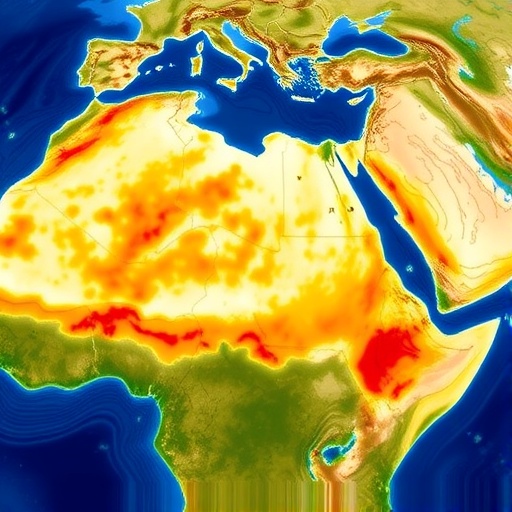
Barcelona, 19 August 2026 — Climate patterns in the Atlantic Ocean can help predict outbreaks of cutaneous leishmaniasis in North Africa up to a year before they occur, according to a new study led by the Barcelona Institute for Global Health (ISGlobal) in collaboration with researchers from the Pasteur Institutes of Tunisia, Morocco and France. Published in Science Advances, the research identifies a chain of climate and ecological processes linking Atlantic variability to the transmission of a parasitic disease that affects vulnerable communities across the Mediterranean region. By combining oceanic and atmospheric climate signals with local weather and disease-transmission data, the researchers developed a seasonal forecasting system capable of estimating both the timing and intensity of outbreaks caused by Leishmania major and Leishmania tropica.
Cutaneous leishmaniasis is transmitted through the bite of infected Phlebotomine sand flies. The disease is rarely fatal, but its effects can be severe and long-lasting. Infected people typically develop skin lesions or ulcers that may remain for months or years, sometimes leaving permanent scars. These visible wounds can cause pain, disability, stigma and psychological distress, particularly when they occur on the face or other exposed areas of the body. The World Health Organization estimates that approximately one million new cutaneous leishmaniasis cases occur worldwide each year, with major concentrations in the Mediterranean Basin, the Middle East, Central Asia and the Americas. Transmission depends on interactions among the parasite, sand flies, animal reservoir hosts and environmental conditions, making the disease highly sensitive to climate.
The new study focuses on two large-scale patterns of Atlantic climate variability: the North Atlantic Oscillation, or NAO, and Atlantic Multidecadal Variability, known as AMV. The NAO describes changes in the difference in atmospheric pressure between the Azores and Iceland. These pressure changes influence the strength and direction of westerly winds, as well as the movement of storms and moisture across the Atlantic and into Europe and North Africa. AMV refers to slow fluctuations in North Atlantic sea-surface temperatures that develop over several years or decades. Although these phenomena operate on different timescales, the researchers found that their interaction can shape rainfall across North Africa. Because ocean temperatures and certain atmospheric circulation patterns retain measurable information about previous climate conditions, they can provide a degree of predictability well beyond the range of ordinary weather forecasts.
Rainfall is a critical link between Atlantic climate variability and leishmaniasis transmission. In the arid and semi-arid landscapes of Morocco and Tunisia, even relatively modest changes in precipitation can stimulate vegetation growth. Increased vegetation alters the availability of food and shelter for rodents, several of which serve as reservoir hosts for Leishmania parasites. When rodent populations increase or become more concentrated in suitable habitats, infected sand flies may encounter reservoir hosts more frequently. The parasites can then circulate more efficiently through the rodent–sand fly system, increasing the probability that humans will be bitten by infected insects. Temperature also affects sand-fly development, survival and parasite replication, while rainfall influences the condition of the soil and microhabitats where the insects breed and rest. Together, these factors create a delayed ecological response to climate conditions.
The desert environment was especially important to the researchers because it acts as a relatively clear natural filter for climate signals. Compared with wetter regions, deserts are influenced by fewer competing environmental processes, allowing the relationship between Atlantic variability and rainfall to emerge more distinctly. “The desert acts as a natural filter that reveals the Atlantic’s climate memory,” said Adrià San-José, an ISGlobal researcher and first author of the study. The team identified parts of the deserts of Tunisia and Morocco where rainfall was sufficiently predictable to support disease forecasting. Their analysis showed that the climate signal was not simply transferred directly from the Atlantic to human cases. Instead, it propagated through a sequence of intermediate processes involving atmospheric circulation, precipitation, vegetation, rodents, sand flies and parasite transmission.
To translate those relationships into an operational tool, the researchers built a dynamic transmission model representing the movement of the parasite between humans, sand flies and rodents. Unlike a statistical model that only links past weather patterns with recorded cases, a dynamic model attempts to reproduce the biological mechanisms underlying transmission. It incorporates local temperature and rainfall, information on Atlantic sea-surface temperatures, atmospheric pressure patterns and the timing of disease cases. The model can therefore account for delays between climate conditions and outbreaks. Rainfall may first affect vegetation, followed by changes in rodent abundance and sand-fly infection rates before human cases begin to rise. Capturing these lags is essential for producing a useful early-warning system rather than merely explaining outbreaks after they have already occurred.
When tested against observed outbreaks, the system predicted the timing and intensity of L. major and L. tropica transmission in Morocco and Tunisia with lead times reaching 12 months. The results were strongest in areas where the Atlantic influence on rainfall was most coherent. Forecast performance was more modest in Tunisia, where the Atlantic signal was weaker and more geographically heterogeneous. This difference highlights an important limitation: a climate-based forecast cannot be applied uniformly across an entire region. Its reliability depends on local geography, the strength of the climate teleconnection, the quality of disease surveillance and the availability of information on sand flies and reservoir hosts. Even so, the researchers argue that the results demonstrate that long-range disease forecasting is possible in a temperate region previously considered too unpredictable for such applications.
Until now, many climate-sensitive early-warning systems have focused on tropical regions, where recurring phenomena such as El Niño and La Niña can produce relatively strong and predictable effects several months ahead. Temperate climates have generally been viewed as less suitable for seasonal health forecasting because atmospheric conditions can change rapidly and regional signals are often weaker. The North African findings challenge that assumption by showing that predictability can arise from the combined influence of the atmosphere and the ocean. “It was widely believed that this type of forecasting was only possible in the tropics,” said Xavier Rodó, an ICREA researcher at ISGlobal and senior author. “We have identified a source of predictability in a temperate region and incorporated it into a model that is ready for operational use.” The approach could provide a framework for investigating other diseases whose transmission is shaped by rainfall and ecological change.
A forecast issued months before an outbreak could give public-health authorities time to target sand-fly control, monitor rodent reservoirs, intensify disease surveillance and prepare clinics for an increase in patients. It could also support public information campaigns in communities at elevated risk and help agencies direct limited resources toward locations where transmission is most likely to intensify. The system does not predict individual infections and cannot replace local surveillance, clinical diagnosis or environmental monitoring. Instead, it provides a regional estimate of changing risk, potentially allowing prevention to begin before cases reach healthcare systems. The researchers say that the same methodology may be adaptable to other rainfall-modulated infectious diseases in North Africa and Europe, where climate change and environmental disruption are altering the conditions that govern contact among vectors, hosts and people.
News Publication Date: 19 August 2026
Web References: https://doi.org/10.1126/sciadv.aeb0774
References: San-José, A., Aoun, K., Lemrani, M., López, L., Idris, M., Bouratbine, A., Paul, R., and Rodó, X. “Coupled Atlantic Atmosphere–Ocean Variability modulates Cutaneous Leishmaniasis in North Africa, enabling long-lead seasonal forecasts.” Science Advances, 2026. DOI: 10.1126/sciadv.aeb0774
Cite Scienmag News
Violet Maxwell. (August 20, 2026). Atlantic climate variability helps predict North African leishmaniasis outbreaks. Scienmag. https://scienmag.com/atlantic-climate-variability-helps-predict-north-african-leishmaniasis-outbreaks/
Violet Maxwell. "Atlantic climate variability helps predict North African leishmaniasis outbreaks." Scienmag, 20 August 2026, https://scienmag.com/atlantic-climate-variability-helps-predict-north-african-leishmaniasis-outbreaks/. Accessed 3 September 2026.
Violet Maxwell. "Atlantic climate variability helps predict North African leishmaniasis outbreaks." Scienmag. August 20, 2026. https://scienmag.com/atlantic-climate-variability-helps-predict-north-african-leishmaniasis-outbreaks/


