


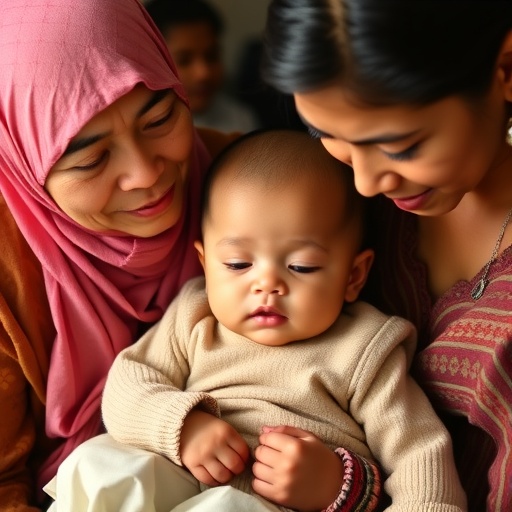
A long-running study of mother–infant interactions in two Argentine communities is challenging one of developmental psychology’s most deeply rooted assumptions: that babies everywhere acquire a sense of agency through the same kind of social exchange.
The research, published in Infancy, compared naturally occurring interactions involving Indigenous Wichí families living in Argentina’s remote Chaco region with interactions involving Spanish-speaking families of European descent in the urban city of Rosario. The investigators found a striking combination of similarities and differences. Across both communities, caregivers responded sensitively to infants’ signals and helped them participate in shared activities. Yet the social forms through which that support unfolded varied substantially, suggesting that there is no single cultural template for how infants become active participants in the world.
Agency refers to an infant’s developing understanding that their actions can produce effects, influence other people and contribute to shared activities. A baby who reaches toward a toy, vocalizes for assistance or shifts attention toward an adult is not merely reacting mechanically. Through repeated interactions, the infant begins to learn that other people have intentions, that signals can be interpreted and that their own behavior can change what happens next. For decades, developmental scientists have often examined this process through episodes that feature direct eye contact, speech, pointing, turn-taking and coordinated attention between a caregiver and a child.
One familiar example involves a baby reaching for a red ball and grunting. The mother looks toward the object, asks whether the baby sees it, picks it up and offers it to the child. The baby responds with excitement as the ball is handed over. In this kind of interaction, language, gaze and object exchange are tightly coordinated. The infant’s action appears to initiate a social sequence, while the caregiver’s response confirms that the infant’s intention has been recognized. Such exchanges have been treated as important building blocks of social cognition and as evidence that infants are learning to act as agents within relationships.
However, much of the evidence behind this account has come from a narrow slice of the world’s population: primarily middle-class, college-educated caregivers and infants of European descent. These families are often studied in homes or laboratories where interactions center on toys, verbal instruction and one-on-one engagement. Because these patterns are so extensively represented in the scientific literature, they can appear universal even when they may reflect the practices and expectations of particular societies. The new study expands the evidence base by examining infant development in communities with different social structures, environments and cultural concepts of participation.
The research team included developmental scientist Sandra Waxman of Northwestern University and Argentine researchers Migdalia Padilla Colón and Andrea Taverna of the National Scientific and Technical Research Council, known as CONICET. Their work grew out of a relationship between Taverna’s research team and the Wichí community that has continued for more than two decades. This sustained partnership enabled the researchers to study infant development within everyday community life rather than relying only on brief laboratory visits or highly structured experimental tasks.
The investigators recorded caregiver–infant interactions beginning when children were 12 months old and continuing until they were approximately 2½ years old. Recordings were made twice a day during ordinary activities, including free play, meals and snacks, physical movement, household activity and encounters with other people. Families selected the settings in which filming took place. Wichí families generally chose outdoor areas near their homes, locations that reflected the communal and open-air organization of daily life. Families in urban Rosario more often chose interiors of their homes. The researchers then worked with speakers familiar with each community to identify episodes in which caregivers and infants were socially engaged.
Across both cultural settings, caregivers were active participants in their infants’ development. Mothers monitored children’s behavior, responded to their movements and vocalizations, and helped them enter into meaningful interactions with people and objects. These commonalities are important because they indicate that infants are not passive recipients of socialization. They are highly sensitive to the structure of their surroundings and capable of extracting regularities from the behavior of the people around them. The infant’s developing agency may therefore depend less on one specific interactional format than on the broader opportunity to influence events and to be recognized as a participant.
The differences lay in how that participation was organized. In the urban European-descendant families, interactions commonly involved a mother and infant directing attention toward the same toy or object. These exchanges were frequently accompanied by spoken language, including questions, descriptions and verbal offers. The interaction often followed a recognizable pattern: the infant indicated interest, the mother interpreted the signal, and the two coordinated their attention around an object. In technical terms, these episodes frequently combined joint attention, contingent responsiveness and symbolic communication. Such interactions can provide repeated opportunities for infants to connect their own actions with an adult’s verbal interpretation of their intentions.
Wichí interactions, by contrast, were more often embedded in communal activity. Infants interacted not only with mothers but also with siblings and other members of the community. Exchanges were predominantly nonverbal and could involve embraces, shared gazes and bodily proximity rather than extended verbal dialogues. Objects from the natural environment sometimes became part of the interaction, but the social relationship itself appeared to be at least as important as the manipulation of a toy. Agency in these episodes was expressed through participation in shared movement and attention, rather than primarily through a one-to-one exchange centered on an object and organized by speech.
These findings do not suggest that one community provides more support for development than the other. Instead, they reveal that developmental processes can be organized through different cultural pathways. In one context, an infant may learn that a spoken signal can direct a caregiver’s attention toward a toy. In another, the infant may learn to coordinate participation through gaze, touch, bodily movement and the presence of several social partners. Both forms of interaction can teach children that their behavior matters, but they may cultivate different expectations about how intentions are communicated and how social action is shared.
The results also complicate the idea that agency is located solely within the individual child. From a strongly individualistic perspective, agency may be understood as a personal capacity that develops as infants learn to initiate actions and influence others. The observations from the Wichí community point toward a more relational interpretation. Agency can be co-constructed through shared activities, distributed across several people and expressed through culturally organized forms of participation. An infant’s ability to act is therefore inseparable from the social environment that makes certain actions visible, meaningful and effective.
Waxman described the findings as an example of nature and nurture working together. Infants showed an “exquisite sensitivity” to their caregivers’ behavior and flexibility in interpreting the interaction patterns of the communities in which they were raised. This flexibility is consistent with the broader view that human development is biologically prepared but highly responsive to experience. Infants may possess general capacities for social learning, attention and communication, while the specific signals they learn to prioritize—words, gazes, touch, objects or group activity—are shaped by the cultural worlds around them.
The study is observational, so it does not establish that one interactional pattern directly causes a particular developmental outcome. It also does not imply that every family within either community behaves in exactly the same way. Nevertheless, repeated observations across the first years of life provide a valuable corrective to theories built primarily from Western, educated, industrialized, rich and democratic populations. By studying development where families actually live and by allowing communities to define appropriate recording settings, the researchers captured forms of caregiving that conventional laboratory designs might overlook.
For developmental psychology, the implications reach beyond the study of infancy. If the “other” who helps constitute a child as a social subject is itself defined through culturally specific relationships, then theories of language, cognition, selfhood and learning must account for more than universal developmental milestones. The central question is not simply whether infants become agents, but how different communities teach them what agency looks like, whom it involves and how it is expressed. The research suggests that babies everywhere may be prepared to participate in social life, while the pathways by which they learn to do so are far more diverse than science has traditionally recognized.
News Publication Date: 21-Jul-2026
Web References: https://onlinelibrary.wiley.com/doi/abs/10.1111/infa.70104; https://psychology.northwestern.edu/people/faculty/core/profiles/sandra-waxman.html
References: Waxman, S., Padilla Colón, M., & Taverna, A. “Caregivers are active agents in their infants’ learning and socialization, but how they do this differs across cultures.” Infancy. DOI: 10.1111/infa.70104.
Cite Scienmag News
Courtney Benton. (August 19, 2026). Caregivers Shape Infants’ Learning and Socialization Differently Across Cultures. Scienmag. https://scienmag.com/caregivers-shape-infants-learning-and-socialization-differently-across-cultures/
Courtney Benton. "Caregivers Shape Infants’ Learning and Socialization Differently Across Cultures." Scienmag, 19 August 2026, https://scienmag.com/caregivers-shape-infants-learning-and-socialization-differently-across-cultures/. Accessed 3 September 2026.
Courtney Benton. "Caregivers Shape Infants’ Learning and Socialization Differently Across Cultures." Scienmag. August 19, 2026. https://scienmag.com/caregivers-shape-infants-learning-and-socialization-differently-across-cultures/


