


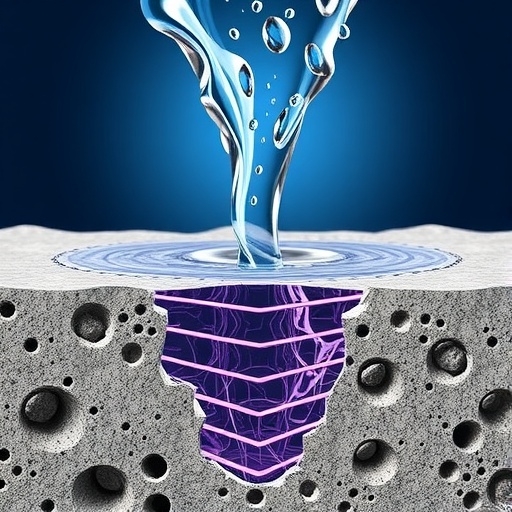
A crack pulling through a water-filled solid may appear to follow the simplest possible path: tension opens the material, the fracture advances, and the structure fails. But new research suggests that the fluid hidden inside pores can fundamentally change that process, transforming a seemingly brittle break into a more resistant and mechanically complex event. In a study published in Nature Communications, A. Guggisberg, M. Allache, P. Braun and colleagues describe “poromechanical toughening” as a mechanism that can increase resistance to tensile fracture in saturated solids. The concept could reshape how scientists understand failure in materials ranging from rocks and concrete to biological tissues, hydrogels and engineered porous composites.
The central idea is that a saturated solid is not simply a solid containing water. It is a coupled system in which the deformation of the solid skeleton interacts with the movement and pressure of the fluid occupying its pores. When the material is stretched, its internal network changes shape. If the fluid cannot move instantly through the pore structure, pressure builds near regions of deformation and around the advancing crack. That pressure can influence how stresses are distributed, how rapidly a crack grows and how much energy is required for the material to separate. The result is a fracture process governed not only by the strength of the solid framework, but also by fluid transport and time.
This coupling is the domain of poromechanics, a field that treats porous materials as interacting solid-fluid systems. In conventional fracture mechanics, researchers often focus on the stress concentration at a crack tip, where applied loads are amplified and bonds or structural connections begin to fail. In a saturated porous material, however, the crack tip is also a site of fluid redistribution. As the crack opens, the pore volume changes, and fluid may be forced away from or drawn toward the highly stressed region. Depending on permeability, viscosity, loading speed and the geometry of the pores, the fluid can generate pressures that modify the local mechanical environment.
The study’s title points to a particularly important consequence: fluid-solid coupling can toughen a material under tension. Toughness describes the energy a material can absorb before a crack causes catastrophic failure. A material with greater tensile toughness can withstand more deformation or load while slowing the advance of damage. Poromechanical toughening does not necessarily mean that the solid skeleton itself becomes intrinsically stronger. Instead, resistance may emerge from the way fluid pressure and solid deformation interact during fracture. The crack must then overcome an evolving field of mechanical forces rather than simply cut through an unchanging material structure.
One way to understand the mechanism is to imagine a crack trying to open a narrow, water-filled network. The newly created fracture surfaces require space, while the fluid inside neighboring pores must adjust to the changing geometry. If drainage is slow, pressure changes can develop faster than the fluid can equilibrate. Those transient pressures may partially oppose the opening of the crack or redistribute stresses into regions that have not yet failed. The crack may consequently advance more slowly, follow a less direct path or require additional energy to continue. The precise outcome depends on the balance between the timescale of loading and the timescale of fluid diffusion through the porous material.
That timescale dependence is one of the most significant implications of the research. A saturated material may behave differently when pulled slowly than when subjected to a rapid impact or sudden load. Under slow loading, fluid may have enough time to migrate through the pores, reducing pressure differences and allowing the system to approach a drained state. Under faster loading, the fluid can behave as though it is temporarily trapped, creating an effectively stiffer response and stronger resistance to crack opening. This does not imply that every saturated solid becomes tougher at high speed, but it highlights why fracture measurements can vary dramatically with loading rate and why fluid transport must be considered alongside conventional strength tests.
The findings are relevant to natural materials whose behavior has long challenged simple descriptions of brittle failure. Rock formations deep underground contain interconnected pores filled with groundwater, brine or hydrocarbons. Their resistance to cracking affects earthquake mechanics, landslide stability, geothermal energy systems and the long-term storage of carbon dioxide. Concrete and cement-based materials also contain pores and often operate in wet environments, where fluid pressure can influence cracking around defects and reinforcement. In biological materials such as cartilage, bone and connective tissue, fluid-filled microstructures contribute to load bearing and damage resistance. The same principles may therefore connect geological fracture, infrastructure durability and the mechanics of living tissue.
The research may also guide the design of advanced materials. Engineers increasingly create porous solids, fiber networks, foams and soft composites whose properties depend on both structure and fluid content. Hydrogels, for example, combine a solid polymer network with a large volume of liquid, making them useful in biomedical devices, sensors and flexible technologies. If their fracture behavior can be controlled through pore size, permeability, fluid viscosity or loading rate, designers could develop materials that resist tearing without relying solely on stronger chemical bonds. Poromechanical toughening could become a strategy for building structures that are lightweight, deformable and capable of dissipating energy under demanding conditions.
At the same time, the work emphasizes that saturation is not a minor detail in fracture experiments. Two samples made from the same solid material may display different failure behavior if their pores contain different fluids or if the fluids can move at different rates. Temperature, pressure, permeability and microstructural connectivity could all affect how rapidly fluid pressure develops and disappears. These variables may help explain why laboratory results do not always translate directly to natural environments or industrial structures. By placing fluid transport at the heart of tensile fracture, the study offers a framework for interpreting failure as a dynamic process that evolves over multiple length and time scales.
The broader message is that cracks are not always simple cuts through solid matter. In a saturated porous material, a crack can become a moving boundary that reorganizes both the solid skeleton and the fluid network around it. The work by Guggisberg, Allache, Braun and colleagues presents poromechanical toughening as a potentially powerful explanation for why some water-filled solids resist tensile fracture more effectively than expected. As researchers seek safer construction materials, more reliable underground engineering methods and tougher soft technologies, understanding how fluids help—or sometimes complicate—the spread of cracks could prove essential. A material’s hidden liquid phase may not merely occupy its pores; under the right conditions, it may actively help hold the material together.
Cite Scienmag News
Violet Maxwell. (August 18, 2026). How Pore Pressure Toughens Saturated Solids During Tensile Fracture. Scienmag. https://scienmag.com/how-pore-pressure-toughens-saturated-solids-during-tensile-fracture/
Violet Maxwell. "How Pore Pressure Toughens Saturated Solids During Tensile Fracture." Scienmag, 18 August 2026, https://scienmag.com/how-pore-pressure-toughens-saturated-solids-during-tensile-fracture/. Accessed 5 September 2026.
Violet Maxwell. "How Pore Pressure Toughens Saturated Solids During Tensile Fracture." Scienmag. August 18, 2026. https://scienmag.com/how-pore-pressure-toughens-saturated-solids-during-tensile-fracture/


