


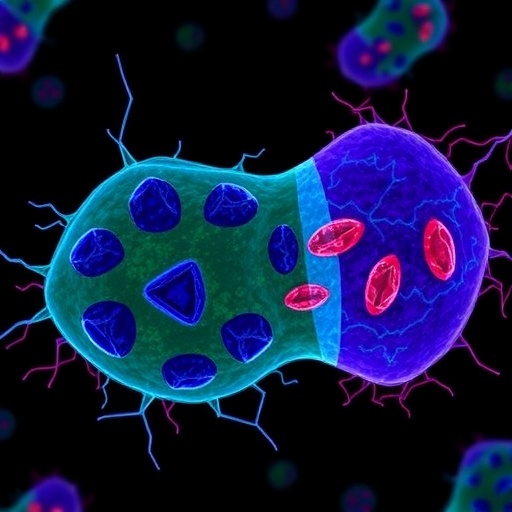
Cancer researchers have unveiled an ambitious biological strategy that turns engineered bacteria into “exogenous organelle mimics”—living microscopic systems designed to restore two of the most frequently disabled defenses against cancer. The study by S. Bi, M. Wang, Q. Guan and colleagues, published in Nature Communications in 2026, describes a platform intended to reintroduce the functions of the tumor suppressors PTEN and p53 directly into malignant cells. Rather than treating cancer only with conventional drugs that circulate throughout the body, the approach seeks to use modified bacteria as programmable carriers capable of operating within the tumor environment.
The concept addresses a central problem in oncology: many cancers survive because they disable the molecular systems that normally prevent uncontrolled growth. PTEN and p53 sit at the heart of those systems, but they act in different yet complementary ways. PTEN is a lipid phosphatase that restrains the phosphoinositide 3-kinase, or PI3K,–AKT signaling pathway, a major driver of cell survival, metabolism and proliferation. When PTEN is lost or weakened, AKT signaling can remain abnormally active, allowing cells to grow and resist stress. P53, meanwhile, functions as a transcription factor that responds to DNA damage and other cellular threats by inducing cell-cycle arrest, senescence or programmed cell death. Mutations or functional inactivation of p53 are among the most common events in human cancer.
Restoring these proteins is far more complicated than simply delivering a molecule into a tumor. PTEN must be positioned and regulated correctly to influence membrane-associated signaling, while p53 must reach the nucleus and activate an appropriate set of target genes. Cancer cells can also alter their internal chemistry, degrade therapeutic cargo or block delivery routes. The researchers’ organelle-mimic strategy is designed to address this challenge by using bacteria as biological compartments. In this framework, the engineered microbes are not intended to replace naturally occurring organelles such as mitochondria or lysosomes, but to perform selected intracellular functions that cancer cells have lost.
Bacteria are attractive for this purpose because they can be genetically programmed, produce complex proteins and respond to defined molecular cues. Some bacterial species also show a natural tendency to accumulate in tumors, where low oxygen levels, abnormal blood vessels, necrotic tissue and immune suppression create conditions that differ sharply from healthy organs. These properties have made bacteria an increasingly important area of research in cancer therapy. However, the same features that make bacteria useful also create safety concerns, including inflammation, uncontrolled growth, dissemination beyond the tumor and unwanted interactions with the immune system. Engineering the organisms to act as controlled therapeutic devices is therefore a critical part of the platform.
According to the study’s central design, the bacteria function as external, programmable sources of tumor-suppressive activity. Once associated with cancer cells or the tumor microenvironment, they are intended to provide the missing PTEN and p53 functions in a coordinated manner. The biological logic is powerful: suppressing PI3K–AKT signaling could reduce the survival signals that help malignant cells persist, while restoring p53 activity could reactivate the cell’s ability to recognize damage and stop dividing or initiate apoptosis. Combining the two may be more effective than correcting either pathway alone because cancer cells often compensate when a single signaling route is blocked.
The approach also reflects a broader shift in synthetic biology, in which living cells are treated as therapeutic machines rather than passive drug containers. Engineered bacteria can potentially sense environmental conditions, manufacture therapeutic proteins locally and interact with host cells in ways that conventional nanoparticles cannot easily reproduce. A microbial platform could, in principle, maintain production of a protein over time instead of delivering a single bolus that is rapidly cleared. It could also be adapted to produce different combinations of payloads, allowing researchers to target the distinct molecular weaknesses of different tumors.
The significance of the work lies not only in the choice of PTEN and p53, but in the attempt to reconstruct lost cellular functions. Most targeted cancer drugs inhibit an overactive protein or block a receptor from the outside. Tumor suppressors present a different therapeutic problem because their absence removes a brake rather than creating a single abnormal signal that can be easily inhibited. Replacing their activity may require delivery to the correct cellular compartment, suitable expression levels and protection from the tumor’s defensive machinery. By framing engineered bacteria as exogenous organelle mimics, the researchers propose a way to supply cancer cells with a localized, biologically active substitute for the regulatory systems they have dismantled.
Any potential clinical application will depend on resolving several major questions. The bacteria must remain sufficiently restricted to tumors while avoiding healthy tissues. Their genetic circuits must operate predictably in the variable conditions found inside human cancers. Researchers will also need to determine how long the organisms persist, how the immune system responds to them and whether repeated administration is possible. Equally important is the risk that tumor cells could adapt to the treatment by disabling downstream components of the PTEN or p53 pathways. Since cancer is genetically diverse, restoration of a tumor suppressor may not be enough if other essential nodes in the same network are irreversibly damaged.
The work also raises an important question about how synthetic biology will be regulated as living therapeutics move closer to medicine. A protein drug can be measured, purified and administered in a defined dose, while a bacterial therapeutic is a dynamic biological system whose behavior may change according to its surroundings. Strict control over genetic stability, containment, manufacturing and elimination will be essential. Researchers will need to demonstrate not only that engineered bacteria can reach tumors and restore molecular activity, but also that they do so with a safety margin that is acceptable for patients.
For now, the study represents a striking attempt to merge microbiology, cancer biology and synthetic engineering into a single therapeutic concept. By using engineered bacteria to deliver or recreate PTEN and p53 functions, the researchers are targeting two of cancer’s most fundamental escape routes: persistent growth signaling and the loss of damage-induced cell death. The strategy remains part of the broader effort to develop precise, programmable cancer treatments, but it illustrates how future therapies may operate less like conventional medicines and more like temporary biological organelles—designed to enter diseased tissue, restore missing functions and help malignant cells regain the consequences of their own genetic damage.
Cite Scienmag News
Nathaniel Bowman. (August 18, 2026). Engineered Bacteria Mimic Organelles, Restore PTEN and p53, Fight Cancer. Scienmag. https://scienmag.com/engineered-bacteria-mimic-organelles-restore-pten-and-p53-fight-cancer/
Nathaniel Bowman. "Engineered Bacteria Mimic Organelles, Restore PTEN and p53, Fight Cancer." Scienmag, 18 August 2026, https://scienmag.com/engineered-bacteria-mimic-organelles-restore-pten-and-p53-fight-cancer/. Accessed 4 September 2026.
Nathaniel Bowman. "Engineered Bacteria Mimic Organelles, Restore PTEN and p53, Fight Cancer." Scienmag. August 18, 2026. https://scienmag.com/engineered-bacteria-mimic-organelles-restore-pten-and-p53-fight-cancer/


