


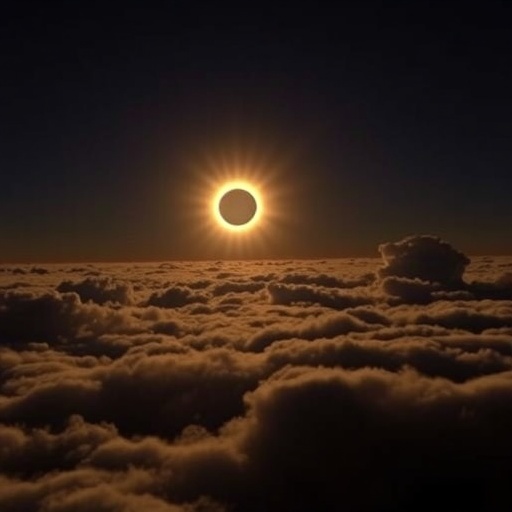
A NASA WB-57 aircraft has delivered an extraordinary airborne view of the August 12, 2026, total solar eclipse, capturing the Sun’s elusive corona and a massive prominence in nine wavelengths spanning visible light to the infrared. Flying at approximately 50,000 feet above heavy cloud cover off the coast of Iceland, the high-altitude research jet entered the Moon’s shadow and observed totality for two minutes and 56 seconds. The mission, led by Southwest Research Institute, was designed to exploit an observing environment unavailable to most ground-based instruments: an aircraft high enough to avoid clouds and to detect infrared radiation that is absorbed by Earth’s atmosphere.
The observations were obtained with the Airborne Multispectral Imager, known as SAMI, mounted on the nose of NASA’s WB-57. The instrument was developed by NASA’s Langley Research Center as part of the Scientifically Calibrated In-Flight Imagery team, or SCIFLI. SAMI was originally created to study the plume produced by the Artemis I rocket and the capsule’s atmospheric reentry, but its ability to record carefully calibrated images across multiple spectral bands has made it a powerful tool for solar research. During the eclipse, the system recorded the corona in wavelengths ranging from visible light through near-infrared, short-wave infrared and mid-wave infrared radiation, producing a detailed, multidimensional record of the solar atmosphere.
The corona is the Sun’s outer atmosphere, a region of extremely tenuous plasma heated to temperatures of roughly one million degrees or more. Under normal conditions, its faint emissions are overwhelmed by the intense glare of the solar photosphere, the visible surface of the Sun. Totality changes that balance when the Moon passes directly in front of the solar disk, acting as a natural occulting mask. With the photosphere hidden, structures in the corona become visible, including magnetically shaped streamers, loops and rapidly changing features associated with the Sun’s activity. By observing in several wavelengths at once, scientists can compare how different temperatures and types of plasma emit radiation, helping them reconstruct the physical conditions in the corona.
One of the most striking discoveries in the first images was a large and unexpected prominence near the Sun’s eastern limb. Prominences are immense structures of relatively cool, dense plasma suspended above the solar surface by magnetic fields. They can appear as glowing arcs or curtains along the edge of the eclipsed Sun and may remain stable for days or weeks before erupting into space. When an eruption launches charged particles toward Earth, it can contribute to geomagnetic storms capable of disrupting satellite operations, degrading radio communications, interfering with navigation systems and, in extreme cases, stressing electrical power networks. The newly observed prominence offers scientists an opportunity to examine the magnetic architecture of such structures across multiple infrared and visible-light channels.
The prominence was especially apparent in visible light because hydrogen alpha emissions caused portions of the plasma to glow with a distinctive pink coloration. Hydrogen alpha radiation is produced when electrons in hydrogen atoms transition between specific energy levels, generating light at a wavelength of approximately 656.3 nanometers. This spectral signature is widely used to track solar prominences and filaments because it reveals hydrogen-rich material suspended in the Sun’s magnetic environment. SAMI’s broader spectral coverage, however, allows the same feature to be investigated beyond hydrogen alpha, potentially showing how its temperature, density and magnetic confinement vary throughout the structure. Researchers expect the complete dataset to clarify how prominences evolve and how their visible appearance relates to emissions at longer infrared wavelengths.
The mission required more than simply placing a camera on an aircraft and flying toward the eclipse. Because totality is brief and the Moon’s shadow moves rapidly across Earth’s surface, the flight path, aircraft position, timing and instrument operations had to be synchronized with exceptional precision. The WB-57 pilot and sensor operator followed a carefully planned sequence intended to maximize the duration of observation while maintaining the correct viewing geometry. Their execution produced precisely the planned two minutes and 56 seconds of totality. The aircraft’s altitude also reduced the effects of atmospheric turbulence and scattering, improving image sharpness and contrast compared with observations made from the ground beneath a thick, unstable atmosphere.
The instruments generated more than two terabytes of high-speed observations at rates reaching tens of images per second. This volume is important because the corona is not static: plasma moves along magnetic field lines, structures brighten and fade, and fine-scale features can change during the short period of totality. A sequence of images can therefore reveal motion and evolution rather than providing only a single frozen view. Scientists will calibrate the data, align images from the different passbands and compare the observations with models of coronal heating, magnetic reconnection and solar plasma dynamics. Such analysis may help explain why the corona is dramatically hotter than the solar surface beneath it, one of the long-standing problems in heliophysics.
The eclipse also demonstrated why NASA’s WB-57 remains a uniquely flexible astronomical platform. Unlike a satellite, the aircraft can be rapidly repositioned for a particular event and can carry instruments that are modified between missions. Unlike a ground observatory, it can fly above clouds and much of the atmosphere that blocks infrared radiation. The aircraft’s mobility was particularly valuable for this eclipse because the path of totality crossed regions of the North Atlantic where cloud cover is common. From the air, the research team could observe the eclipse without the risk that a low cloud layer would erase the event at the last moment. The combination of altitude, mobility and specialized imaging made it possible to study the corona in spectral regions rarely accessible during a total eclipse.
The NASA-funded project brings together researchers from Southwest Research Institute, NASA’s Johnson Space Center and Langley Research Center, Predictive Sciences Inc., the NSF National Center for Atmospheric Research High Altitude Observatory and the Smithsonian Astrophysical Observatory. The team’s success depended on contributions from the WB-57 flight and ground crews, the SCIFLI/SAMI instrument group and scientists responsible for planning and analysis. Support also came from U.S. Navy squadrons VP-1 and VP-62, the Icelandic Coast Guard and the U.S. Embassy in Iceland. As the full dataset is processed, the newly detected prominence and the surrounding corona could become among the most valuable solar observations obtained during the eclipse, offering a vivid reminder that a fleeting alignment of the Moon and Sun can expose some of the most energetic and mysterious physics in the solar system.
News Publication Date: August 14, 2026
Web References: https://www.swri.org/markets/earth-space/space-research-technology/space-science/heliophysics
Keywords
Total solar eclipse, solar corona, solar prominence, NASA WB-57, SAMI, airborne astronomy, heliophysics, infrared solar imaging, space weather, solar physics
Cite Scienmag News
Grant Pearson. (August 14, 2026). SwRI-Led Mission Observes Recent Eclipse Above Cloud Cover. Scienmag. https://scienmag.com/swri-led-mission-observes-recent-eclipse-above-cloud-cover/
Grant Pearson. "SwRI-Led Mission Observes Recent Eclipse Above Cloud Cover." Scienmag, 14 August 2026, https://scienmag.com/swri-led-mission-observes-recent-eclipse-above-cloud-cover/. Accessed 3 September 2026.
Grant Pearson. "SwRI-Led Mission Observes Recent Eclipse Above Cloud Cover." Scienmag. August 14, 2026. https://scienmag.com/swri-led-mission-observes-recent-eclipse-above-cloud-cover/


