


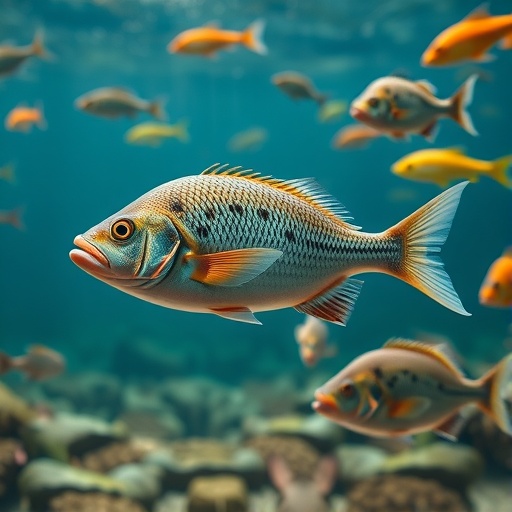
Why do two animals confronted with the same information sometimes make entirely different decisions? A new study of wild cichlid fish in Lake Tanganyika suggests that the answer may lie not in what animals prefer, but in the decision rules they use to evaluate competing information. In more than 5,000 underwater trials, researchers found that two closely related species of Featherfin cichlids responded almost identically when choices were simple. But when the animals had to weigh conflicting features, their behavior sharply diverged. Blue featherfins made faster, more decisive choices, apparently focusing on a single prominent feature. Golden featherfins slowed down and appeared to integrate several features before reaching a decision. The finding offers a rare glimpse into how different cognitive strategies can evolve in closely related animals living in the same environment.
The research was conducted by scientists from the Max Planck Institute of Animal Behavior, Université Clermont Auvergne and the French National Centre for Scientific Research. The team studied male golden featherfins, Aulonocranus dewindti, and blue featherfins, Cyathopharynx furcifer. Both species construct elaborate sand structures known as bowers, which males maintain to attract females. These structures are not passive displays: males repeatedly inspect them and immediately remove foreign objects that appear inside. That instinctive housekeeping behavior gave researchers a natural, non-invasive way to test decision-making in the wild. Instead of training fish to perform artificial laboratory tasks, the scientists placed carefully designed 3D-printed objects into the bowers and observed which objects the males removed first, how consistently they chose, and how long they took to act.
The first experiments tested whether the two species shared basic preferences. Researchers varied individual features such as object size and color while keeping the choice straightforward. Both species consistently removed larger objects before smaller ones, revealing a common preference for size. They also tended to remove an object whose color differed from the surrounding group, a response known as the oddity effect. In cognitive science, the oddity effect describes the tendency to direct attention toward an item that stands out from otherwise similar alternatives. It is observed in humans and other animals and is thought to reflect selective attention: the brain rapidly identifies a distinctive stimulus as potentially more relevant than repetitive background information. The matching responses showed that the fish were similarly motivated and that their attention was guided in comparable ways when only one important feature determined the choice.
The researchers then increased the cognitive demands of the task by creating conflicts between features. An object might have the color the fish generally preferred but be smaller than a competing object, while the alternative was larger but less attractive in color. Such tests are valuable because they reveal how an animal resolves competing sources of information. A fish that relies primarily on one feature may make a rapid choice based on color or size, while an animal that combines information may compare the relative value of both properties before acting. The results showed a striking species difference. Blue featherfins continued to make rapid, decisive choices, apparently allowing one feature to dominate the decision. Golden featherfins, by contrast, showed no clear preference between the conflicting alternatives and took significantly longer to remove an object.
The difference became even more pronounced as the choices grew more complex. Golden featherfins became slower when additional information had to be considered, a pattern consistent with a decision process that gathers or weighs multiple cues. Blue featherfins did the opposite: their decisions became faster as task complexity increased. This counterintuitive result suggests that the blue featherfins may have adopted a simplifying rule that allows them to focus quickly on the feature that matters most to them. In technical terms, the species may differ in the way they allocate limited attentional resources. Rather than processing every available feature with equal weight, the blue featherfin could be using a highly selective decision rule, while the golden featherfin appears to preserve more information during evaluation. The study does not show that one species is more intelligent, but it does demonstrate that similar cognitive inputs can be transformed into different behavioral strategies.
To determine whether the slower golden featherfins were merely confused, the team used a classic decision-making test known as the decoy effect. In human psychology, the decoy effect occurs when the introduction of a third, inferior option changes the relative appeal of two original choices. The phenomenon is widely studied in behavioral economics and is sometimes used in marketing to steer consumers toward a preferred product. If the golden featherfins were responding randomly or failing to discriminate among alternatives, the presence of a decoy might be expected to disrupt their choices. Instead, the fish largely ignored the inferior option and continued to treat the two main alternatives as similarly attractive. This pattern suggests that their slower decisions reflected active comparison rather than indecision caused by confusion. The fish appeared to evaluate several dimensions of the objects without being strongly manipulated by the decoy, a form of rational choice that humans do not always display.
The comparison with human cognition is provocative, but the researchers emphasize that the fish should not be described as possessing human versions of Daniel Kahneman’s “fast” and “slow” systems. Kahneman’s framework distinguishes between rapid, intuitive judgments and slower, more deliberative reasoning in people. Fish brains are organized differently, and there is no evidence that their internal experiences resemble human thought. The parallel instead concerns a general computational problem shared by all nervous systems: attention and processing capacity are limited, so an animal must determine which information deserves priority. A fast strategy can be advantageous when a quick response prevents wasted energy or reduces exposure to danger. A broader integration strategy may be useful when several environmental cues jointly determine the best action. The two Featherfin species therefore provide an example of cognitive variation without requiring human-like consciousness or reasoning.
The origins of the divergence remain unknown. The species are closely related, share the same lake environment and exhibit similar ecological behavior, yet their decision rules differ under demanding conditions. The contrast could arise from different life experiences, developmental histories or social conditions. It could also reflect evolutionary divergence shaped by subtle differences in habitat use, competition, mating behavior or the costs of delaying action. If natural selection favored rapid choices in one lineage and broader information integration in the other, the result would illustrate an important principle of evolution: cognitive systems do not necessarily become universally more complex over time. Instead, they may become better matched to the problems an animal regularly faces. A simple rule can be highly effective when one cue reliably predicts the right response, while a more integrative rule may pay off when information is variable or conflicting.
The study also demonstrates how sophisticated experiments from psychology can be adapted for animals living in natural conditions. Wild fish were not required to memorize arbitrary symbols, navigate laboratory mazes or undergo lengthy training. Their everyday bower-cleaning behavior became the experimental platform, allowing researchers to observe cognition in a biologically meaningful context. The findings challenge the tendency to rank animals on a single scale of intelligence and instead highlight the diversity of strategies that evolution can produce. The blue featherfin’s rapid selectivity and the golden featherfin’s slower integration may each be beneficial in different circumstances, even though both species confront similar problems and share fundamental preferences. By examining not only what animals choose but also how their decisions unfold in time, comparative cognition may move closer to understanding intelligence as a collection of adaptive solutions rather than a contest with winners and losers.
News Publication Date: 12-Aug-2026
Web References: https://www.pnas.org/doi/10.1073/pnas.2620602123; https://www.ab.mpg.de/; https://www.uca.fr/en; https://www.rhone-auvergne.cnrs.fr/fr
References: Proceedings of the National Academy of Sciences; DOI: 10.1073/pnas.2620602123
Cite Scienmag News
Drew Townsend. (August 14, 2026). Wild fish reveal diverse decision-making strategies. Scienmag. https://scienmag.com/wild-fish-reveal-diverse-decision-making-strategies/
Drew Townsend. "Wild fish reveal diverse decision-making strategies." Scienmag, 14 August 2026, https://scienmag.com/wild-fish-reveal-diverse-decision-making-strategies/. Accessed 4 September 2026.
Drew Townsend. "Wild fish reveal diverse decision-making strategies." Scienmag. August 14, 2026. https://scienmag.com/wild-fish-reveal-diverse-decision-making-strategies/


