


Johannes Mitscherling, a theoretical solid-state physicist whose work explores the hidden geometry of quantum states, is establishing a new Emmy Noether research group at the University of Würzburg. Beginning on August 1, 2026, the group will be based at the university’s Chair of Theoretical Physics IV and will investigate quantum materials whose electronic wave functions possess unusual geometric structures. Supported by €1.9 million from the German Research Foundation over six years, the initiative is designed to connect abstract mathematical ideas with materials that could transform technologies such as photovoltaics, quantum electronics and advanced magnetic devices. Mitscherling most recently worked with Dr Libor Šmejkal at the Max Planck Institute for the Physics of Complex Systems in Dresden and with Professor Joel Moore at the University of California, Berkeley.
The appointment places Mitscherling at the centre of a rapidly expanding effort to understand quantum matter not only through its observable properties, but through the detailed structure of the wave functions that generate them. In quantum mechanics, a wave function contains the information needed to describe the possible states of a particle or system. In a solid, the wave functions of electrons are shaped by the atoms, crystal lattice and symmetries of the material. Their global features can reveal whether a system is topological, but Mitscherling’s research focuses on a finer level of description known as quantum geometry. This approach examines how quantum states are arranged, separated and connected throughout the mathematical space of all possible states.
“Researchers are now able to specifically generate and control the wave functions of electrons,” Mitscherling says, pointing to progress in quantum simulators and materials science. That control creates an opportunity to test theories that were once largely confined to mathematics. The challenge is that the global topology of a wave function, although powerful, does not capture every detail relevant to an experiment. Two materials may share the same topological classification while displaying very different responses to light, pressure, electric fields or magnetic fields. Quantum geometry supplies additional information by describing the local structure of the wave functions and the distances and overlaps between neighbouring quantum states.
One of the central mathematical tools in this field is the quantum geometric tensor, which combines two related quantities. Its antisymmetric component is associated with Berry curvature, a geometric property that can influence transport, anomalous velocities and other electronic responses. Its symmetric component is known as the quantum metric, which measures how rapidly quantum states change as parameters such as crystal momentum vary. In practical terms, the metric can indicate how close or distant electronic states are in Hilbert space, even when their energies appear similar. These geometric quantities can affect optical transitions, electrical conductivity and the way electrons respond to external perturbations. By mapping them across a crystal’s Brillouin zone, researchers can begin to link the shape of wave functions with measurable material behaviour.
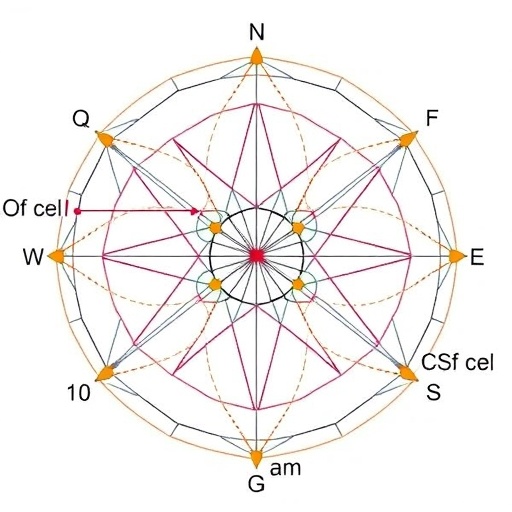
Mitscherling’s group aims to develop a comprehensive geometric classification of wave functions in crystalline systems. The project will ask questions that sound almost visual despite describing highly abstract quantum spaces: Do the permitted states form structures resembling rings or spheres? How are those structures distributed? Where do states approach one another, and where are they separated by large geometric distances? Crystal symmetries impose strict constraints on the answers. Rotations, reflections, translations and other symmetry operations determine which electronic states can coexist and how they may transform. A systematic classification could therefore provide a map connecting a material’s microscopic structure to its macroscopic performance.
The potential payoff is substantial. If researchers can identify geometric signatures associated with efficient light absorption, charge separation or unconventional electrical responses, they may be able to screen materials before producing them in the laboratory. Such a strategy could accelerate the search for improved photovoltaic compounds, where the geometry of electronic states may influence how efficiently sunlight is converted into electrical energy. The same framework could help predict how a material will respond when compressed, illuminated or placed in an electromagnetic field. Instead of relying exclusively on trial and error, scientists could use geometric principles to guide the design and control of quantum materials under conditions far from equilibrium, where electrons are driven by intense light or other external forces.
The new group will focus particularly on unconventional magnetism and exotic quasiparticles in two-dimensional heterostructures. One major target is altermagnetism, a recently developed magnetic concept in which a material can possess zero net magnetization while still exhibiting spin-dependent electronic structure. Unlike conventional ferromagnets, whose magnetic moments align to produce a macroscopic magnetization, altermagnets can combine compensated magnetic order with momentum-dependent spin splitting. This unusual combination may allow information to be manipulated through spin without the large stray fields associated with ordinary magnets. Quantum geometry could help reveal how the electronic states in altermagnets generate these effects and how they might be controlled.
The second research direction involves two-dimensional heterostructures, structures made by stacking atomically thin crystals such as graphene and transition-metal dichalcogenides. When layers are placed together with a small rotational mismatch, known as a twist angle, their electronic bands can form a moiré pattern with a much larger effective periodicity. This can dramatically reshape the available quantum states and produce narrow energy bands in which electron interactions become especially important. Such systems have hosted exotic quasiparticles and correlated phases, including superconducting and insulating states. A geometric analysis of their wave functions may reveal why tiny changes in twist angle, pressure or electric field can trigger major changes in their behaviour.
Although the research is theoretical, its ambitions are closely tied to experimental advances. Quantum simulators can now create controlled analogues of solid-state systems, while modern spectroscopic and transport techniques can probe the response of real materials with increasing precision. These experiments may test predictions about Berry curvature, quantum metrics, optical selection rules and nonequilibrium dynamics. The Würzburg group is expected to collaborate closely with local physics departments and the Würzburg-Dresden Cluster of Excellence ctd.qmat, an international research network focused on topological quantum materials. Mitscherling says topology remains essential for understanding the overall shape of wave functions, but quantum geometry offers a more detailed description that may connect theory to experiment in new ways.
Mitscherling’s path to Würzburg began with physics studies at RWTH Aachen University in 2011, followed by an Erasmus placement in Paris and a master’s project at the Jülich Research Centre focused on theoretical solid-state physics. He moved to the Max Planck Institute for Solid State Research in Stuttgart in 2016 and completed his doctorate in 2021 with the distinction summa cum laude. His early work on quantum geometry later earned him a Walter Benjamin Fellowship from the German Research Foundation and a postdoctoral fellowship from the German National Academy of Sciences Leopoldina. From 2022 to 2024, he conducted research at the University of California, Berkeley, before returning to Germany to join the Max Planck Institute for the Physics of Complex Systems in Dresden. Through the Emmy Noether Programme, he will now lead an independent team with the long-term goal of turning the geometry of quantum states into a practical guide for discovering and controlling new forms of matter.
Keywords
Quantum materials, quantum geometry, electronic wave functions, topology, geometric classification, altermagnetism, two-dimensional heterostructures, exotic quasiparticles, photovoltaics, University of Würzburg, Emmy Noether Group, solid-state physics
Cite Scienmag News
Katie Riggs. (August 13, 2026). New Emmy Noether Group Builds Theoretical Foundations for Geometric Quantum Matter. Scienmag. https://scienmag.com/new-emmy-noether-group-builds-theoretical-foundations-for-geometric-quantum-matter/
Katie Riggs. "New Emmy Noether Group Builds Theoretical Foundations for Geometric Quantum Matter." Scienmag, 13 August 2026, https://scienmag.com/new-emmy-noether-group-builds-theoretical-foundations-for-geometric-quantum-matter/. Accessed 4 September 2026.
Katie Riggs. "New Emmy Noether Group Builds Theoretical Foundations for Geometric Quantum Matter." Scienmag. August 13, 2026. https://scienmag.com/new-emmy-noether-group-builds-theoretical-foundations-for-geometric-quantum-matter/


